
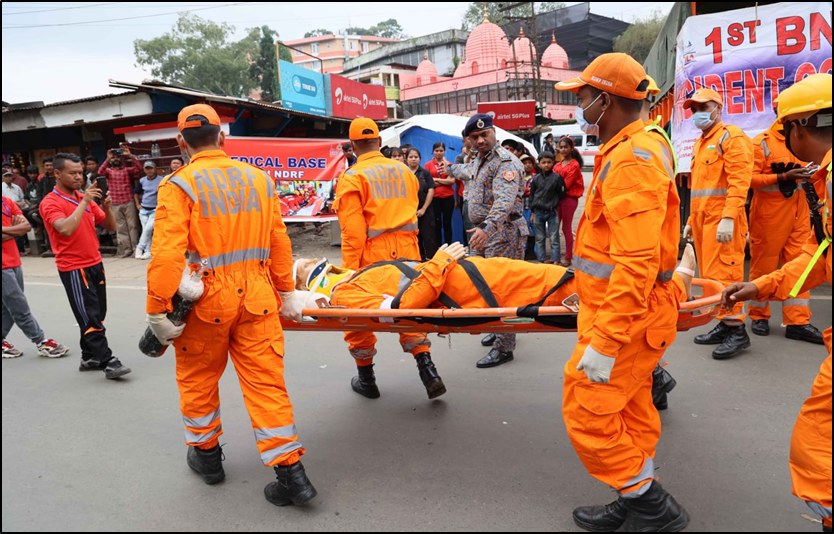
Important for UPSC Prelims: Disaster Management | Governance
About National Disaster Management Authority (NDMA)
- The National Disaster Management Authority (NDMA) is the apex statutory body for disaster management in India.
- It was established under the Disaster Management Act, 2005 and formally constituted on 27 September 2006.
- It functions under the Ministry of Home Affairs (MHA).
- Chairperson: Prime Minister of India.
Why was NDMA Created?
The need for a dedicated disaster management institution emerged after a series of devastating disasters, including:
- 1999 Odisha Super Cyclone
- 2001 Bhuj (Gujarat) Earthquake
- 2004 Indian Ocean Tsunami
These events led to the enactment of the Disaster Management Act, 2005, replacing the earlier relief-centric approach with a comprehensive disaster risk management framework.
Composition
- Chairperson: Prime Minister of India.
- Composition: Up to nine members, including the Vice-Chairperson.
- Vice-Chairperson: Appointed by the Central Government.
Institutional Framework under the Disaster Management Act, 2005
| Level | Institution | Chairperson |
| National | National Disaster Management Authority (NDMA) | Prime Minister |
| National (Executive) | National Executive Committee (NEC) | Union Home Secretary |
| State | State Disaster Management Authority (SDMA) | Chief Minister |
| State (Executive) | State Executive Committee (SEC) | Chief Secretary |
| District | District Disaster Management Authority (DDMA) | District Magistrate / Collector |
Major Functions
- Frames national policies, plans and guidelines for disaster management.
- Approves the National Disaster Management Plan (NDMP).
- Coordinates implementation of disaster management policies.
- Promotes mitigation, preparedness and capacity building.
- Guides the National Institute of Disaster Management (NIDM).
- Supports international disaster relief when directed by the Central Government.
Major Guidelines Issued by NDMA
The National Disaster Management Authority (NDMA) has issued national guidelines for the management of earthquakes, floods, cyclones, landslides, heatwaves, urban flooding, lightning, chemical, biological, nuclear and radiological emergencies, along with school and hospital safety and the Incident Response System (IRS).
International Frameworks
India’s disaster management framework is aligned with:
- Sendai Framework for Disaster Risk Reduction (2015–2030)
- Paris Agreement on Climate Change
- Sustainable Development Goals (SDGs)
Conclusion
The National Disaster Management Authority (NDMA) is the cornerstone of India’s disaster governance framework, driving a shift from post-disaster relief to prevention, preparedness, mitigation and resilience, in line with global best practices and the Sendai Framework for Disaster Risk Reduction.
| This Concept has been mentioned in the following article 3rd BRICS Ministerial Meeting on Disaster Risk Reduction (DRR), 2026 |