
Relevance: GS Prelims – Health | Government Schemes & Programmes | Diseases | SDGs
Context
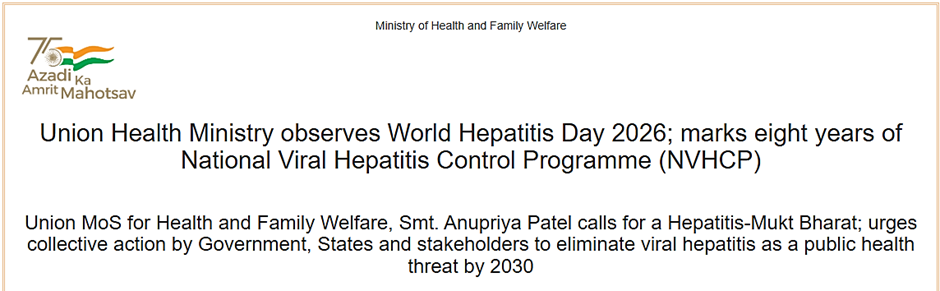
- Recently, the Union Ministry of Health and Family Welfare observed World Hepatitis Day 2026 (28 July), marking eight years of the National Viral Hepatitis Control Programme (NVHCP), under the global theme “Hepatitis: Let’s Break It Down.”
Key Facts
I. About World Hepatitis Day
- Observed annually on 28 July, the birthday of Dr. Baruch Blumberg, who discovered the Hepatitis B virus.
- One of only four disease-specific days officially endorsed by the World Health Organization (WHO) (others: World AIDS Day, World TB Day, World Malaria Day).
II. About NVHCP
- Launched on World Hepatitis Day, 2018 under the National Health Mission (NHM).
- Nodal Ministry: Ministry of Health and Family Welfare.
- Objective: Eliminate viral hepatitis as a public health threat by 2030, aligned with SDG Target 3.3.
- SDG Target 3.3: It seeks to end epidemics of major communicable diseases, including:
- AIDS
- Tuberculosis
- Malaria
- Neglected tropical diseases
- Hepatitis
- Water-borne diseases
- Other communicable diseases.
III. About Viral Hepatitis
- Viral hepatitis refers to inflammation of the liver caused by hepatitis viruses.
- Major hepatitis viruses include:
- Hepatitis A
- Hepatitis B
- Hepatitis C
- Hepatitis D
- Hepatitis E
- The NVHCP primarily focuses on Hepatitis B and Hepatitis C.
- Chronic Hepatitis B and C can result in serious complications such as:
- Cirrhosis
- Liver failure
- Liver cancer
Hepatitis B Vs Hepatitis C
| Feature | Hepatitis B | Hepatitis C |
| Causative Virus | Hepatitis B Virus (HBV) — DNA virus | Hepatitis C Virus (HCV) — RNA virus |
| Mode of Transmission | Blood, body fluids, mother-to-child (perinatal), unsafe sex, unsafe injections | Primarily blood-to-blood contact — unsafe injections, transfusions, needle-sharing (esp. among Injecting Drug Users) |
| Vaccine Available | Yes — part of Universal Immunization Programme (UIP) since 2011; birth-dose coverage >92% in India | No vaccine available |
| Prevention (India-specific) | Birth-dose vaccination Hepatitis B Immunoglobulin (HBIG) within 24 hrs for newborns of HBV-positive mothers; antenatal screening | No vaccine; prevention via screening high-risk groups (e.g., IDUs) and safe blood/injection practices |
| Chronicity | Can become chronic, especially if acquired at birth/infancy | High tendency to become chronic (~75-85% of infected adults) |
| Curability | Not typically curable, but manageable/suppressible | Curable in most cases (short-course DAA therapy) |
| Complications | Cirrhosis, liver failure, hepatocellular carcinoma (liver cancer) | Cirrhosis, liver failure, liver cancer |
| India’s NVHCP Data (2026) | Birth-dose coverage: >92%; ~65% pregnant women screened (target 100%) | Focus on high-risk group screening, especially IDUs |
| Special Notes Hepatitis A & E → faecal-oral route, usually self-limiting, no chronic form. Hepatitis B, C & D → blood-borne, can cause chronic infection, cirrhosis, and liver cancer. |
Significance
- Strengthens India’s efforts towards elimination of viral hepatitis by 2030.
- Expands access to screening, diagnosis and treatment.
- Focuses on preventing mother-to-child transmission of Hepatitis B.
- Strengthens primary healthcare delivery through Ayushman Arogya Mandirs.
- Convergence with UIP, RCH and National AIDS Control Programme promotes an integrated public-health response.
- Free treatment and affordable diagnostics can improve access for vulnerable populations.
- Digital integration through ABDM can improve patient tracking and continuity of care.
Conclusion
The National Viral Hepatitis Control Programme represents an integrated approach to tackling viral hepatitis through prevention, screening, treatment, maternal and child health interventions and convergence across health programmes. Its expansion to primary healthcare facilities and emphasis on digital tracking can help India move closer to the 2030 target of eliminating viral hepatitis as a public health threat.
| Important CTC from this article National Viral Hepatitis Control Programme (NVHCP) and Hepatitis B & C. |