
Why in the News?
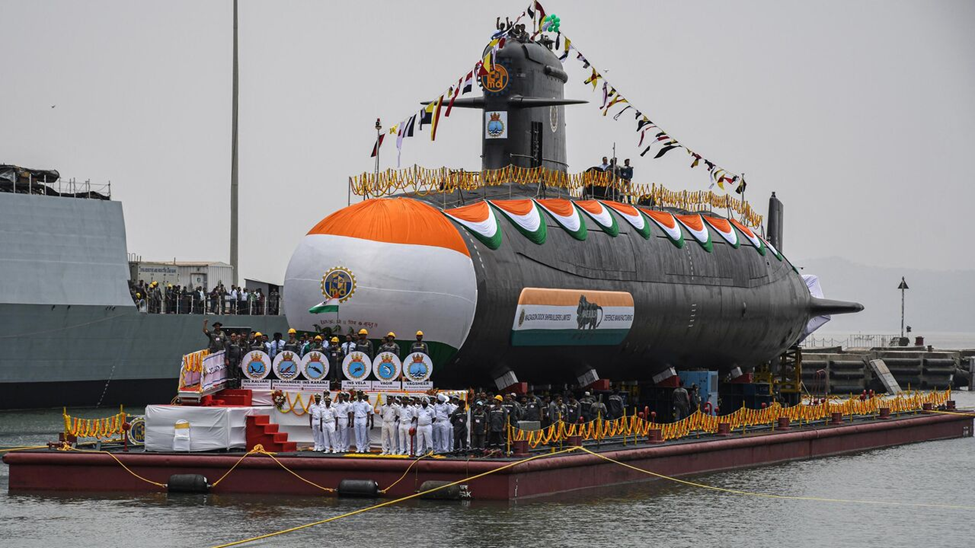
- Recently, President Droupadi Murmu undertook a dive sortie aboard the Indian Navy’s indigenous Kalvari-class submarine INS Vagsheer at the Karwar Naval Harbour in Karnataka.
- With this embarkation, she became the second President of India after Dr. A.P.J. Abdul Kalam to undertake a submarine sortie.
Overview of INS Vagsheer
- Class & Project: Sixth submarine of the first batch of six Kalvari-class (Scorpene-class) submarines, built under Project-75.
- Naming: Named after the Vagsheer (sandfish), a lethal deep-sea predator of the Indian Ocean, continuing the tradition of naming submarines after sea creatures.
- Commissioning Sequence: Joins its sister vessels:
- INS Kalvari: December 2017
- INS Khanderi: September 2019
- INS Karanj: March 2021
- INS Vela: November 2021
- INS Vagir: January 2023
- Builder: Constructed by Mazagon Dock Shipbuilders Limited (MDL) through French technology transfer.
About Project-75
- Under Project-75, India is manufacturing Scorpene-class submarines, based on French design.
- These submarines are powered by diesel-electric propulsion systems.
- Additionally, they are designed to incorporate an indigenously developed Air-Independent Propulsion (AIP) system, which enables non-nuclear submarines to stay submerged for extended durations, enhancing stealth and operational endurance.
Key Features and Capabilities of INS Vagsheer
Dimensions & Performance:
- Length: 67.5 metres
- Submerged speed: 20 knots
- Maximum diving depth: 350+ metres
- Endurance: up to 50 days at sea
- Stealth & Design:
- Incorporates advanced stealth technologies, reduced radiated noise, and sophisticated hydrodynamic design.
- Considered one of the quietest submarines globally, enhancing covert operations.
- Armament:
- Equipped with torpedoes, anti-ship missiles, and mine-laying capabilities.
- Excels in anti-surface and anti-submarine warfare, as well as intelligence gathering and surveillance.
- Indigenous Systems:
- Features domestically developed air-conditioning plant, internal communication network, and Ku-Band SATCOM system.
- Fitted with an anti-torpedo countermeasure system for enhanced survivability.
- Crew Capacity:
- 8 officers and 35 sailors, allowing efficient operation of complex onboard systems.
Significance of INS Vaghshefor Indian Navy and Strategic Perspective
- Enhances Undersea Warfare Capability: Strengthens the Indian Navy’s ability to conduct anti-submarine and anti-surface operations, improving maritime security in the Indian Ocean Region (IOR).
- Strategic Deterrence: Adds to India’s submarine-based deterrence, ensuring credible underwater combat readiness against regional threats.
- Indigenous Defence Manufacturing: Demonstrates Make in India success, as it is built by Mazagon Dock Shipbuilders Limited (MDL) using French technology transfer.
- Intelligence, Surveillance, and Reconnaissance: Equipped with advanced sensors and communication systems, enhancing covert surveillance and intelligence gathering capabilities.
- Operational Readiness and Fleet Modernization: Completes the Kalvari-class submarine fleet, providing a state-of-the-art, stealthy platform that improves the Navy’s long-term operational preparedness and versatility.
Consider the following statements regarding INS Vagsheer:
1. INS Vagsheer is the sixth submarine of the Kalvari-class built under Project-75.
2. It is designed exclusively for anti-surface warfare.
3. It incorporates advanced stealth technologies, including reduced radiated noise.
4. The submarine can stay submerged for extended periods using an Air-Independent Propulsion (AIP) system.

Which of the statements given above is/are NOT correct?
(a) 1 only
(b) 2 only
(c) 2 and 4 only
(d) 3 and 4 only

Answer: (b) 2 only

Explanation:
Statement 1 is correct: INS Vagsheer is indeed the sixth Kalvari-class submarine.
Statement 2 is incorrect: It is not designed exclusively for anti-surface warfare; it is capable of anti-surface, anti-submarine operations, surveillance, and intelligence gathering.
Statement 3 is correct: It features advanced stealth technologies, including reduced noise and hydrodynamic design.
Statement 4 is correct: The AIP system enables extended submerged operations.