
Context
The Centre for Development of Telematics (C-DOT) has resumed the rollout of the indigenous Emergency Cell Broadcasting Service (CBS) for extreme weather and natural disasters, highlighting India’s push for indigenous, sovereign telecom infrastructure.
What is Cell Broadcast Service (CBS)?
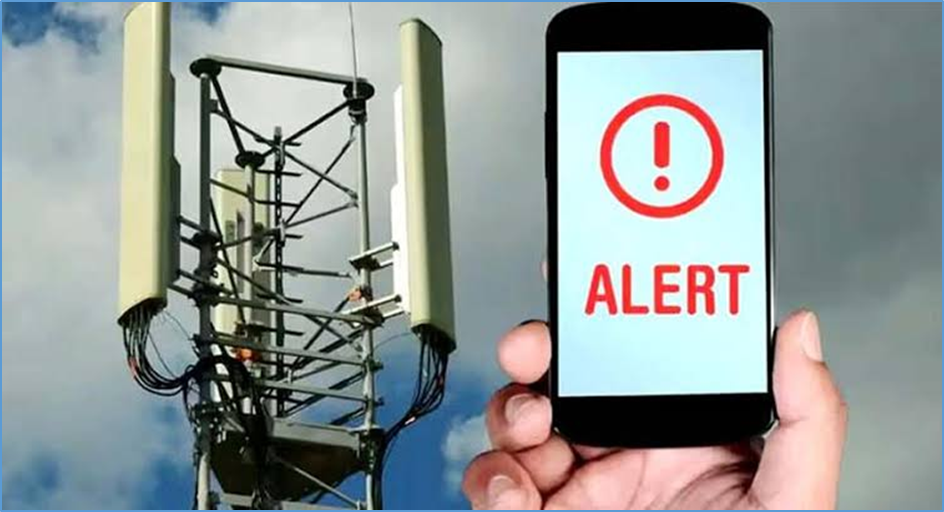
- Technology Mechanism: It is a one-to-many, geo-targeted mobile messaging technology that transmits emergency alerts simultaneously to all mobile devices connected to specific cell towers in an affected area.
- Network Agnostic & Interoperability: C-DOT developed 300–350 proprietary adapters to make the system compatible across multi-vendor telecom hardware (e.g., Ericsson, Nokia, Huawei, ZTE) and multiple generations of networks (from legacy 2G variants up to 5G).
- Data Integration (“War Room”): The system aggregates real-time multi-agency data (weather data from IMD, train movements, etc.) to provide situational awareness before triggering alerts.
Conceptual Comparison: CBS vs. Traditional SMS
| Parameter | Cell Broadcast Service (CBS) | Traditional SMS |
| Transmission Type | One-to-Many (Broadcast) | Point-to-Point (Unicast) |
| User Privacy | Preserved (Does not require phone numbers; sent to cell towers directly) | Exposed (Requires active database of personal mobile numbers) |
| Network Congestion | Immune (Operates on dedicated channels; delivers during high traffic) | Vulnerable (Prone to network bottlenecks, delays, and dropouts) |
| Latency/Speed | Near instantaneous broadcast to millions simultaneously | Sequential queue; significant delivery lag in mass disasters |
Key Institutional Framework
- Developing Agency: C-DOT (Centre for Development of Telematics), the premier R&D arm of the Department of Telecommunications (DoT), which recently celebrated its 43rd foundation day.
- Operating Agencies: While C-DOT provides the technological backbone, the actual operational authority to trigger these alerts rests with the State Disaster Management Authorities (SDMAs) and the National Disaster Management Authority (NDMA).
| Important Current To Concept from This Article for UPSC The Centre for Development of Telematics (C-DOT) |
Q. Consider the following statements regarding the Emergency Cell Broadcasting Service (CBS) recently seen in the news:
1. It is a point-to-point communication technology that requires the active mobile numbers of users in a disaster-hit area.
2. The indigenous CBS technology has been developed by the Centre for Development of Telematics (C-DOT).
3. The alerts under this system are exclusively triggered and operated by the India Meteorological Department (IMD).
Which of the statements given above is/are correct?
(a) 1 and 2 only
(b) 2 only
(c) 2 and 3 only
(d) 1, 2 and 3
Correct Answer: (b)
• Statement 1 is incorrect: CBS is a geo-targeted, one-to-many broadcast technology. It broadcasts to all active cell towers in an area and does not require user mobile numbers, thus bypassing network congestion and preserving privacy.
• Statement 2 is correct: The entire system, including over 300 interoperability adapters, was developed in-house by the state-owned C-DOT.
• Statement 3 is incorrect: While the system aggregates data like weather statistics (from IMD, etc.), the alerts are actively decided and operated by State Disaster Management Agencies (SDMAs).