
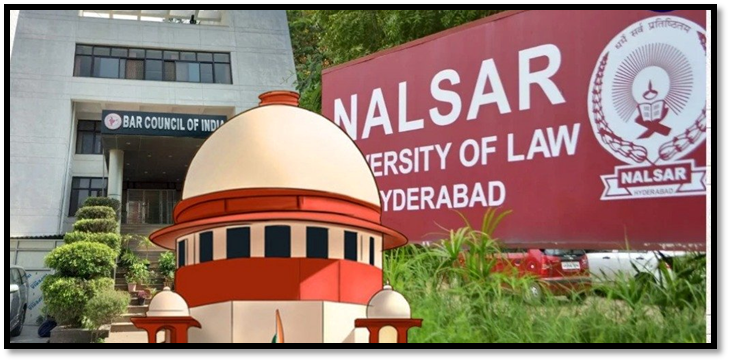
Context
- Recently, the Supreme Court of India ruled that neither the Bar Council of India (BCI) nor State Bar Councils possess statutory jurisdiction or powers under the Advocates Act, 1961, to take disciplinary or punitive actions against law students.
- The judgment arose from the NALSAR controversy, where the BCI sought to prevent the 2026 graduating batch from enrolment after students opposed the proposed CJI’s participation as chief guest at the convocation.
Key SC Observations
- The Court held that the Advocates Act, 1961 does not confer either an express or implied power on the BCI or State Bar Councils to discipline students pursuing legal education.
- The Court clarified that disciplinary action against law students falls within the authority of their parent university/institution or any authority specifically empowered under its regulations/by-laws
- BCI’s disciplinary powers under the Act are limited to registered/enrolled advocates only — not students who haven’t yet enrolled.
- BCI’s disciplinary jurisdiction applies after enrolment as an advocate.
- Studying law alone does not place students under Bar Council discipline.
About Bar Council of India (BCI)
· Nature: Statutory body.
· Parent legislation: Advocates Act, 1961.
· Primary role: Regulation of the legal profession and legal education in India.
· It lays down standards of professional conduct and etiquette for advocates.
· BCI Chairperson is elected by its members (not a government appointee).
About Advocates Act, 1961
- Consolidated law relating to legal practitioners; created All India Bar with common roll of advocates.
- Established BCI at the Centre and State Bar Councils in states.
- Provides for two classes: Senior Advocates and other advocates.
Fundamental Rights Intersecting the Ruling
- Article 19(1)(a): Protects the freedom of speech and expression, including the right of students to peaceful dissent and protest.
- Article 19(1)(c): Guarantees the right to form associations or unions.
Advocate vs Lawyer: Key Difference
| Lawyer | Advocate |
| A person who has studied law and holds a law degree. | A lawyer who is enrolled with a State Bar Council and is entitled to practise law in courts. |
| May work in legal consultancy, corporate jobs, academia, etc. | Can represent clients before courts and tribunals, subject to applicable rules. |
| The term is broader. | It is a specific professional status under the Advocates Act, 1961. |
| Important CTC from this article for UPSC: Supreme Court Of India |
Q. With reference to the recent Supreme Court judgment concerning the Bar Council of India (BCI), consider the following statements:
1. The BCI derives its statutory powers from the Advocates Act, 1961.
2. The BCI has express or implied disciplinary power over law students before their enrolment as advocates.
3. Disciplinary action against law students can be taken by the concerned educational institution under its applicable rules.
Which of the statements given above is/are correct?
(a) 1 and 3 only
(b) 1 and 2 only
(c) 2 and 3 only
(d) 1, 2 and 3
Answer: A. 1 and 3 only
• Statement 1 is Correct: The BCI is a statutory body constituted under the Advocates Act, 1961.
• Statement 2 is Incorrect: The Supreme Court held that the Advocates Act gives the BCI neither express nor implied power to punish law students.
• Statement 3 is Correct: The concerned university or educational institution can take disciplinary action against students according to its applicable rules.