
Why In the news?
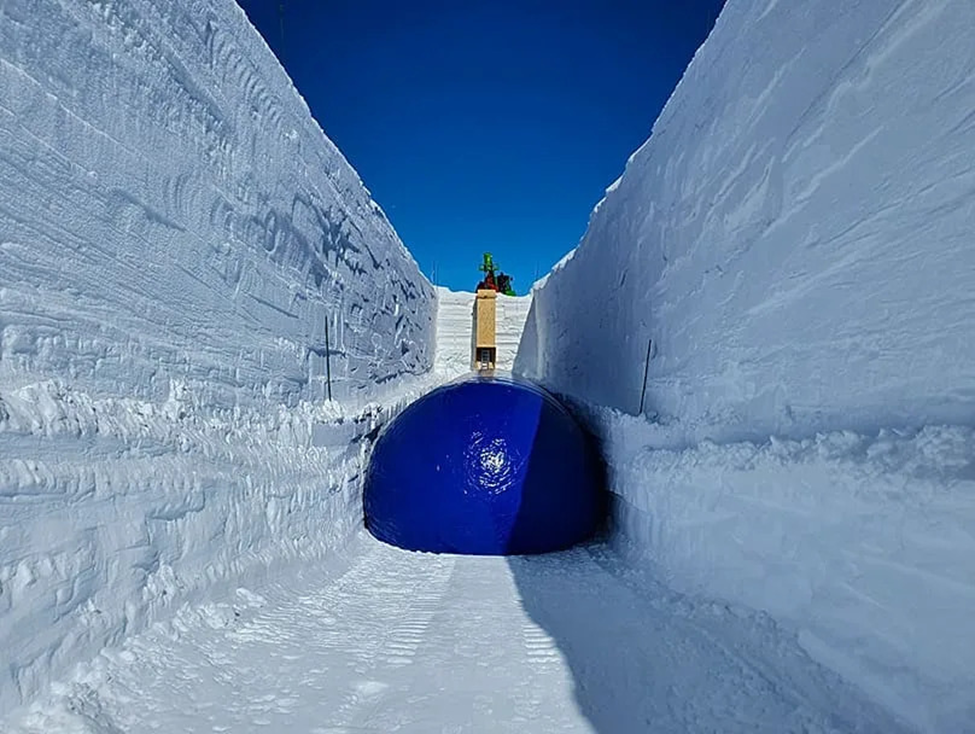
- Recently, the Ice Memory Foundation opened the world’s first sanctuary for mountain ice cores in Antarctica, aiming to preserve vital records of Earth’s climate for centuries.
- The sanctuary is designed to protect ice cores from glaciers that are rapidly disappearing due to global warming.
1. What are Ice Cores?
- Ice cores are cylindrical samples drilled from glaciers.
- They act as time capsules, preserving:
- Atmospheric gases
- Aerosols
- Pollutants
- Dust particles
- Useful for reconstructing past climate and atmospheric conditions.
2. Location of the Sanctuary
- The sanctuary is located at Concordia Station on the Antarctic Plateau, stored in a snow cave within an area protected under the 1959 Antarctic Treaty and the Madrid Protocol.
- Maintained at a constant temperature of around –52°C.
- Ensures long-term preservation without artificial cooling.
Short Code:





3. First Stored Samples
- Extracted from:
- Mont Blanc (France)
- Grand Combin (Switzerland)
- Total weight: 1.7 tonnes of ice
- Transported via icebreaker on a 50-day refrigerated journey from Trieste, Italy.
4. Ice Memory Foundation
- Launched in 2015.
- A consortium of European research institutes, including:
- The National Centre for Scientific Research (CNRS)
- The French National Research Institute for Sustainable Development (IRD)
- University of Grenoble Alpes
- The National Council of Research (CNR) and the Ca’ Foscari University in Venice from Italy.
- Paul Scherrer Institute (Switzerland)
5. Objectives
- Preserve ice cores for centuries for future scientific study.
- Enable future researchers to analyze samples using technologies not yet developed.
- Develop an international convention over the next decade for safeguarding ice core heritage.
6. Current Status & Future Plans
- Ice cores already drilled from 10 glacier sites worldwide.
- More samples to be transported to Antarctica in coming years.
7. Why is it Important? (Climate Change Link)
- Global glacier loss since 2000:
- 2%–39% regionally
- ~5% globally
- Loss of glaciers means loss of critical atmospheric and climate data.
Q. Consider the following products of environmental particles:
1. Atmospheric gases
2. Aerosols
3. Pollutants
4. Dust particles

How many of the above are considered as time capsules?
(a) Only two
(b) Only three
(c) All four
(d) None

Answer: C

Explanation:
Certain environmental particles and materials are considered "time capsules" by scientists because they naturally trap and preserve samples of ancient air, dust, or pollutants from specific points in history or even from the early solar system. Analyzing these particles provides direct physical evidence of past environmental conditions.
Practice Today’s MCQs
Short Code: