
Context
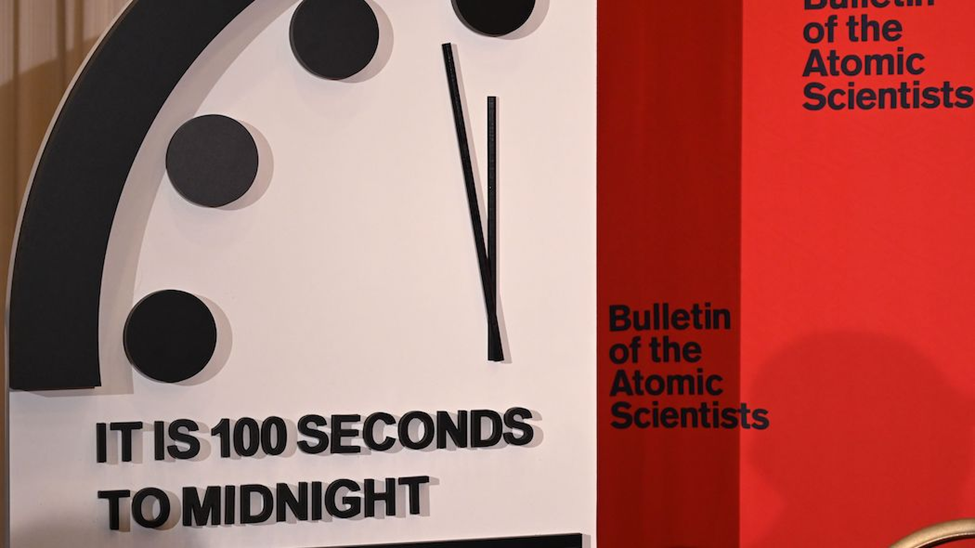
- Recently, on January 27, 2026, the Bulletin of the Atomic Scientists moved the hands of the Doomsday Clock to 85 seconds to midnight, the closest it has ever been to a global catastrophe in its 79-year history.
- This decision was driven by the imminent expiration of the New START Treaty (February 2026), the lack of progress in mitigating climate change, and the destabilizing effects of generative Artificial Intelligence (AI) and misinformation.
- The clock moved four seconds forward from its 2025 setting of 89 seconds, signaling an unprecedented “state of emergency” for humanity.
1. Origin and Organization
- Foundation: The Doomsday Clock was established in 1947 by the Bulletin of the Atomic Scientists, a non-profit organization founded in 1945 by Manhattan Project scientists (including Albert Einstein and J. Robert Oppenheimer) concerned about the implications of the nuclear age.
- Symbolism: “Midnight” represents the point of a man-made global catastrophe (apocalypse). The clock is a metaphor for the proximity of humanity to self-destruction.
- Maintenance: The time is set annually by the Bulletin’s Science and Security Board in consultation with its Board of Sponsors, which includes several Nobel Laureates.
2. Determinants of the Clock’s Time
Initially focused solely on nuclear threats, the criteria have expanded to include:
- Nuclear Weapons: Modernization of arsenals, breakdown of arms control treaties, and regional conflicts (e.g., Ukraine, Middle East).
- Climate Change: Acceleration of global warming, record-high temperatures, and failure of international cooperation on decarbonization.
- Biological Threats: Potential for engineered pathogens, laboratory leaks, and lack of pandemic preparedness.
- Disruptive Technologies: The role of AI in autonomous weaponry, cyberattacks on critical infrastructure, and the erosion of truth through “Information Armageddon.”
3. Historical Timeline and Trends
- Initial Setting (1947): Seven minutes to midnight.
- Safest Point (1991): 17 minutes to midnight, following the end of the Cold War and the signing of the Strategic Arms Reduction Treaty (START).
- Deterioration (2020s): The clock broke the “two-minute” barrier in 2020 (100 seconds) and has continued to tick closer (90 seconds in 2023, 89 in 2025, and 85 in 2026).
4. Geographical and Strategic Context (2026)
- The Bulletin specifically highlighted the “winner-takes-all” great power competition and the rise of nationalistic autocracies.
- The risk of a “runaway nuclear arms race” was emphasized due to the lack of a replacement for the New START treaty between the US and Russia.
Which of the following best describes the Doomsday Clock?
(a) It is a scientific instrument maintained by the United Nations to measure the probability of nuclear war based on global missile deployment.
(b) It is a symbolic clock created by the Bulletin of the Atomic Scientists to represent how close humanity is to global catastrophe caused by nuclear, climate, and technological threats.
(c) It is a real-time digital clock maintained by the International Atomic Energy Agency to track nuclear accidents worldwide.
(d) It is an index prepared by the World Economic Forum to assess global geopolitical instability and climate risks.

Correct Answer: (b)
Explanation:
 The Doomsday Clock is a symbolic representation, not a physical measuring instrument, created and maintained by the Bulletin of the Atomic Scientists since 1947. It reflects how close humanity is perceived to be to global catastrophe, originally focused on nuclear war but now also incorporating climate change, biological threats, and disruptive technologies such as artificial intelligence. It is not maintained by the United Nations, IAEA, or the World Economic Forum.