
Context
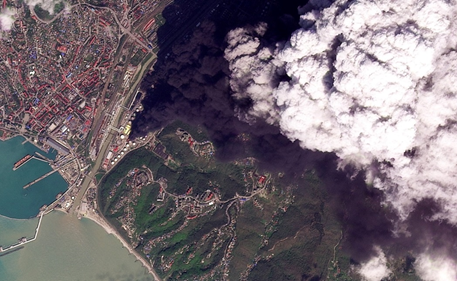
A long-burning fire at the Tuapse oil refinery (Russia) following a Ukrainian drone strike has highlighted significant environmental risks, specifically toxic rainfall and particulate matter pollution. This event serves as a case study for the intersection of geopolitical conflict, energy infrastructure, and environmental science.
1. Geographical Significance: Tuapse & The Black Sea
- Location: Tuapse is a major port city in Krasnodar Krai, Russia, situated on the northeast shore of the Black Sea.
- Strategic Importance: It is home to a massive oil refinery and terminal, serving as a primary hub for Russian energy exports.
- UPSC Tip: Map-based questions often focus on Black Sea port cities (e.g., Novorossiysk, Sevastopol, Odessa, Tuapse).
2. Environmental Impact: Toxic Rainfall & Air Quality
I. Toxic Rainfall (Black Rain)
- Mechanism: Large-scale combustion of hydrocarbons (oil) releases massive quantities of Soot (Black Carbon) and sulfur/nitrogen oxides into the atmosphere.
- Precipitation: When these particles interact with moisture in the clouds, they fall as “toxic rainfall,” leaving a carbonaceous black coating on surfaces.
- Impact: This can lead to soil acidification, water contamination, and damage to local flora.
- Comparison to Acid Rain: While traditional acid rain involves sulfur and nitrogen oxides lowering the pH of precipitation, toxic “black rain” often refers to direct contamination from heavy pollution loads.
II. Particulate Matter (PM) & Emissions
- Concentration: Local authorities reported toxic particle levels 2–3 times higher than permissible limits.
- Health Hazards: High concentrations of PM 2.5 penetrate deep into the lungs and enter the bloodstream.
- Public Health Protocol: Mitigation strategies include:
- Staying indoors (Shelter-in-place).
- Using N95/Face masks to filter out fine soot particles.
- Sealing windows to prevent indoor infiltration of toxic plumes.
3. WHO Air Quality Guidelines (AQG)
The WHO significantly tightened limits in 2021 due to new evidence of health impacts at lower concentrations.
- PM 2.5 Annual Mean: Reduced from 10mu g/m^3 to 5mu g/m^3.
- PM 10 Annual Mean: Reduced from 20mu g/m^3 to 15mu g/m^3.
Note for Prelims: These guidelines are not legally binding for countries. They serve as a scientific template for nations to set their own national standards (like India’s NAAQS).
With reference to atmospheric pollution, consider the following statements:
I. Acid rain is primarily caused by sulfur dioxide and nitrogen oxides reacting with water vapor, leading to a decrease in the pH of precipitation.
II. “Black rain” refers to precipitation contaminated with high concentrations of particulate matter and toxic pollutants, often giving it a dark appearance.
III. Both acid rain and black rain originate from identical chemical processes in the atmosphere.
Which of the statements given above is/are correct?
(a) I and II only
(b) II and III only
(c) I and III only
(d) I, II and III
Answer: A
Explanation:
Detailed Analysis of Statements
• Statement I is Correct: Acid rain is a result of Sulfur Dioxide (SO2) and Nitrogen Oxides (NOX) reacting with atmospheric water, oxygen, and other chemicals. This forms sulfuric and nitric acids, which lower the pH of rainwater typically to a range of 4.2 to 4.4.
• Statement II is Correct: “Black rain” is distinct from standard acid rain. It occurs when rain scavenges large amounts of Particulate Matter (PM), specifically Soot or Black Carbon, from the air. This usually follows high-intensity events like oil refinery fires (as seen in the Tuapse incident), volcanic eruptions, or nuclear explosions. The high concentration of carbonaceous particles gives the rain a literal dark or "black" appearance and leaves a residue on surfaces.
• Statement III is Incorrect: While both are forms of atmospheric deposition, their "chemical origin" is different:
o Acid Rain is a chemical transformation process (gas-to-acid conversion).
o Black Rain is primarily a physical scavenging process (wet deposition of solid particles).
While they often occur simultaneously (as burning oil releases both SO2 and soot), the processes—acidification vs. particulate contamination—are scientifically distinct.