
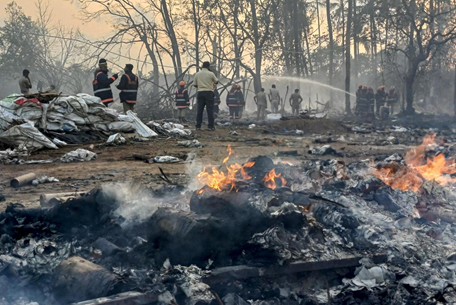
Context
Recently, a major explosion at a firecracker manufacturing unit in Thrissur resulted in the death of 14 people and left over 40 injured, occurring just days before the Thrissur Pooram festival.
In the previous year, the same festival had already raised serious safety concerns when a fireworks display led to chaos after a disoriented elephant went on a rampage, injuring 42 individuals. Additionally, another elephant had attacked its handler a day prior to the incident.
1. Noise Pollution Standards in India
- Regulatory Body: Central Pollution Control Board (CPCB).
- Noise Standards for Firecrackers: Prohibits manufacture, sale, or use of firecrackers generating noise levels exceeding 125 decibels (dB) at 4 metres distance from the point of bursting.
- Ambient Noise Limits (National Ambient Noise Monitoring Network):
- Residential Areas: 45–55 dB.
- Silence Zones (Hospitals/Educational Institutions): 40–50 dB.
- Health Impact: The WHO identifies noise pollution as the third most hazardous environmental threat to human health, following air and water pollution.
2. Cold Spark Technology (Noiseless Alternatives)
- Mechanism: Uses a chemical combustion reaction of fine granulated metal alloy powders (typically Titanium and Zirconium).
- The “Cold Sparkular”: A device equipped with a heater and fan. The heater warms the alloy powder to increase activation energy, and the fan ejects the glowing particles.
- Key Differences from Traditional Fireworks:
- Temperature: Traditional sparklers emit temperatures around 1,200°C. Cold sparklers/anars operate at significantly lower temperatures (60–100°C), reducing burn risks.
- Combustion: Utilizes rapid exothermic reactions without explosive combustion, heavy smoke, or high-decibel noise.
- Deployment: Can be arranged in arrays for sequential triggering to create visual effects like “cascading bursts” or “vertical expansion” without sound.
3. Ecological and Social Impact
- Animal Welfare: High decibel levels and specific sound frequencies disorient captive animals (e.g., festival elephants), leading to unpredictable behavior and public safety risks.
- Vulnerable Populations: High noise levels near hospitals pose significant risks to Neonatal Intensive Care Units (NICUs), potentially impacting infant brain development.
- Economic Barriers: Cold spark pyrotechnics remain expensive and are currently largely imported, though indigenous manufacturing is technologically feasible.
With reference to noise pollution standards in India, consider the following statements:
I. The Central Pollution Control Board regulates permissible noise levels for firecrackers.
II. Firecrackers generating noise above 125 decibels at a distance of 4 metres are prohibited.
III. Ambient noise limits in silence zones such as hospitals range between 70–80 dB.
Which of the statements given above is/are correct?
(a) I and II only
(b) II and III only
(c) I and III only
(d) I, II and III
Answer: A
Explanation:
• Statement I is Correct: The Central Pollution Control Board (CPCB) is the statutory body responsible for setting and regulating noise standards in India, including those for firecrackers and ambient noise levels.
• Statement II is Correct: According to the "Noise Standards for Firecrackers," the manufacture, sale, or use of firecrackers generating noise levels exceeding 125 decibels (dB) at a distance of 4 metres from the point of bursting is prohibited.
• Statement III is Incorrect: Ambient noise limits for silence zones (which include hospitals and educational institutions) are much lower than stated. The recommended limits are 50 dB during the day and 40 dB at night. A range of 70–80 dB would be closer to industrial area limits or high-traffic zones, which would be hazardous to a hospital environment.