
After Reading This Article You Can Solve This UPSC PYQ Question:
Examine the evolving pattern of Centre-State financial relations in the context of planned development in India. How far have the recent reforms impacted the fiscal federalism in India? 2025 (15 Marks, GS-3 Economy)
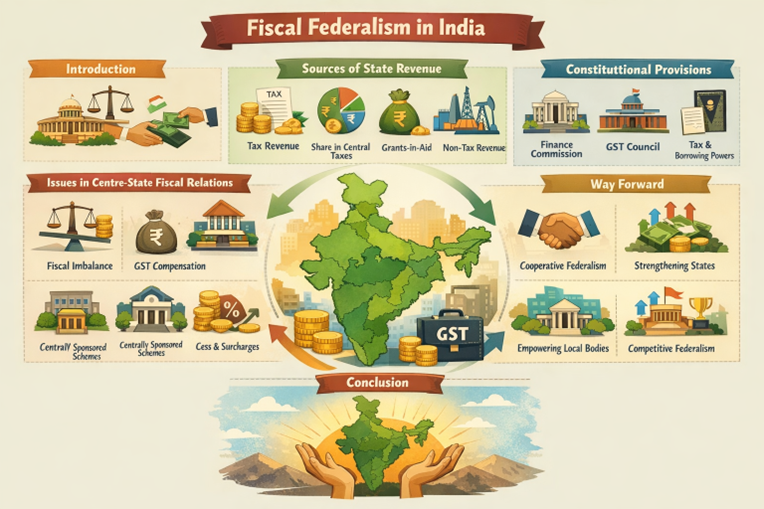
Introduction
- Definition: Fiscal Federalism is the study of how revenues and expenditures are allocated across different layers of the government.
- Nature: India follows a Quasi-Federal fiscal structure. While the Centre has more elastic revenue sources (Income Tax, Corp Tax), the States bear the majority of “ground-level” expenditures (Health, Education, Agriculture).
- Musgrave’s Three Functions: It aims to achieve Allocation (public goods), Distribution (equity), and Stabilization (macroeconomic health).
Constitutional Provisions on Fiscal Federalism
The legal framework is primarily contained in Part XII (Articles 268-293).
1. Division of Taxing Powers (The Foundation)
- Article 246 (Seventh Schedule):Union List (List I): Centre has exclusive power over Income Tax (except agriculture), Customs, Corporate Tax, and Central Excise (on tobacco, petroleum, etc.).
- State List (List II): States have exclusive power over Land Revenue, State Excise (on alcohol), Stamp Duty, and Agricultural Income Tax.
- Concurrent List (List III): Minimal taxation powers; mostly regulatory.
- Article 246A (101st Amendment): The “Special Provision” that bypasses the Seventh Schedule to allow both Centre and States to levy GST on the same transaction.
2. Revenue Distribution (The Mechanism)
- Article 268: Duties levied by the Union but collected and appropriated by the States (e.g., Stamp duties).
- Article 269: Taxes levied and collected by the Union but assigned to the States (e.g., taxes on inter-state trade, though largely subsumed by IGST).
- Article 270 (The Divisible Pool): Mandatory sharing of “Net Proceeds” of all Union taxes (except cesses and surcharges) between the Centre and States.
- Current Status: The 16th Finance Commission has maintained the vertical devolution at 41% for 2026-31.
- Article 271: Power of the Union to levy Cesses and Surcharges. These are not part of the divisible pool, meaning the Centre keeps 100% of this revenue. This remains a major point of friction.
3. Grants-in-Aid (The Gap Filler)
- Article 275 (Statutory Grants): Mandatory grants given to specific states based on the Finance Commission’s recommendations. Charged on the Consolidated Fund of India.
- Article 282 (Discretionary Grants): Allows the Centre or States to make grants for any “public purpose.” Most Centrally Sponsored Schemes (CSS) are funded under this article.
- N.B: The 16th FC has signaled a shift toward performance-linked grants (e.g., 20% of local body grants are now performance-tied).
4. Institutional Pillars
- Article 280 (Finance Commission): A quasi-judicial body appointed every 5 years to recommend the formula for horizontal and vertical tax devolution.
- Article 279A (GST Council): A constitutional body for joint decision-making. Decisions require a 75% majority, where the Centre has 1/3rd voting power and States have 2/3rd.
5. Financial Management & Borrowing
- Article 292: Union’s power to borrow upon the security of the Consolidated Fund of India (within limits set by Parliament).
- Article 293: States’ power to borrow.
- Constraint: A State cannot borrow without the Centre’s consent if it has any outstanding loan due to the Union (Art. 293(3)).
- Recent Conflict: The Centre has used this to include Off-Budget Borrowings in the state’s debt ceiling, a move challenged by states like Kerala.
Sources of State Revenue
1. State’s Own Tax Revenue (SOTR)
This is the most critical component for a state’s fiscal autonomy.
- State GST (SGST): The single largest source. It is the state’s share of the Goods and Services Tax levied on intra-state supply.
- State Excise Duty: Primarily levied on the manufacture of alcohol for human consumption and narcotics. (A major “sin tax” revenue source).
- VAT on Petroleum: Since petrol, diesel, and aviation turbine fuel are outside GST, states levy a Value Added Tax (VAT) on them.
- Stamp Duty & Registration Fees: Levied on the transfer of property and legal documents.
- Taxes on Vehicles: One-time or annual life taxes on motor vehicles.
- Land Revenue: Tax on agricultural land (historically significant, now a smaller share).
- Electricity Duty: Tax on the consumption or sale of electricity.
2. State’s Own Non-Tax Revenue (SONTR)
Often underutilized, this includes:
- User Charges: Fees for social and economic services (e.g., irrigation charges, tuition fees in govt colleges, health hospital fees).
- Interest Receipts: Interest earned on loans provided by the State to PSUs or local bodies.
- Dividends & Profits: Income from State Public Sector Undertakings (SPSUs).
- Mining Royalty: Fees paid by mining companies for extracting minerals (crucial for states like Odisha, Jharkhand, and Chhattisgarh).
- Lottery Proceeds: Significant for states like Kerala and Sikkim.
3. Transfers from the Centre
- Tax Devolution (Art. 270): States receive 41% of the “Divisible Pool” of central taxes (Income Tax, Corp Tax, CGST, etc.).
- Grants-in-Aid (Art. 275):Revenue Deficit Grants: Given to states facing a fiscal gap after devolution.
- Local Body Grants: For Panchayats and Urban Local Bodies (RLBs/ULBs).
- Centrally Sponsored Schemes (CSS): Funds transferred for specific schemes (e.g., Jal Jeevan Mission, PM-Kisan) under Article 282.
Issues In Center-state Fiscal Relations
I. Vertical Fiscal Imbalance: The Centre collects roughly 60% of total revenue but the States perform 60% of total public expenditure. This creates a dependency of States on the Union.
II. Growth of Cesses and Surcharges: Under Article 271, the Centre levies cesses (e.g., Health & Education Cess) which are not shared with states. This has effectively reduced the “divisible pool.”
- Note: The 16th FC recently proposed a “Grand Bargain” where States might accept a lower devolution percentage if Cesses are merged into the shared pool.
III. Erosion of Autonomy (GST): The “One Nation, One Tax” regime has taken away the States’ power to vary tax rates on most goods, making them “pensioners of the Centre.”
IV. Borrowing Constraints (Article 293): The Centre imposes a Net Borrowing Ceiling (NBC). States like Kerala have challenged this in the Supreme Court, arguing it infringes on their constitutional right to manage their own finances.
V. Centrally Sponsored Schemes (CSS): States argue that CSS (like MGNREGA or Ayushman Bharat) are “one-size-fits-all” and force states to spend their limited resources on Central priorities, often with a 60:40 or 90:10 funding pattern.
Way Forward: Strengthening Fiscal Federalism
- Cess Neutralization: Implement a “Grand Bargain” by merging major cesses into the divisible pool. This ensures transparency and prevents the “shrinking” of the states’ share of Gross Tax Revenue.
- GST 2.0 Reform: Move toward a simplified two-slab structure (e.g., 5% and 18%) and establish a clear roadmap for including Petroleum and Electricity under GST to reduce cascading costs and broaden the revenue base.
- Revenue Floor Guarantee: To mitigate the “North-South” divide created by efficiency-linked criteria (like GDP contribution), the Centre should guarantee that no state’s absolute revenue falls below its previous levels during the transition.
- Local Body Empowerment: Shift focus from “Grant-Dependency” to “Fiscal Autonomy” for Panchayats and ULBs. States must mandate the implementation of State Finance Commission (SFC) reports to improve local property tax collection.
- Flexi-CSS Model: Replace rigid Centrally Sponsored Schemes with “Outcome-based Tied Grants.” This allows states the flexibility to customize scheme implementation based on local geographical and demographic needs.
- Institutional Consensus: Revitalize the Inter-State Council (Art. 263) to resolve disputes over Net Borrowing Ceilings (NBC) and off-budget liabilities, shifting the resolution of fiscal friction from the Judiciary to collaborative Executive dialogue.
Conclusion
India’s fiscal architecture must evolve from “Centralized Coordination” to “Equitable Partnership.” Leveraging the 16th Finance Commission’s efficiency-linked criteria while absorbing cesses into the divisible pool will ensure a fiscally resilient, Viksit Bharat @ 2047.