
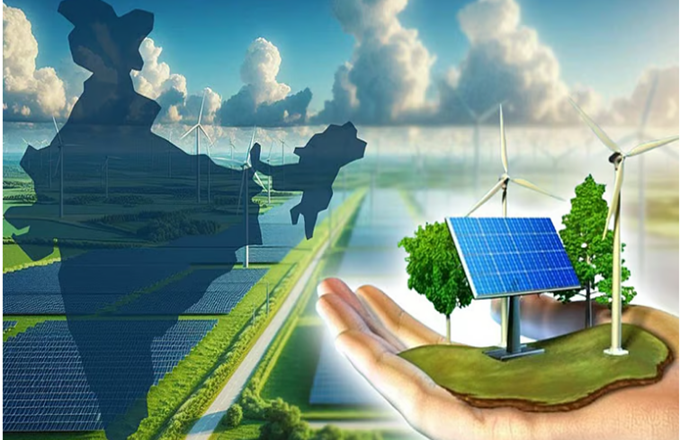
After Reading This Article You Can Solve This UPSC Mains Model Question:
In light of rising geopolitical tensions affecting global oil supply, evaluate the role of sustainable energy in strengthening India’s energy security. 15 Marks (GS-3 Economy)
Introduction
Sustainable energy refers to energy that meets present needs without compromising the ability of future generations to meet their needs, ensuring energy security, environmental protection and economic growth.
Core Principles of Sustainable Energy
(a) Environmental Sustainability: Energy production should minimize environmental damage and carbon emissions.
(b) Economic Sustainability: Energy systems must be cost-effective and support economic development.
(c) Social Equity: Energy should be accessible and affordable for all sections of society.
(d) Energy Security: Ensuring continuous and reliable energy supply for economic growth.
Why Sustainable Energy is Crucial for India
1. Economic Resilience (The “Import Bill” Crisis)
- Fiscal Stability: India spends over $160 billion annually on crude oil imports. This drain on foreign exchange reserves directly impacts the value of the Rupee.
- Inflation Control: High oil prices lead to “imported inflation,” raising transport costs for food and essential goods. Sustainable energy (Solar/Wind) has zero fuel cost, stabilizing long-term energy prices.
2. Energy Security & Geopolitical Autonomy
- The “Hormuz” Risk: 60% of India’s oil comes from the Middle East. Any conflict in the Persian Gulf can cripple the Indian economy in days.
- Strategic Autonomy: By generating power domestically via Renewables and Green Hydrogen, India reduces its “Energy Dependency” and can maintain a neutral foreign policy without fear of energy blackmail.
3. Environmental & Health Mandates
- Air Quality: 14 of the world’s 20 most polluted cities are in India. Moving away from coal-fired plants reduces PM2.5 levels, saving billions in healthcare costs.
- Climate Leadership: As the world’s 3rd largest CO2 emitter, meeting Net Zero 2070 targets is essential for India’s global standing and to avoid “Carbon Border Taxes” imposed by the EU/USA.
4. The “Demographic Dividend” & Job Creation
- Green Jobs: The renewable sector is more labor-intensive than fossil fuels. India’s RE sector could create 3.4 million jobs by 2030 in manufacturing, installation, and maintenance.
- Rural Electrification: Decentralized solar (PM-KUSUM) empowers farmers to become “Urjadatas” (energy providers), increasing rural incomes.
Major Sources of Sustainable Energy in India
1. Solar Energy (The Dominant Lead)
Solar power is the “anchor” of India’s green transition. India has surpassed Japan to become the world’s 3rd largest solar producer.
- Current Capacity: ~143.6 GW.
- Ground-Mounted: ~109.5 GW, dominated by massive parks like Khavda (Gujarat), which is becoming the world’s largest renewable energy zone.
- Rooftop Solar: Reached ~25 GW, accelerated by the PM Surya Ghar Yojana aiming to solarize 1 crore homes.
- Floating Solar: Increasing deployment in reservoirs (e.g., Omkareshwar Dam) to save land and reduce water evaporation.
2. Green Hydrogen (The Decarbonizer)
- Production Status: Costs have dropped below $4/kg.
- Strategic Hubs: Three dedicated ports are now “Green Hydrogen Hubs”: Kandla (Gujarat), Tuticorin (Tamil Nadu), and Paradip (Odisha).
- India is integrating Green Hydrogen into “hard-to-abate” sectors like Steel and Fertilizer to reduce dependence on imported LNG.
3. Wind Energy (Onshore & Offshore)
- Current Capacity: ~54 GW (Onshore).
- Offshore Leap: Following the VGF (Viability Gap Funding) scheme, the first 1 GW offshore tenders off the coasts of Gujarat and Tamil Nadu are now in the execution phase.
- Hybridization: Most new projects are now “Solar-Wind Hybrids” (3.5 GW currently) to ensure a more stable, round-the-clock power supply to the grid.
4. Nuclear Energy (The “Base Load” Pillar)
Under the SHANTI Act of 2025, India has opened the nuclear sector to limited private participation to reach 100 GW by 2047.
- Current Capacity: ~8.8 GW.
- Bharat Small Reactors (BSRs): 220 MW indigenous reactors are being deployed as “captive power plants” for heavy industries.
- SMR-55: India’s first dedicated 55 MWe Small Modular Reactor is now under construction, specifically designed for decentralized industrial use.
5. Bio-Energy & Circular Economy
- Ethanol Blending: Having achieved 20% blending (E20) in 2025, India is now testing E100 (pure ethanol) vehicles in select cities.
- CBG (Compressed Biogas): Utilizing agricultural waste (parali) to produce gas, effectively reducing the LPG import bill and urban pollution.
Major Government Policies & Initiatives
1. PM Surya Ghar: Muft Bijli Yojana (2024–2027): Decentralized solar adoption through rooftop installations.
2. National Green Hydrogen Mission (NGHM): Production of 5 MMT (Million Metric Tonne) of Green Hydrogen per annum by 2030.
3. SHANTI Act, 2025 (Sustainable Harnessing of Nuclear Energy): Ending the state monopoly by allowing limited private participation and accelerating the deployment of Small Modular Reactors (SMRs) for industrial captive power.
4. PM-KUSUM: De-dieseling the farm sector by providing solar pumps and allowing farmers to become “Urjadatas” (selling surplus solar power back to the grid).
5. PM E-DRIVE Scheme (2024–2028): Accelerate the transition to Electric Mobility. Support for e-2Ws, e-3Ws, e-trucks, and e-ambulances, while establishing a pan-India public charging network (EVPCS).
6. National Policy on Biofuels (Amended 2022): Achieve 20% Ethanol Blending (E20) by ESY 2025-26. Using surplus food grains and agricultural residue for fuel.
Challenges in Achieving Sustainable Energy
- Storage Infrastructure Gap: India lacks sufficient Battery (BESS) and Pumped Hydro capacity to store surplus midday solar power for nighttime use.
- Critical Mineral Dependency: India relies heavily on imports for Lithium, Cobalt, and Rare Earths required to manufacture EV batteries and solar panels.
- High Capital Cost: Renewable projects require massive upfront investment, and high interest rates in India increase the overall “Levelized Cost of Electricity.”
- Land Acquisition Conflicts: Solar/Wind farms require vast areas, leading to competition with agriculture and threats to biodiversity (e.g., the Great Indian Bustard).
- Transmission Bottlenecks: Most green energy is produced in a few states (Rajasthan/Gujarat), but the Green Energy Corridor lacks the capacity to evacuate all of it to the rest of India.
- DISCOM Financial Health: State-owned distribution companies are in deep debt, making them hesitant to sign long-term Power Purchase Agreements (PPAs) for green energy.
- Technological Import Reliance: Despite “Make in India,” a significant portion of high-efficiency solar cells and electrolyzers for hydrogen are still imported.
Way Forward
- Integrated Storage Policy: Accelerate the deployment of Pumped Hydro Storage and Battery Energy Storage Systems (BESS) to manage the intermittency of solar and wind power.
- Mineral Security Partnerships: Secure long-term supplies of Lithium and Cobalt through the KABIL (Khanij Bidesh India Ltd) joint venture and the “Mineral Security Partnership” to reduce import reliance.
- Green Hydrogen Scaling: Transition from pilot projects to industrial-scale production to decarbonize heavy industries like steel, cement, and refineries.
- Grid Modernization: Complete the Green Energy Corridor and implement “Smart Grids” that can automatically balance fluctuating renewable inputs..
- Incentivizing Domestic Manufacturing: Use the PLI (Production Linked Incentive) Scheme to move beyond assembly and start manufacturing high-efficiency solar cells and electrolyzers in India.
- Agricultural Synergy: Expand PM-KUSUM and Agrivoltaics to ensure energy production doesn’t compete with food security for land use.
Conclusion
India must transition from energy dependency to energy sovereignty by integrating Green Hydrogen, SMRs, and DAC, ensuring a resilient, Net-Zero future that decouples economic growth from geopolitical oil shocks.