
Context
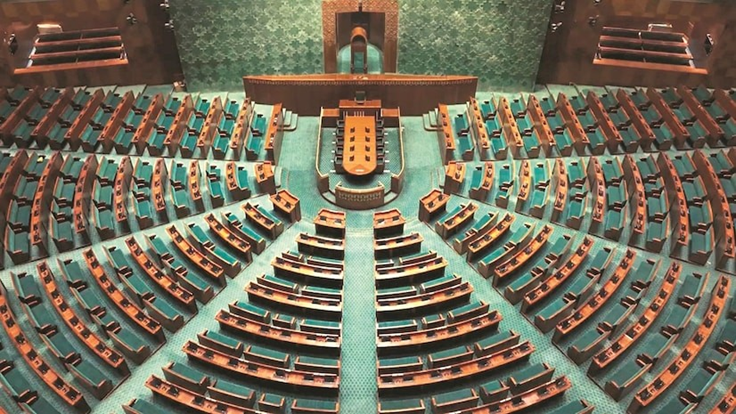
Recently, the Lok Sabha referred the Corporate Laws (Amendment) Bill, 2026 to a Joint Parliamentary Committee (JPC) for detailed examination. Union Finance Minister Nirmala Sitharaman proposed the motion to allow for wider stakeholder scrutiny regarding amendments to the Companies Act, 2013, and the Limited Liability Partnership Act, 2008.
1. Nature and Status
- Ad-hoc Committee: A JPC is a temporary (ad-hoc) body constituted by the Parliament for a specific purpose and a fixed duration.
- Dissolution: The committee ceases to exist once it completes its assigned task and submits its report to the Parliament.
- Bipartisan Representation: It consists of members from both the ruling coalition and the opposition parties, ensuring a balanced scrutiny of controversial issues.
2. Composition and Formation
- Creation: A JPC is set up through a motion passed in one House (usually the Lok Sabha) and concurred with by the other House. Alternatively, the presiding officers of both Houses can communicate to form a joint committee.
- Membership Ratio: The strength of a JPC is not fixed by any permanent rule but is decided by the motion. Conventionally, the ratio of members from the Lok Sabha to the Rajya Sabha is 2:1.
- Example: For a 31-member committee, 21 members are from the Lok Sabha and 10 from the Rajya Sabha.
- Appointment: Members are either elected or nominated by their respective Houses. The Chairperson is typically a member of the Lok Sabha, appointed by the Speaker.
3. Powers and Functions
- Investigative Authority: A JPC can investigate financial irregularities, major scams, or complex legislative bills (like the Corporate Laws Amendment Bill).
- Summoning Powers: It has the power to summon individuals, experts, or government officials to give oral evidence and can demand the production of confidential documents.
- Confidentiality: The proceedings of the committee are generally confidential, though the final report is tabled in the House.
- Dispute Resolution: Any dispute regarding the relevance of evidence or the production of documents is resolved by the Speaker of the Lok Sabha.
4. Recommendations and Accountability
- Advisory Nature: The recommendations made by a JPC are persuasive and advisory, meaning they are not legally binding on the Government.
- Action Taken Report (ATR): While the government may reject the recommendations, it is mandatory to submit an ‘Action Taken Report’ to the Parliament, explaining the steps taken or reasons for non-implementation.
5. JPC vs. Standing Committees
| Feature | Joint Parliamentary Committee (JPC) | Standing Committees (DRSCs) |
| Duration | Temporary (Ad-hoc) | Permanent (Reconstituted annually) |
| Scope | Specific issue or Bill | Subject-specific (Ministry-wise) |
| Powers | Higher investigative powers (Summoning) | Focused on budget and policy review |
Q. With reference to the Joint Parliamentary Committee (JPC) in India, consider the following statements:

1. A JPC is a permanent body of the Parliament whose members are nominated by the President of India.

2. The strength of the committee is fixed at 31 members by the Rules of Procedure of the Lok Sabha.

3. The recommendations of a JPC are binding on the government if the report is passed by a simple majority in both Houses.

Which of the statements given above is/are correct?
A) 1 and 2 only
B) 2 and 3 only
C) 1 and 3 only
D) Neither 1, 2 nor 3

Solution: D

•	STATEMENT 1 IS INCORRECT: A JPC is an ad-hoc (temporary) committee, not a permanent one. Its members are elected or nominated by the Houses of Parliament, not the President.
•	STATEMENT 2 IS INCORRECT: The strength of a JPC is not fixed by the Rules of Procedure; it is decided by the motion that creates the specific committee, though a 2:1 ratio (e.g., 31 members) is a common convention.
•	STATEMENT 3 IS INCORRECT: The recommendations of a JPC are advisory and persuasive in nature; they are never legally binding on the executive government.