
After Reading This Article You Can Solve This UPSC Mains Model Question:
“Discuss the significance of the One Health approach in strengthening pandemic preparedness and addressing emerging zoonotic diseases in India. What challenges hinder its effective implementation?” 10 Marks (GS-2 Health)
Introduction
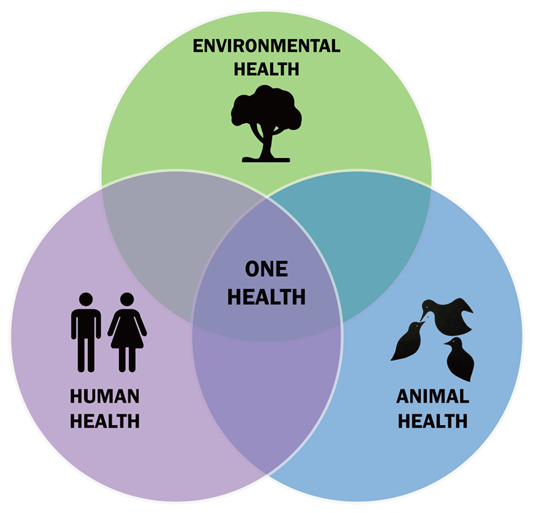
One Health is an integrated, multi-sectoral paradigm that recognizes the fundamental interdependence between human health, animal health and the resilience of our shared environment.
- Evolution: The term was officially coined in 2003-04 (post-SARS), though the concept of “One Medicine” dates back to Rudolf Virchow (19th century).
- The Quadripartite: Formally led by a collaboration between:
- WHO (World Health Organization)
- FAO (Food and Agriculture Organization)
- UNEP (UN Environment Programme)
- WOAH (World Organisation for Animal Health)
Significance of the ‘One Health’ Approach
- Zoonotic Disease Burden: According to the World Organisation for Animal Health (WOAH), 60% of known infectious diseases in humans are zoonotic and 75% of emerging infectious diseases (like COVID-19, Ebola, and Nipah) originate in animals.
- Antimicrobial Resistance (AMR): Overuse of antibiotics in livestock and humans creates “superbugs” that cycle through the environment.
- Food Security: As per the FAO, animal diseases reduce global livestock production by at least 20%, directly impacting the nutritional security of nearly 1.3 billion people who depend on livestock for livelihoods.
- Climate Change & Biodiversity Loss: Deforestation and warming temperatures force animals out of natural habitats, increasing human-wildlife conflict and “spillover” events.
- Economic Stability: The World Bank estimates that implementing One Health would cost roughly $10 billion to $11 billion annually, whereas the cost of a major pandemic (like COVID-19) is measured in trillions of dollars of lost GDP.
Global Institutional Frameworks
- One Health Joint Plan of Action (2022-2026): A 5-year roadmap by the Quadripartite focusing on health system strengthening and emerging zoonoses.
- WHO Pandemic Agreement: A legally binding treaty under Article 19 of the WHO Constitution.
- Key Pillar: The Pathogen Access and Benefit-Sharing (PABS) system for equitable access to vaccines and data.
- Manhattan Principles (2004): Based on the Wildlife Conservation Society’s foundational documents, these 12 principles were the first to formally recognize that “the health of one is the health of all.”
India’s One Health Ecosystem
A. National One Health Mission (NOHM)
Launched by the PM-STIAC (Prime Minister’s Science, Technology and Innovation Advisory Council), it is a cross-ministerial effort coordinated by the Department of Animal Husbandry & Dairying (DAHD) and the Ministry of Health.
- Surveillance: Integrated digital platforms for real-time tracking of human and animal disease.
- Lab Network: Creation of a network of BSL-3 and BSL-4 laboratories across the country (currently 22 labs in the network).
- Response: Establishing a “One Health Support Unit” to develop a national roadmap.
B. State-Led Best Practices
- Odisha: Pioneering the Climate Budget to track resilient development.
- Kerala: Participatory carbon-neutral plans (e.g., Meenangadi model).
- Tamil Nadu: Green Climate Company and “Cool Roof” projects to mitigate environmental stressors.
Challenges of the ‘One Health’ Approach
- Institutional Silos: As per the PM-STIAC, fragmented coordination persists because human, animal and environmental health fall under separate ministries with conflicting mandates (as per NITI Aayog).
- Funding Asymmetry: According to World Bank and WHO assessments, global and national funding is skewed toward curative care and preventative sectors like animal health receive less than 15% of the total budget.
- Data Fragmentation: Based on NCDC reports, India lacks a unified digital architecture, as human and veterinary data are stored in incompatible formats, hindering real-time AI outbreak predictions.
- Legal & Regulatory Gaps: India lacks a dedicated “One Health Act.” As per the Observer Research Foundation (ORF), existing laws like the Epidemic Diseases Act (1897) do not address the complex modern human-animal interface.
- Infrastructure & HR Deficit: According to ICMR and WOAH, there is a critical shortage of BSL-3 laboratories at the district level and a veterinarian-to-livestock ratio that falls below global standards.
- Socio-Economic Barriers: As per FAO reports, low awareness among farmers and fear of economic loss (due to culling) often lead to the under-reporting of zoonotic illnesses.
Way Forward
- Integrated Legislative Framework: India should move toward a dedicated “One Health Act.” As per legal recommendations from the Observer Research Foundation (ORF), this would provide the statutory backing needed to mandate inter-ministerial cooperation and shared budgeting.
- Operationalizing “One Health” Units: According to NITI Aayog’s Vision 2035, India must establish integrated surveillance units at the district level, co-locating medical, veterinary and environmental officers to ensure grassroots rapid response.
- Unified Data Architecture: Based on Digital India initiatives, the creation of a “National One Health Digital Portal” is essential to sync data from the IDSP (human) and NADRS (animal) systems via AI.
- Incentivized Reporting : According to FAO guidelines, the government should implement “loss-compensation” schemes for farmers to prevent under-reporting of zoonotic outbreaks due to fear of economic ruin.
- Strengthening “Environmental” Health: As per UNEP’s recommendations, India must integrate forest officials and ecologists into urban planning to better manage the “wildlife-human interface.”
- Global Leadership: Leveraging G20 New Delhi Declaration commitments, India should lead the Global South in operationalizing the WHO Pandemic Agreement’s PABS system for equitable sharing of medical countermeasures.
Conclusion
Adopting the One Health approach is a biological and economic necessity. By integrating human, animal and environmental health, India can ensure pandemic resilience, global leadership, and sustainable development.