
Context
- Recently, the global scientific community has intensified its focus on sustainable energy alternatives, with the Artemis II mission achieving record-breaking lunar flybys in April 2026, renewing interest in lunar-based infrastructure.
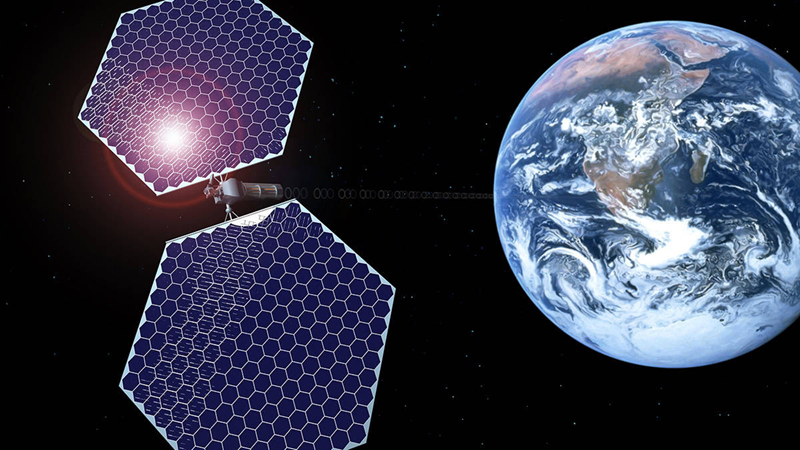
- Against this backdrop, concepts like the Shimizu Corporation’s “Lunar Ring”—a proposed 11,000 km belt of solar power plants on the moon’s equator—have moved from speculative science fiction to serious academic and policy discussion. These systems aim to collect uninterrupted solar energy and beam it back to Earth via microwave radiation to provide a constant, clean power source.
1. What is Space-Based Solar Power?
SBSP refers to the collection of solar energy in outer space (either in Earth’s orbit or on the lunar surface) and its subsequent transmission to Earth.
Working Mechanism:
- Collection: Large solar arrays or mirrors reflect sunlight onto photovoltaic cells.
- Conversion: The electricity generated is converted into microwaves or laser beams.
- Transmission: These beams are transmitted through the atmosphere to a ground-based receiving antenna (often called a rectenna).
- Re-conversion: The rectenna converts the microwave/laser energy back into electricity for the grid.
2. Key Concepts & Projects
- Lunar Ring (Luna Ring): A Japanese proposal (Shimizu Corp) to build a solar belt around the moon’s equator. It utilizes In-Situ Resource Utilization (ISRU), where robots build the structure using lunar soil (regolith).
- Constant Energy: Unlike Earth-based solar, an orbital satellite or a 360-degree lunar ring can collect sunlight 24/7, regardless of weather, seasons, or day-night cycles.
- Wireless Power Transfer (WPT): The fundamental technology used to “beam” energy across the vacuum of space.
3. Advantages Over Terrestrial Solar
- High Intensity: Solar radiation in space is roughly 35-40% more intense than on Earth’s surface due to the absence of atmospheric scattering.
- Zero Intermittency: Space-based systems are not affected by cloud cover, dust, or the 12-hour night cycle.
- Global Reach: Energy can theoretically be beamed to any location on Earth, including remote islands or disaster-hit zones.
4. Critical Challenges
- Economics: The “levelized cost of energy” remains prohibitively high due to the massive cost of launching thousands of tonnes of hardware.
- Transmission Loss: Significant energy is lost as heat during the conversion and atmospheric entry phases.
- Space Debris: The Kessler Syndrome (cascading collisions) poses a major risk; a single piece of debris could destroy a billion-dollar array.
- Environmental Impact: Potential heating of the ionosphere or release of hazardous chemicals during frequent rocket launches required for assembly.
- Maintenance: Dependence on tele-robotics since human-led maintenance in high orbits (GEO) or on the moon is extremely costly and dangerous.
5. Institutional & Global Efforts
- ISRO (India): Has expressed interest in SBSP as part of its long-term space vision to ensure energy security.
- China: Developing “Bishantai,” a space-based solar power station test facility.
- Caltech (USA): Recently demonstrated the first successful wireless power transfer from space to Earth via the MAPLE experiment.
Q. With reference to Space-Based Solar Power (SBSP), consider the following statements:

1. SBSP systems can provide "round-the-clock" electricity, bypassing the intermittency issues of ground-based solar power.

2. The "Lunar Ring" concept involves the use of lunar regolith to construct solar arrays on the moon's equator.

3. Microwave transmission of power from space is preferred over laser beams because microwaves are less affected by atmospheric conditions like rain or clouds.

How many of the above statements are correct?
(a) Only one
(b) Only two
(c) All three
(d) None

Answer: (c) All three

Solution:
STATEMENT 1 IS CORRECT: Unlike terrestrial solar, space-based satellites in high orbits or a lunar ring can stay in sunlight almost 100% of the time, providing constant baseload power.

STATEMENT 2 IS CORRECT: The Shimizu Corporation’s proposal specifically mentions using robots to process lunar soil (regolith) to build the 11,000 km infrastructure.

STATEMENT 3 IS CORRECT: Microwaves can pass through clouds and rain with minimal loss compared to laser beams, which are easily scattered or blocked by atmospheric moisture, making microwaves more reliable for all-weather power delivery.