
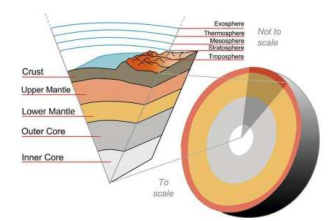
Context
- Recently, researchers from the University of Edinburgh and the British Geological Survey tracked 27 years of iron movement inside the Earth’s outer core using satellite and ground data. They found that the liquid iron layer changes direction much faster than previously believed, helping explain sudden changes or “geomagnetic jerks” in Earth’s magnetic field.
1. Key Discoveries
- The 2010 Reversal: Around 2010, liquid iron below the equatorial Pacific Ocean abruptly changed direction from a slow westward crawl to a rapid eastward surge.
- These sudden changes help explain geomagnetic jerks.
2. What are Geomagnetic Jerks?
- Sudden and rapid changes in Earth’s magnetic field.
- Caused by abrupt movement of molten iron in the outer core.
- These jerks can influence:
- Satellite operations
- GPS and navigation systems
- Communication networks
3. Outer Core vs. Inner Core
A. The Outer Core (The Dynamo)
- State of Matter: It is a voluminous liquid layer composed primarily of iron and nickel (along with trace lighter elements like sulfur and oxygen).
- Depth: It lies around 2,800 km beneath the surface..
- The Geodynamo Effect: Because the liquid iron is constantly churning and moving due to convection currents (driven by heat loss from the inner core), it acts like a massive electrical generator. This movement creates electric currents, which generate the Earth’s magnetic field (Magnetosphere).
- Significance: The generated magnetic field shields the planet from harmful solar radiation and solar winds, making life on Earth possible.
- Westward Drift: Historically, the main pattern (accounting for 95% of movement) has been a steady westward flow, explaining why the Earth’s magnetic field traditionally drifted west.
B. The Inner Core (The Solid Anchor)
- State of Matter: Unlike the outer core, the inner core is solid, despite experiencing extremely high temperatures (estimated to be around 5,400°C—comparable to the surface of the Sun).
- Why is it solid? It remains solid because the immense crushing gravitational pressure at the center of the Earth prevents the iron atoms from melting.
- Composition: Primarily an iron-nickel alloy (NiFe).
- Depth: Extends from the boundary of the outer core (5,150 km) to the very center of the Earth (approximately 6,371 km).
3. High-Yield Facts
- Seismic Wave Behavior:P-waves (Primary waves) slow down drastically when passing through the liquid outer core because liquids are less rigid than solids. They speed back up upon hitting the solid inner core.
- S-waves (Secondary waves) cannot travel through liquids at all. Therefore, S-waves are completely blocked by the liquid outer core, creating a massive S-wave shadow zone (between 105° and 145° from an earthquake epicenter), which is how scientists originally discovered the outer core was liquid.
- Discontinuities:
- The boundary between the Lower Mantle and Outer Core is called the Gutenberg Discontinuity.
- The boundary between the Outer Core and Inner Core is called the Lehmann Discontinuity.
With reference to Earth’s core, consider the following statements:
1. Earth’s magnetic field is generated by the movement of molten iron in the outer core.
2. S-waves can pass through the liquid outer core.
Which of the statements given above is/are correct?
(a) 1 only
(b) 2 only
(c) Both 1 and 2
(d) Neither 1 nor 2
Answer: A
Explanation:
•  Statement 1 is correct because the movement of molten iron and nickel in the liquid outer core creates Earth’s magnetic field through the Geodynamo Effect.
•  Statement 2 is incorrect because S-waves cannot travel through liquids, so they are blocked by the liquid outer core.