
Context
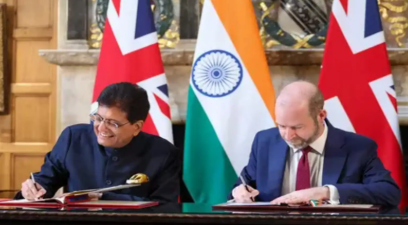
- The landmark India–U.K. Comprehensive Economic and Trade Agreement (CETA) and the accompanying Double Contribution Convention (DCC) have officially come into force.
- Described as a “gold standard” trade pact, the agreement seeks to deepen economic cooperation, enhance market access, and strengthen strategic ties between the two countries.
India–U.K. CETA: Key Features
A. Comprehensive Economic and Trade Agreement (CETA)
Unlike conventional trade agreements focused solely on goods, CETA features 30 comprehensive chapters.
- Beyond Tariffs: Covers digital trade, government procurement, MSMEs, innovation, labor, environment, and gender.
- Non-Tariff Barriers: Resolves regulatory friction points such as Sanitary and Phytosanitary Measures (SPS) and Technical Barriers to Trade (TBT) to prevent unjustified trade restrictions.
B. Double Contribution Convention (DCC)
- Termed a “game changer” for India’s services sector and skilled workforce.
- Core Objective: Serves as a social security agreement to avoid dual taxation contributions for temporary Indian professionals in the U.K.
- Currently, Indian employees/employers contribute ~25% of salary to the U.K.’s National Insurance system — treated as a sunk cost since employees can’t draw benefits.
- Exemption Rule: Indian employees on temporary assignments in the U.K. are exempt from making local National Insurance contributions for up to 5 years, provided they continue paying social security in India.
Key Tariff Provisions
U.K. side:
- Immediate elimination of tariffs on 96.8% of tariff lines, covering 97.7% of trade value.
- Additional 2% of tariff lines (1.8% of trade value) reduced to nil/near-nil via quota-based access
- Total coverage: 98.8% of tariff lines and 99.5% of trade value
India side:
- Immediate elimination of tariffs on 30.3% of trade value
- 47% more trade value to see tariffs phased out over time
- 12.1% of trade value to get reduced, quota-based tariffs
Protected Sectors (Excluded from Concessions)
- The deal protects India’s sensitive sectors such as dairy, cereals, pulses, vegetables, gold and jewellery, smartphones, and critical polymers.
| What are Sanitary and Phytosanitary (SPS) Measures? Sanitary and Phytosanitary (SPS) measures are regulations adopted by countries to protect human, animal, and plant life and health from risks arising from pests, diseases, contaminants, toxins, and food additives. These measures are governed by the WTO Agreement on the application of Sanitary and Phytosanitary Measures (SPS Agreement), which came into force in 1995. International Standard-Setting Bodies under SPS: Food Safety: Codex Alimentarius Commission (CAC) Animal Health: World Organisation for Animal Health (WOAH) Plant Health: International Plant Protection Convention (IPPC) What are Technical Barriers to Trade (TBT)? Technical Barriers to Trade (TBT) refer to technical regulations, product standards, testing procedures, and certification requirements imposed by countries to ensure quality, safety, and environmental protection. The WTO Agreement on Technical Barriers to Trade (TBT Agreement) came into force in 1995. |
With reference to the India–U.K. Comprehensive Economic and Trade Agreement (CETA), consider the following statements:
1. The United Kingdom has agreed to eliminate tariffs on 99.6% of Indian exports by value under the agreement.
2. The Double Contribution Convention (DCC) exempts Indian professionals temporarily working in the U.K. from social-security contributions for up to three years.
3. India has agreed to remove tariffs on all agricultural products imported from the U.K.
Which of the statements given above is/are correct?
(a) 1 and 2 only
(b) 2 and 3 only
(c) 1 and 3 only
(d) 1, 2 and 3
Answer: (a) 1 and 2 only
Explanation:
• Statement 1 is Correct: The U.K. will eliminate tariffs on 99.6% of Indian exports by value, covering almost the entire trade basket.
• Statement 2 is Correct: Under the Double Contribution Convention (DCC), Indian professionals temporarily working in the U.K. are exempted from making social-security contributions for up to three years.
• Statement 3 is Incorrect: India has retained tariff protection for sensitive sectors, including certain agricultural products such as dairy, apples, edible oils, and oats.