
Context
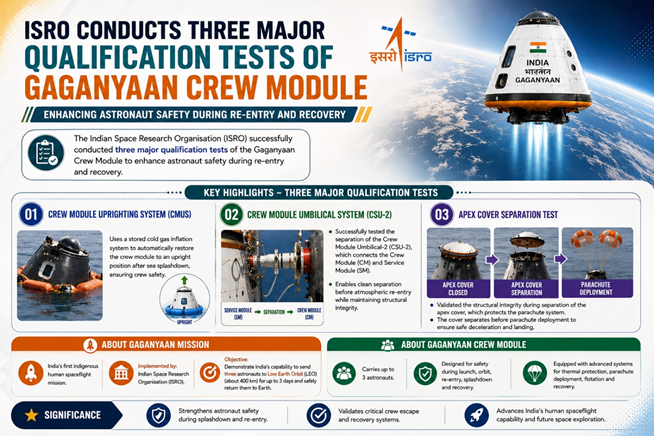
- Recently, the Indian Space Research Organisation (ISRO) successfully conducted three major qualification tests of the Gaganyaan Crew Module, validating critical crew safety, separation, and recovery systems.
About Gaganyaan Mission
- Gaganyaan is India’s first indigenous human spaceflight mission, being implemented by the Indian Space Research Organisation (ISRO).
- Objective: To demonstrate India’s capability to send three astronauts to Low Earth Orbit (LEO) (about 400 km) for up to three days and safely return them to Earth.
- The mission will be launched aboard the Human-rated LVM3 launch vehicle.
- It represents a major step towards India’s indigenous human spaceflight capability and future space exploration missions.
Key Qualification Tests of Gaganyaan Mission
1. Crew Module Uprighting System (CMUS)
- The Crew Module Uprighting System (CMUS) ensures that the Crew Module returns to an upright position after sea splashdown.
- It uses a stored cold-gas inflation system to automatically inflate flotation bags and restore the capsule if it lands upside down.
- The system is crucial for astronaut safety and post-landing recovery operations.
2. Crew Module Umbilical System (CSU-2)
- The Crew Module Umbilical-2 (CSU-2) connects the Crew Module (CM) and the Service Module (SM) by transmitting power, data and communication.
- The qualification test successfully demonstrated the clean separation of the Crew Module from the Service Module before atmospheric re-entry.
- It also validated the structural integrity of the separation mechanism.
3. Apex Cover Separation Test
- The Apex Cover protects the parachute system during launch and orbital flight.
- The successful test validated its safe separation before parachute deployment.
- This ensures the proper deployment of parachutes for controlled deceleration and safe splashdown of the Crew Module.
Significance of the Tests
- They strengthen astronaut safety during re-entry, splashdown, and recovery.
- They validate critical crew separation, recovery, and parachute deployment systems.
- They mark another important step in advancing India’s indigenous human spaceflight capability and future missions, including the Bharatiya Antariksh Station.
Conclusion
The successful qualification of the Crew Module Uprighting System, Crew Module Umbilical System, and Apex Cover Separation System marks a significant milestone in the Gaganyaan Mission. These tests reinforce India’s readiness for safe human spaceflight and reflect the growing maturity of its indigenous space technology.
With reference to the Gaganyaan Mission, consider the following statements:
1. Gaganyaan is India's first indigenous human spaceflight mission, aimed at sending astronauts to Low Earth Orbit (LEO) and safely returning them to Earth.
2. The Crew Module Uprighting System (CMUS) helps the Crew Module regain an upright position after sea splashdown.
3. The Service Module is the pressurised habitable module that carries astronauts during the mission.
4. The mission will be launched using the human-rated LVM3 launch vehicle.
Which of the statements given above are correct?
(a) 1, 2 and 4 only
(b) 1 and 3 only
(c) 2, 3 and 4 only
(d) 1, 2, 3 and 4
Answer (a)
Explanation:
● Statement 1 is correct: Gaganyaan is India's first indigenous human spaceflight mission, which aims to demonstrate India's capability to send astronauts to Low Earth Orbit (around 400 km) for up to three days and safely return them to Earth.
● Statement 2 is correct: The Crew Module Uprighting System (CMUS) helps restore the Crew Module to an upright position after sea splashdown by using a cold-gas inflation system to deploy flotation bags.
● Statement 3 is incorrect: The Crew Module, not the Service Module, is the pressurised habitable module that carries astronauts and supports life during the mission.
● Statement 4 is correct: Gaganyaan will be launched using the human-rated LVM3 launch vehicle developed by ISRO.