
Context
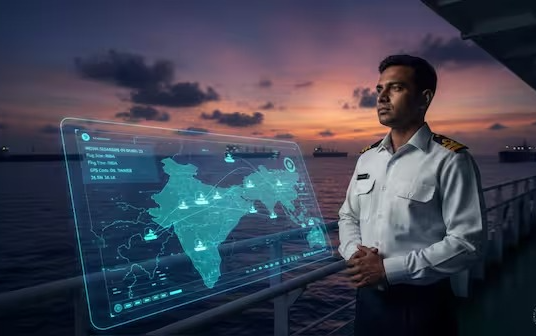
- Recently, the Ministry of Ports, Shipping and Waterways (MoPSW) launched the Seafarer-FiRST initiative with a real-time dashboard to protect Indian seafarers in high-risk maritime regions, including the Strait of Hormuz, Persian Gulf, and Gulf of Oman.
Seafarer-FiRST Dashboard – Key Features
- Developed by: Directorate General of Shipping (DG Shipping) under the Ministry of Ports, Shipping and Waterways (MoPSW).
- Objective: To ensure the safety, welfare, and real-time monitoring of Indian seafarers operating in high-risk maritime zones.
- Coverage: Tracks Indian seafarers on both Indian-flagged and foreign-flagged vessels, particularly in the Persian Gulf, Strait of Hormuz, and Gulf of Oman.
- Real Time Monitoring: Provides vessel-by-vessel tracking of:
- Vessel location
- Ownership details
- Cargo information
- Crew strength and welfare
- Threat perception
- Intended voyage and next port of call
- Availability of food, fuel, medicines, and communication facilities
- Institutional Coordination: Operated round the clock by MoPSW in coordination with the Ministry of External Affairs (MEA), Indian Navy, DG Shipping, and Indian diplomatic missions.
- Family Support: Dedicated liaison officers serve as single points of contact for seafarers’ families, assisting with welfare, repatriation, and legal or contractual issues.
- Compliance Mechanism: Ship owners, managers, and recruitment/placement agencies must submit regular compliance reports ensuring that no Indian seafarer sails without adequate safety information and protective measures.
Key Concepts
Who is a Seafarer?
- A person employed or engaged to work on a merchant ship, including:
- Navigating officers
- Marine engineers
- Deck and engine crew (ratings)
- Catering staff
- Technical personnel
| Directorate General of Shipping (DG Shipping) Established: 1949 Ministry: Ministry of Ports, Shipping and Waterways (MoPSW) Headquarters: Mumbai India’s principal maritime administration responsible for: Merchant shipping regulation Ship registration Seafarer certification and welfare Maritime safety and training Implementation of the Merchant Shipping Act, 1958 Prevention of marine pollution |
Consider the following statements regarding the recently launched 'Seafarer-First' initiative:
1. It is a comprehensive response launched by the Ministry of External Affairs to track Indian citizens stranded in land-locked conflict zones.
2. The real-time operational dashboard under this initiative tracks Indian seafarers only if they are aboard vessels flying the Indian national flag.
3. The tracking scope explicitly covers high-risk maritime zones including the Strait of Hormuz and the Persian Gulf.
Which of the statements given above is/are correct?
A) 1 and 2 only
B) 3 only
C) 2 and 3 only
D) 1, 2 and 3
Answer: B) 3 only
Statement I is Incorrect:
• Launched by the Ministry of Ports, Shipping and Waterways (MoPSW), not the Ministry of External Affairs.
• It tracks Indian seafarers in high-risk maritime zones, not citizens in land-locked conflict areas.
Statement II is Incorrect:
• The dashboard tracks Indian seafarers irrespective of the vessel's flag (Indian or foreign-flagged).
• The word "only" makes the statement incorrect.
Statement III is Correct
• The initiative covers high-risk maritime regions such as the Persian Gulf, Strait of Hormuz, and Gulf of Oman for real-time monitoring of Indian seafarers.