
Context
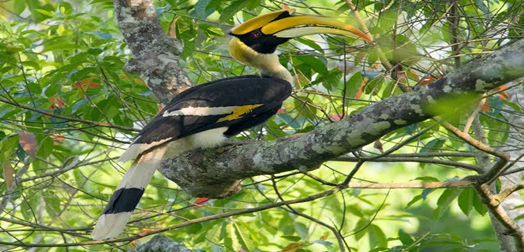
- The Indian Grey Hornbill has recorded four consecutive years of successful breeding in Gir Forest, Gujarat, after being reintroduced in 2021.
- The species had disappeared from Gir during the 1950s–1960s, making this a significant conservation success.
Recent Conservation Success in Gir Forest
- Reintroduction: The Indian Grey Hornbill, locally extinct from Gir since the 1950s–60s, was reintroduced in 2021. A total of 40 birds were released in two phases (28 in 2021–22 and 12 in 2023).
- Monitoring & Outcome: 11 male hornbills were satellite-tagged to track movement, habitat use, and breeding. The species has now recorded four consecutive years of successful breeding, indicating a self-sustaining population.
About Indian Grey Hornbill
- Scientific Name: Ocyceros birostris
- IUCN Status: Least Concern (LC)
- Habitat: Open forests, wooded farmlands, and urban parks across the Indian subcontinent.
- Diet: Mainly fruits, insects, and small reptiles.
Ecological Importance
- A long-distance seed disperser that promotes forest regeneration.
- Helps maintain forest biodiversity and ecosystem health.
About Gir Forest
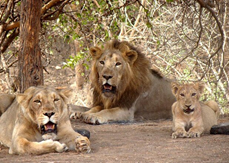
Gir Forest, located in Gujarat, comprises the Gir National Park and Wildlife Sanctuary and is the only natural habitat of the Asiatic Lion (Panthera leo persica). It is a biodiversity hotspot supporting species such as the Leopard, Striped Hyena, Golden Jackal, Marsh Crocodile, and over 300 species of birds.
| Species Reintroduction in India: Other Examples Cheetah reintroduction in Kuno National Park (Madhya Pradesh). Gharial reintroduction in selected river systems. Indian Rhino conservation and translocation under Indian Rhino Vision (IRV). |
Conclusion
The successful revival of the Indian Grey Hornbill in Gir highlights the importance of species reintroduction, scientific monitoring, and habitat conservation, making it a significant topic for UPSC Prelims in Environment and Ecology.
With reference to the Indian Grey Hornbill, consider the following statements:
1. The Indian Grey Hornbill is endemic to the Indian subcontinent.
2. It plays an important ecological role as a long-distance seed disperser.
3. It is currently classified as Endangered under the IUCN Red List.
Which of the statements given above is/are correct?
(a) 1 and 2 only
(b) 2 and 3 only
(c) 1 and 3 only
(d) 1, 2 and 3
Answer :  (a) 1 and 2 only
Explanation
• Statement 1: Correct. The Indian Grey Hornbill (Ocyceros birostris) is native to the Indian subcontinent.
• Statement 2: Correct. It is an important seed disperser, contributing to forest regeneration.
• Statement 3: Incorrect. The species is listed as Least Concern (LC) on the IUCN Red List.
Conclusion
The successful re-establishment of the Indian Grey Hornbill in Gir Forest demonstrates the effectiveness of scientific species reintroduction and habitat conservation. In addition to restoring a locally extinct bird, the project strengthens forest ecosystems by improving seed dispersal and conserving biodiversity.