
Context
- Recently, the Kerala coast near Thiruvananthapuram continues to face severe pollution from nurdles (plastic pellets) even one year after the Liberian-flagged ship MSC Elsa 3 sank off the coast.
1. What are Nurdles?
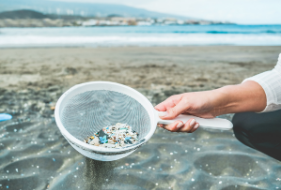
- Definition: Nurdles are tiny, pre-production plastic pellets that serve as the raw material for manufacturing nearly all plastic products.
- Classification: They are classified as primary microplastics because they are intentionally manufactured to be small, unlike secondary microplastics which break down from larger plastic items (like bags or bottles).
- Physical Characteristics: They typically measure between 1 mm to 5 mm in diameter.
- They possess high buoyancy, allowing them to float easily, spread rapidly via ocean currents, and wash ashore over vast distances.
2. Chemical Composition: Polyethylene & PVC
- Materials: Nurdles are primarily made from polymers such as Polyethylene (PE) or Polyvinyl Chloride (PVC).
- Toxicity Profile: In their pure, manufactured form, these polymers are not inherently toxic in themselves.
- Bioaccumulation: Because of their chemical properties, nurdles act like “sponges” in the ocean. They highly attract and concentrate Persistent Organic Pollutants (POPs), heavy metals, and toxins from the surrounding seawater onto their surfaces.
3. Polyethylene vs Polyvinyl chloride
| Feature | Polyethylene (PE) | Polyvinyl chloride (PVC) |
| Flexibility | Highly flexible, lightweight, and ductile. | Naturally rigid and brittle (requires plasticizers to make it flexible). |
| Density & Strength | Lower density; moderate tensile strength. | High density; exceptional structural strength and rigidity. |
| Thermal Properties | Lower melting point; melts easily. | Higher melting point; inherently fire-retardant due to chlorine content. |
| Recycling Challenges | Highly recyclable | Notoriously difficult to recycle |
| Applications | Squeeze bottles, plastic grocery bags, cling wraps, milk jugs, shampoo bottles, agricultural pipes, geomembranes, and pre-production nurdles etc. | Construction pipes (plumbing), window frames, electrical conduits, medical tubing, blood bags, cable insulation, imitation leather, and flooring. |
4. Environmental and Health Footprint
The environmental impacts of these two plastics vary deeply due to their distinct chemical hazards during manufacturing and disposal.
I. Hazardous Byproducts
- PE: Relatively clean to manufacture compared to PVC. It burns to produce carbon dioxide and water if combustion is complete, though incomplete burning releases carbon monoxide and particulate matter.
- PVC: Dubbed the “Poison Plastic.” Throughout its lifecycle (production, use, and disposal), PVC releases highly toxic, bioaccumulative chlorinated organic chemicals, including dioxins and furans (both are persistent organic pollutants or POPs).
II. The Plasticizer Dilemma
- Pure PVC is unusable for flexible products without chemical additives called phthalates. Phthalates are used to soften plastics, making them more flexible or more durable.
- Phthalates are not chemically bound to the PVC matrix and easily leach out into liquids, soils, or the human body.
- They are recognized endocrine disruptors, linked to reproductive anomalies, and are heavily restricted in children’s toys and specific medical devices globally. PE does not require these plasticizers.
With reference to Nurdles Pollution, consider the following statements:
1. Nurdles are classified as primary microplastics because they are intentionally manufactured in small sizes.
2. Polyethylene (PE) requires phthalate plasticizers to become flexible.
3. PVC can release toxic chlorinated compounds like dioxins during its lifecycle.
Which of the statements given above is/are correct?
(a) 1 and 2 only
(b) 1 and 3 only
(c) 2 and 3 only
(d) 1, 2 and 3
Answer:
(b) 1 and 3 only
Explanation:
• Statement 1 is correct: Nurdles are intentionally manufactured tiny plastic pellets and are therefore classified as primary microplastics.
• Statement 2 is incorrect: PVC requires phthalates for flexibility, while PE is naturally flexible and does not require such plasticizers.
• Statement 3 is correct: PVC releases toxic chlorinated compounds such as dioxins and furans during production, use, and disposal.