
Context
- Recently, RBI data showed that India’s net foreign investment sharply fell to –$11.7 billion in March 2026, mainly due to heavy foreign capital outflows after the West Asia geopolitical crisis.
- The decline was caused by massive selling by Foreign Portfolio Investors (FPIs), even though Foreign Direct Investment (FDI) remained positive for the second straight month.
1. Key Data Trends & Macro Insights from the Article
- The Outflow Metrics: Foreign Portfolio Investors (FPIs) pulled out a massive net $-13.3 billion from the Indian markets in March 2026 alone, with the selling streak continuing into April and May.
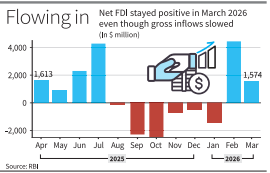
- The FDI Cushion: Net FDI stood positive at 1.6 billion for March 2026, driven by lower levels of profit repatriation and outward FDI by Indian firms. Gross FDI inflows for the month stood at 6.2 billion.
- Macroeconomic Impact: The rapid dollar outflow by FPIs has put immense pressure on the Indian Rupee (depreciation) and has simultaneously eaten into the RBI’s Foreign Exchange (Forex) Reserves as the central bank manages currency volatility.
2. FDI vs. FPI
Understanding the conceptual boundaries between Foreign Direct Investment (FDI) and Foreign Portfolio Investment (FPI) is a high-yield area for Prelims.
1. Foreign Direct Investment (FDI)
- Definition: Investment made by a foreign entity to acquire a lasting management interest (usually defined as 10% or more of the equity shares) in an enterprise operating in India.
- Nature: Long-term, stable, and physical asset-driven (plant, machinery, infrastructure).
- Key Feature: It brings not just capital, but also technology, management expertise, and best practices. It is non-debt creating and cannot be easily liquidated overnight.
- Routes: Can enter via the Automatic Route (no prior government approval required) or the Government Route (requires approval via the Foreign Investment Facilitation Portal administered by DPIIT).
- Regulatory Body: Foreign Direct Investment (FDI) in India is primarily regulated by the Department for Promotion of Industry and Internal Trade (DPIIT) under the Ministry of Commerce and Industry, and the Reserve Bank of India (RBI)
2. Foreign Portfolio Investment (FPI)
- Definition: Investment by non-residents in passive financial assets such as shares, bonds, or derivatives of Indian companies, where the stake is less than 10% of the company’s paid-up capital.
- Nature: Short-term, highly volatile, and liquid transaction capital.
- Key Feature: Popularly referred to as “Hot Money” because investors can easily liquidate their holdings and exit the country at the first sign of global risk aversion or interest rate hikes abroad (as seen during the West Asia crisis).
- Regulatory Body: FPIs are strictly regulated by the Securities and Exchange Board of India (SEBI).
Important Macroeconomic Keywords to Remember
- Hot Money: Foreign Portfolio Investment (FPI) is often referred to as “hot money” because it is highly liquid, driven by short-term profit, and can flee an economy at the first sign of trouble.
- Currency Depreciation: A fall in the value of a currency in a floating exchange rate system due to market forces (high demand for US Dollars relative to the Rupee).
- Foreign Exchange Reserves: Assets held on reserve by a central bank in foreign currencies. In India, it comprises Foreign Currency Assets (FCA), Gold, Special Drawing Rights (SDRs) with the IMF, and the Reserve Tranche Position with the IMF.
With reference to Foreign Direct Investment (FDI) and Foreign Portfolio Investment (FPI), consider the following statements:
1. Foreign Direct Investment (FDI) generally involves a long-term management interest of 10% or more in an enterprise.
2. Foreign Portfolio Investment (FPI) is often called “hot money” because it is highly liquid and can quickly move out during global uncertainties.
Which of the statements given above is/are correct?
(a) 1 only
(b) 2 only
(c) Both 1 and 2
(d) Neither 1 nor 2
Answer:
(c) Both 1 and 2
Explanation:
• Statement 1 is correct: FDI involves a lasting management interest, usually 10% or more equity ownership in a company.
• Statement 2 is correct: FPI is known as “hot money” because investors can rapidly withdraw funds during crises or market instability.