
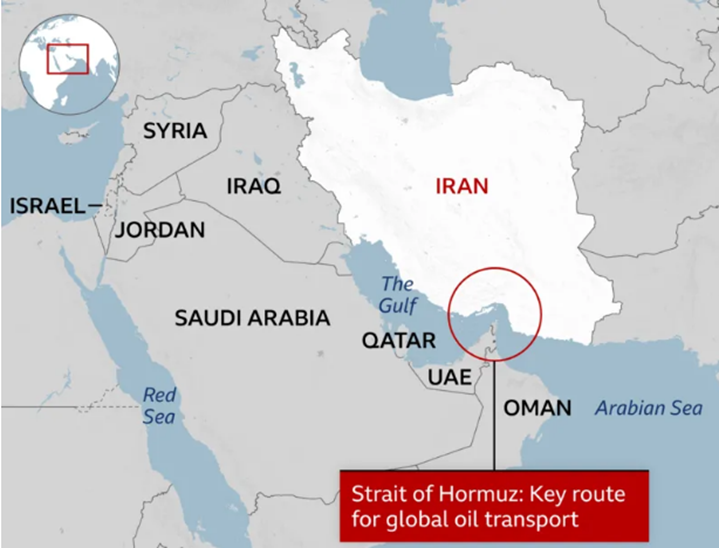
Context
- Recently, the Strait of Hormuz has re-emerged as a major global concern due to escalating tensions between the United States and Iran since February 2026.
- The situation intensified following military strikes, naval blockades, and threats to close the strait, raising serious fears of disruption in global oil and gas supplies.
- The region has witnessed missile and drone attacks on vessels, mining threats, and restrictions on shipping, significantly impacting global energy markets and trade flows.
1. What is a Maritime Chokepoint?
- A maritime chokepoint is a narrow water passage that connects major seas or oceans.
- It serves as an alternative or shorter route for shipping.
- Disruption in chokepoints can:
- Delay shipping
- Increase transport costs
- Disrupt global trade and energy flows
2. Why is the Strait of Hormuz Critical?
- Located between Persian Gulf and Gulf of Oman.
- Acts as the only sea passage for oil exports from major producers like:
- Saudi Arabia
- Iran
- Iraq
- UAE
- Kuwait
- Width: ~21 nautical miles (38 km) at narrowest point.
3. Energy Significance
- Around 21 million barrels/day of oil pass through → ~1/5th of global oil consumption.
- Also major route for Liquefied Natural Gas (LNG), especially from Qatar.
👉 Key Importers:
- India
- China
- Japan
- South Korea
4. Other Key Global Chokepoints
- Strait of Malacca
- Connects Indian Ocean & South China Sea
- Major route for trade between Asia and Europe
- Bab el-Mandeb Strait
- Connects Red Sea to Gulf of Aden
- Important for access to Suez Canal
- Suez Canal
- Artificial waterway in Egypt
- Connects Mediterranean Sea & Red Sea
- Shortens Europe–Asia trade route
- Panama Canal
- Connects Atlantic & Pacific Oceans
- Avoids long journey around South America
5. International Law (UNCLOS)
- Governed by United Nations Convention on the Law of the Sea (UNCLOS)
Key Principle: Transit Passage
- Applies to international straits like Hormuz
- Allows:
- Continuous and uninterrupted navigation
- Applies to all ships and aircraft
Limitations: Countries along the strait can regulate shipping for safety and environmental reasons, but they cannot stop ships from passing through or impose selective restrictions.
With reference to the Strait of Hormuz and international law, consider the following statements:
1.	Under the United Nations Convention on the Law of the Sea, the Strait of Hormuz is classified as an international strait where the right of transit passage applies.
2.	Transit passage allows continuous and uninterrupted navigation for all ships and aircraft through such straits.
3.	Coastal states have the authority to suspend transit passage in international straits for security reasons.
Which of the statements given above are correct?
(a) 1 and 2 only
(b) 2 and 3 only
(c) 1 and 3 only
(d) 1, 2 and 3
Answer: A
Explanation:
•  Statement 1 is Correct: Under the United Nations Convention on the Law of the Sea (UNCLOS), the Strait of Hormuz is classified as a "strait used for international navigation." For such straits, the regime of Transit Passage applies, allowing vessels and aircraft to move through the territorial waters of coastal states (Iran and Oman) for the purpose of continuous and expeditious transit between one part of the high seas (or an EEZ) and another.
•  Statement 2 is Correct: Transit Passage is a more liberal regime than "Innocent Passage." It allows for continuous and uninterrupted navigation or overflight solely for the purpose of transit. Crucially, for submarines, it implies the right to transit submerged, and for aircraft, it includes the right to fly through the international airspace above the strait.
•  Statement 3 is Incorrect: Under UNCLOS (specifically Article 44), coastal states bordering international straits shall not hamper or suspend transit passage. Unlike "Innocent Passage" in a country's territorial sea (which can be suspended temporarily for security), the right of transit passage through international straits is non-suspendable.