
After Reading This Article You Can Solve This UPSC Mains Model Question:
Regulation of online speech in India increasingly reflects a tension between security and liberty.” Discuss. 10 Marks (GS 2 Polity)
Context
In recent years, the Union government’s approach towards regulating online content has become increasingly assertive. Through amendments to the Information Technology (Intermediary Guidelines and Digital Media Ethics Code) Rules, 2021 and expansive use of provisions under the Information Technology Act, 2000, the State has acquired significant control over digital discourse.
While the stated objective is to curb misinformation, unlawful content, and emerging threats such as AI-generated manipulation, the manner of enforcement has raised serious concerns regarding freedom of speech, institutional accountability, and democratic norms.
Legal Architecture and Its Evolution
The legal basis of online content regulation lies primarily in two provisions:
- Section CUA: Empowers the government to block public access to information on grounds such as sovereignty, integrity, and public order.
- Section 7U(3)(b): Removes “safe harbour” protection from intermediaries if they fail to act upon knowledge of unlawful content.
Originally, these provisions were meant to function within a narrow and procedurally safeguarded framework. This was clarified by the Supreme Court in Shreya Singhal vs Union of India, which held that intermediaries are required to act only upon receiving:
- A court order, or
- A legally valid government notification.
This judgment was crucial in preventing arbitrary censorship and protecting Article 1U(1)(a).
However, current practices suggest a shift from rule-of-law-based regulation to executive-driven enforcement, often without the procedural safeguards envisaged by the Court.
Nature of the Emerging Problem
1. Compression of Response Time and Coercive Compliance
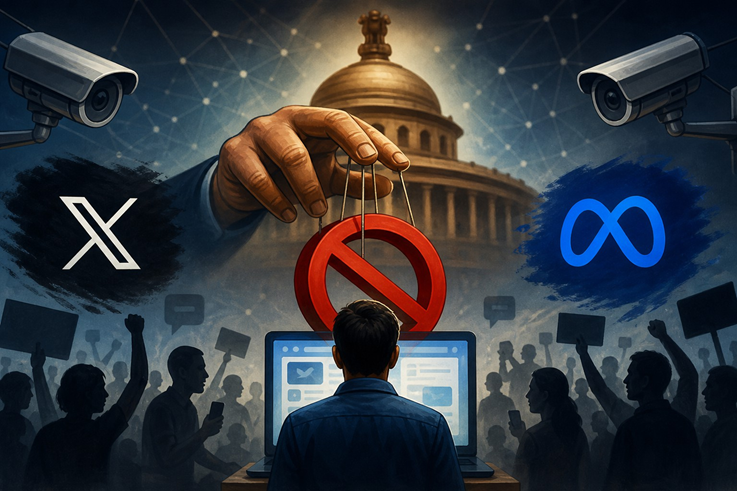
Digital platforms such as Meta and X are reportedly required to remove flagged content within extremely short timeframes (as little as three hours).
In such a scenario:
- Platforms are left with no realistic opportunity to assess legality.
- The fear of losing safe harbour protection or facing criminal liability leads to over-compliance.
This transforms intermediaries into agents of state censorship rather than neutral platforms.
2. Expansion of Executive Power Without Legislative Backing
Mechanisms like the Sahyog portal—which allow law enforcement agencies across the country to send takedown requests—have effectively expanded censorship infrastructure.
The critical issue here is:
- These powers are being exercised without explicit parliamentary sanction.
- This undermines the principle of separation of powers, where lawmaking should remain within the domain of the legislature.
3. Opacity and Absence of Transparency
- Number of takedown orders
- Nature of content removed
- Grounds invoked
One of the most serious democratic deficits is the lack of publicly available data on:
This secrecy creates:
- Information asymmetry
- Lack of accountability
- Difficulty in judicial or public scrutiny
4. Chilling Effect on Free Speech
The cumulative impact of these measures is a “chilling effect”, where individuals refrain from expressing critical opinions due to fear of:
- Account suspension
- Legal consequences
- Loss of livelihood (especially for digital creators)
Importantly, this does not only affect unlawful speech but also legitimate political dissent, satire, and investigative journalism.
5. Institutional Concerns and Judicial Response
There are growing concerns that:
- Lower courts have, at times, failed to strictly enforce the precedent laid down in Shreya Singhal.
- The executive has avoided formal legislation, possibly to circumvent deeper scrutiny and debate.
This creates a situation where constitutional protections exist in theory but weaken in practice.
6. Risk of Political Misuse Across Regimes
A particularly important dimension is that such tools are politically neutral in structure but politically exploitable in practice.
- Today’s ruling party may benefit from narrative control.
- Tomorrow’s opposition, once in power, may use the same mechanisms.
Thus, the issue is not partisan but systemic, raising long-term concerns for democratic resilience.
Government’s Justification: A Necessary Counterpoint
It is important to acknowledge that the State’s concerns are not entirely unfounded. The digital ecosystem today faces:
- Rapid spread of misinformation and deepfakes
- Threats to national security
- Online radicalisation and communal tensions
In such a context, the government argues that:
- Speed is essential in content moderation
- Traditional legal processes may be too slow for digital harms
However, the key issue is not the existence of regulation, but the manner and extent of its exercise.
Way Forward
A more balanced and constitutionally sound approach would require:
- Legislative Backing
Any expansion of state power in digital regulation must be debated and enacted through Parliament, ensuring democratic legitimacy.
- Strengthening Judicial Oversight
Takedown mechanisms should involve:
- Independent review
- Time-bound appellate processes
- Transparency and Disclosure Regular publication of:
- Takedown statistics
- Legal grounds
- Compliance reports
- Platform Accountability with Due Process Intermediaries should:
- Avoid blind compliance
- Develop robust internal review systems
- Digital Rights Framework
India needs a comprehensive framework that balances:
- Security concerns
- Fundamental rights
- Technological realities
Conclusion
The regulation of online speech sits at the intersection of technology, law, and democracy. While the State has a legitimate role in addressing digital harms, the concentration of unchecked power risks eroding the very democratic values it seeks to protect.
If left unaddressed, such trends could gradually transform India’s digital public sphere into a controlled and homogenised space, undermining pluralism and dissent. The challenge, therefore, lies in crafting a framework that is effective yet restrained, powerful yet accountable, and firm yet constitutionally grounded