
Context
- Recently, Russia deployed its nuclear-capable hypersonic Oreshnik missile to launch a massive bombardment against the Ukrainian capital of Kyiv, marking the third time Moscow has utilized this specific weapon system during the course of the war. According to reports from the ground, the strike was part of one of the largest aerial barrages involving an estimated 600 drones and 90 missiles.
- The Russian Army confirmed the deployment, stating it was carried out in response to Ukrainian strikes on civilian infrastructure within Russian-occupied eastern territory, while Ukrainian authorities reported significant damage to residential areas, schools, and utility facilities.
1. Key Features & Technical Specifications of Oreshnik Missile
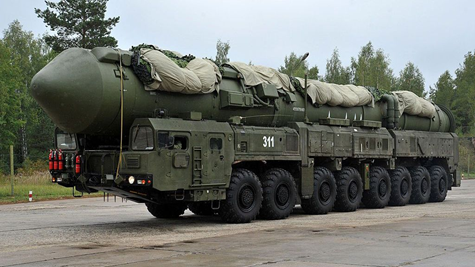
- System Classification: The Oreshnik (meaning “Hazelnut” or “Hazel Shrub” in Russian) is classified as a road-mobile, solid-fueled Intermediate-Range Ballistic Missile (IRBM).
- Operational Range: The missile possesses an estimated range varying between 3,500 kilometers and 5,470 kilometers. This strategic range enables the system to target nearly all major capital cities across Europe from launch positions located deep within the territory of western Russia.
- Hypersonic Velocity: Upon atmospheric re-entry, the missile reaches speeds exceeding Mach 10 (which translates to approximately 12,300 kilometers per hour or nearly 13,000 kilometers per hour at peak flight). Because it travels at faster-than-hypersonic speeds through the upper atmosphere, it leaves a minimized reaction window for terminal interception.
- Payload Delivery System (MIRV Technology):
- The most distinct feature of the Oreshnik is its integration of Multiple Independently Targetable Reentry Vehicle (MIRV) capability.
- During the terminal phase, a specialized maneuvering payload section (“bus”) separates and releases six distinct warheads.
- Each of these six warheads can further split into multiple submunitions, enabling a single missile to accurately overwhelm and destroy multiple independent targets simultaneously.
- Dual-Capable Warheads: The system is explicitly designed to function with dual capability, meaning it can carry either conventional high-explosive payloads or nuclear warheads.
- Structural Lineage: Global defense experts and intelligence assessments indicate that the Oreshnik is not an entirely novel system, but rather an optimization of the discontinued RS-26 Rubezh Intercontinental Ballistic Missile (ICBM) program. By modifying the payload bus and removing a booster stage, engineers effectively reduced the range from intercontinental parameters down to intermediate-range parameters.
Q. Consider the following statements regarding the recently discussed ‘Oreshnik’ missile system:
1. It is a solid-fueled, air-launched cruise missile engineered primarily for close-range theater support.
2. It incorporates Multiple Independently Targetable Reentry Vehicle (MIRV) technology capable of dispersing multiple submunitions.
3. Its operational range allows it to hit targets at intermediate distances between 3,500 km and 5,500 km.
Which of the statements given above are correct?
(a) 1 and 2 only
(b) 2 and 3 only
(c) 1 and 3 only
(d) 1, 2 and 3
Solution
Correct Answer: (b) (2 and 3 only)
• STATEMENT 1 IS INCORRECT: The Oreshnik is explicitly classified as a road-mobile, ground-launched ballistic missile, rather than an air-launched cruise missile. Cruise missiles fly continuously within the atmosphere using jet engine propulsion, whereas the Oreshnik follows a ballistic trajectory, reaching high altitudes into the upper atmosphere before descending at hypersonic speeds.
• STATEMENT 2 IS CORRECT: The definitive technical feature of the Oreshnik missile system is its integration of a MIRV payload section. The missile utilizes a maneuvering "bus" that splits into six separate warheads, each dropping multiple submunitions to saturate air defense networks.
• STATEMENT 3 IS CORRECT: The system is categorized precisely as an Intermediate-Range Ballistic Missile (IRBM). Its estimated operational envelope falls between 3,500 km and 5,470 km, filling the strategic gap between shorter medium-range missiles and long-range intercontinental ballistic missiles (ICBMs).