
Context
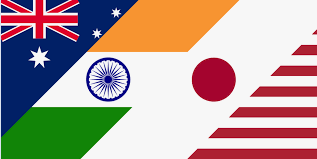
- Recently, the Quadrilateral (Quad) Foreign Ministers’ Meeting was held in New Delhi, hosted by India’s External Affairs Minister S. Jaishankar and attended by ministers from the Japan, United States, and Australia. The meeting gained attention amid debates over the Quad’s relevance due to limited mention in recent strategic policy documents of member countries.
1. Key Agenda Items
- Critical Minerals Initiative: “Cooperation over critical minerals” needed for green energy and high technology is a top priority. Japan is currently working on critical minerals projects in India, pushing for improved infrastructure, tax subsidies, and intellectual property (IPR) protection.
- Geopolitical Flashpoints: The grouping is actively taking stock of:
- The conflict in West Asia and supply chain disruptions.
- The Strait of Hormuz blockade.
- The torpedoing of the Iranian ship IRIS Dena in the Indian Ocean.
- POWERR Asia: Japan proposed the “Partnership On Wide Energy and Resources Resilience” (POWERR Asia). This initiative aims to coordinate oil, gas, and renewables procurement, financing, and storage mechanisms to mitigate energy crises resulting from West Asian conflicts.
- Free and Open Indo-Pacific (FOIP): The core diplomatic driving philosophy behind the grouping to ensure maritime security, economic security, and cyber security.
2. Basics of QUAD
I. What is the Quad?
The Quadrilateral Security Dialogue (Quad) is an informal strategic forum comprising four democracies: India, the United States, Japan, and Australia.
II. Evolution of the Grouping
- 2004: The concept originated as a cooperative response to the devastating Indian Ocean Tsunami (Tsunami Core Group).
- 2007: Formally initiated by Japanese Prime Minister Shinzo Abe. However, it lost momentum shortly after due to Australian hesitation regarding Chinese pushback.
- 2017: Resurrected and rebranded as “Quad 2.0” during the ASEAN Summit, shifting focus firmly toward maintaining a rules-based order in the Indo-Pacific region.
- 2021: The first-ever virtual Leaders’ Summit was held, elevating the dialogue from official/ministerial levels to the head-of-state level.
III. Key Characteristics & Objectives
- Not a Military Alliance: Unlike NATO, the Quad is not a formal, institutionalized military alliance with mutual defense pacts. It describes itself as a “diplomatic partnership.”
- Primary Objective: To support a “Free and Open Indo-Pacific” that is inclusive, rules-based, and free from coercion (subtly countering China’s aggressive expansion in the South China Sea and Indian Ocean).
- The “Spirit of the Quad”: Focuses on functional cooperation across six core working groups:
- Vaccine Partnership and Global Health Security
- Climate Change and Clean-Energy Supply Chains
- Critical and Emerging Technologies (including Critical Minerals)
- Space Cooperation
- Cyber Security
- Maritime Domain Awareness (MDA)
With reference to the Quadrilateral Security Dialogue (Quad), consider the following statements:
1. The Quad is a formal military alliance similar to NATO.
2. The Quad was initially formed in response to the 2004 Indian Ocean Tsunami.
3. One of the major objectives of the Quad is to promote a Free and Open Indo-Pacific (FOIP).
4. China is a founding member of the Quad.
Which of the statements given above are correct?
(a) 1 and 2 only
(b) 2 and 3 only
(c) 1, 3 and 4 only
(d) 2, 3 and 4 only
Answer: (b) 2 and 3 only
Explanation:
• Statement 1 is incorrect: Quad is not a formal military alliance like NATO.
• Statement 2 is correct: It originated from cooperation after the 2004 Indian Ocean Tsunami.
• Statement 3 is correct: FOIP is a core objective of the Quad.
• Statement 4 is incorrect: China is not a member of the Quad.