
Context
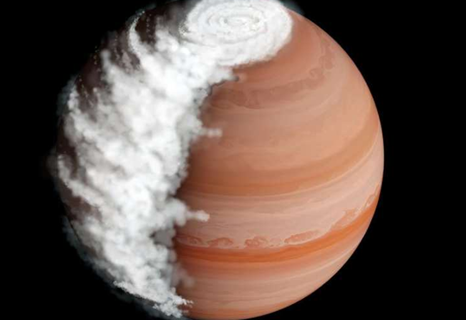
- Recently, a landmark study published in the journal Science, used NASA’s James Webb Space Telescope (JWST) to observe daily cloud cycles and changing weather patterns on the exoplanet WASP-43b for the first time. The discovery provides a more accurate understanding of exoplanet atmospheres and helps scientists improve estimates of their chemical composition.
1. What is WASP-43b?
- A Hot Jupiter exoplanet located about 280 light-years from Earth.
- Similar in size to Jupiter but much closer to its parent star.
- Completes one orbit in approximately 19 hours (less than one Earth day).
- Tidally locked: one side permanently faces the star while the other remains in darkness.
2. Atmospheric Conditions
- Day-side temperatures are high enough to melt rocks.
- Night-side temperatures are significantly cooler.
- Presence of water vapour and cloud formations detected.
- Experiences extreme weather patterns due to temperature differences.
3. Significance of the Research
- Helps scientists understand how planetary systems formed from protoplanetary disks of gas and dust.
- Atmospheric composition reveals a planet’s formation history and original location in the disk.
- Enables comparison between the formation of Hot Jupiters and smaller rocky planets like Earth.
- Provides insights into the early evolution of our Solar System about 4.6 billion years ago.
- Improves understanding of the processes that shape diverse planetary architectures across the universe.
4. About James Webb Space Telescope (JWST)
- Launched by NASA in 2021.
- Joint project of NASA, European Space Agency and Canadian Space Agency.
- Studies the universe primarily in the infrared spectrum.
- Successor to the Hubble Space Telescope.
5. Future Instruments
- Extremely Large Telescope (ELT): Currently being constructed by Europe in northern Chile. Once operational, its main objective will be to discover and analyze “exoplanet nurseries” around distant stars, dramatically increasing the chances of finding extra-solar, Earth-like rocky planets.
With reference to the exoplanet WASP-43b and the James Webb Space Telescope (JWST), consider the following statements:
1. WASP-43b is classified as a Hot Jupiter and is located about 280 light-years from Earth.
2. The planet is tidally locked, with one side permanently facing its parent star.
3. JWST primarily observes the universe in the ultraviolet spectrum.
4. The study of WASP-43b's atmosphere can provide insights into planetary formation and the early evolution of the Solar System.
Which of the statements given above are correct?
A. 1, 2 and 4 only
B. 1 and 3 only
C. 2 and 4 only
D. 1, 2, 3 and 4
Answer: A. 1, 2 and 4 only
Explanation:
• Statement 1 is Correct: WASP-43b is a Hot Jupiter located about 280 light-years away.
• Statement 2 is Correct: It is tidally locked, with one side always facing its star.
• Statement 3 is Incorrect: JWST studies the universe primarily in the infrared spectrum, not ultraviolet.
• Statement 4 is Correct: Atmospheric composition helps scientists understand planetary formation, migration, and Solar System evolution.