
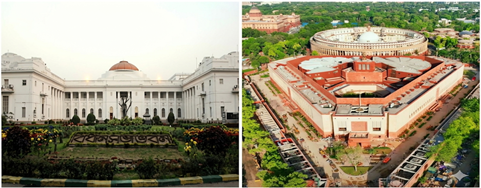
Context
- Recently, an expelled political leader was officially appointed as the Leader of the Opposition (LoP) in the West Bengal Legislative Assembly after proving the physical support of a majority faction of 58 MLAs to the Assembly Speaker.
- This internal party shift and subsequent recognition by the Speaker highlights the critical procedural powers wielded by the Presiding Officer in deciding the official status and leadership of the opposition in a legislative house.
1. Legal Status & Evolution
- Status: It is a statutory post, not a constitutional one.
- Origin: Formally recognized under The Salary and Allowances of Leaders of Opposition in Parliament Act, 1977.
- History: First officially recognized in 1969. The post remained vacant at the central level between 2014 and 2024 as no single opposition party secured the required threshold.
- Rank: Enjoys the rank, salary, and perks equivalent to a Cabinet Minister.
2. Numerical Criteria
- The 10% Quorum Rule: Based on the directions of the Presiding Officers, a party must win at least one-tenth (10%) of the total seats of the House to claim the post.
- No Alliance Aggregation: This 10% requirement must be met by a single political party, not a pre-poll or post-poll coalition.
- Deciding Authority: The Speaker (Lok Sabha/Legislative Assembly) and the Chairman (Rajya Sabha/Legislative Council) hold final recognition powers based on numerical strength and internal party support.
3. Key Functions & Appointment Committees
- Role: Acts as the “Alternative Prime Minister” (or Alternative Chief Minister at the state level), standing ready to form a government if the ruling setup falls.
- Appointment Panels: The LoP of the Lok Sabha is a mandatory member of critical statutory selection committees:
- Lokpal
- Central Vigilance Commission (CVC)
- Central Information Commission (CIC)
- National Human Rights Commission (NHRC)
- CBI Director
- The Single Largest Group Rule: If there is no official LoP due to the 10% rule, amended central acts permit the leader of the single largest opposition party to sit on these panels instead.
4. Global Comparison
- UK System: The United Kingdom uses an official “Shadow Cabinet” where opposition MPs track and scrutinize individual ministerial portfolios.
- Indian System: India does not have an officially instituted or statutory Shadow Cabinet system at either the Central or State levels.
Question: Consider the following statements regarding the office of the Leader of the Opposition (LoP) in India:
Statement-I: The Leader of the Opposition in the Lok Sabha is a constitutional office that must be mandatorily filled after every general election.
Statement-II: The Leader of the Opposition receives statutory recognition and enjoys the rank and status equivalent to a Cabinet Minister under an Act passed in 1977.
Which one of the following is correct in respect of the above statements?
(a) Both Statement-I and Statement-II are correct and Statement-II is the correct explanation for Statement-I
(b) Both Statement-I and Statement-II are correct and Statement-II is not the correct explanation for Statement-I
(c) Statement-I is correct but Statement-II is incorrect
(d) Statement-I is incorrect but Statement-II is correct
Answer: (d)
Solution
• STATEMENT I IS INCORRECT: The position is statutory, not constitutional. It can remain vacant, and it did remain vacant at the federal level from 2014 to 2024 because no single opposition party secured the necessary 10% seats of the total strength of the House.
• STATEMENT II IS CORRECT: The position was officially defined and granted Cabinet Minister rank under The Salary and Allowances of Leaders of Opposition in Parliament Act, 1977.