
Context
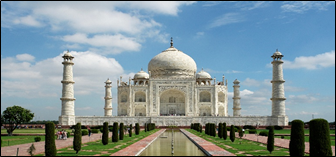
- The Taj Mahal, one of India’s most celebrated UNESCO World Heritage monuments, is back in the news after the Allahabad High Court sought a response from the Centre and the Archaeological Survey of India (ASI) on a plea concerning the monument, renewing public attention on its heritage status and legal protection framework.
About the Case
- A plea before the Allahabad High Court has raised questions relating to the Taj Mahal; the court has issued notices to the Centre and the ASI, seeking their response.
About the Taj Mahal
- Built between 1632 and 1654 by Mughal Emperor Shah Jahan in memory of his wife Mumtaz Mahal; located in Agra, Uttar Pradesh, on the banks of the Yamuna River.
- Chief architect traditionally credited: Ustad Ahmad Lahori.
- Declared a UNESCO World Heritage Site in 1983, recognised for its architectural and artistic universal value.
- Voted one of the New 7 Wonders of the World in 2007 through global public polling.
- Built of white marble, noted for pietra dura (inlay work), calligraphy, and a symmetrical Mughal Charbagh garden layout.
- Protected as a centrally protected monument by the Archaeological Survey of India (ASI), under the Ministry of Culture, per the AMASR Act, 1958.
Strategic/Cultural Significance
- Reinforces India’s standing in global cultural diplomacy and tourism as custodian of a world heritage icon.
- Highlights the ASI’s role in the scientific conservation and statutory protection of monuments of national importance.
- Underlines the judicial oversight mechanisms available for matters concerning protected heritage sites.
About the AMASR Act, 1958
- Governs the protection of monuments and sites of national importance declared by the Centre, and establishes the ASI, under the Ministry of Culture, as India’s premier body for archaeological research and heritage protection.
- A 2010 amendment introduced a 100-metre “prohibited area” and a further 200-metre “regulated area” around protected monuments, restricting construction and mining activity.
About UNESCO
- Overview: A specialized UN agency founded in 1945 (succeeding the International Committee on Intellectual Cooperation), headquartered in Paris, France. It Runs the World Heritage Convention (1972), protecting sites of “Outstanding Universal
- Mission: To strengthen shared humanity and peace through education, science, culture, and communication.
- Membership: 194 member countries and 12 associate members.
- Focus Areas: Education, Natural Sciences, Social & Human Sciences, Culture, and Communication & Information.
- Key Functions: Eradicates illiteracy, promotes free education, and serves as a global hub for knowledge exchange.
- Network: Operates as part of the UN Sustainable Development Group, collaborating closely with NGOs and private companies
- World Heritage: Designates and protects global sites of outstanding universal value…
- India has 44 UNESCO World Heritage Sites (36 Cultural, 7 Natural, 1 Mixed) — 6th highest globally.
Maharashtra has the maximum UNESCO sites in India.
With reference to the Taj Mahal, consider the following statements:
I. It was built during the reign of Mughal Emperor Akbar.
II. It was declared a UNESCO World Heritage Site in 1983.
III. It was voted one of the New7Wonders of the World in 2007.
Which of the statements given above is/are correct?
(a) I and II only
(b) II and III only
(c) I and III only
(d) I, II and III
Answer: (b) II and III only
Explanation:
● Statement I is Incorrect: The Taj Mahal was built under Emperor Shah Jahan, not Akbar.
● Statement II is Correct: It was declared a UNESCO World Heritage Site in 1983.
● Statement III is Correct: It was voted one of the New7Wonders of the World in 2007.