
Context
- A landmark biodiversity expedition known as the Cassai Life Atlas survey, organized by the conservation group The Wilderness Project, has uncovered over 70 new species unknown to science on the remote Lisima plateau in eastern Angola.
- This region is considered one of Africa’s last great “biodiversity blank spots,” historically isolated due to rugged terrain and a 27-year civil war.
1. Major Species Discoveries
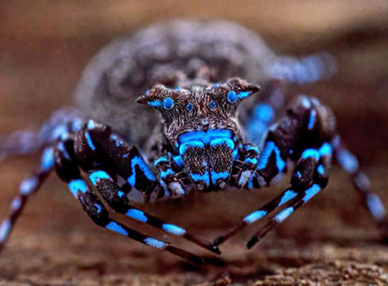
- Fluorescent Crowned Crab Spider (Smodicinus sp. nov.): A major highlight of the expedition; this newly identified arachnid fluoresces a vibrant blue under ultraviolet (UV) light. While the exact evolutionary purpose is still under study, bio-fluorescence in arachnids typically aids in communication, camouflage, or predator avoidance.
- Ladybird Orb-Web Spider (Paraplectana sp. nov.): A new blood-orange-hued spider that utilizes Batesian mimicry, copying the distinct coloration of toxic ladybird beetles to trick predators into thinking it is bitter or toxic.
- Armoured Predatory Cricket: A fierce-looking insect featuring hardened external body plating. As an evolutionary defense mechanism, it can squirt a noxious defensive fluid onto threats.
- Other Taxa: The expedition documented 8 new species of dragonflies/damselflies, 3 new grasshoppers, and roughly 60 new species of butterflies and moths.
| Bio-fluorescence vs. Bioluminescence Bio-fluorescence: The organism absorbs external light (like invisible UV rays) and re-emits it instantly as a different, visible color (e.g., this Crowned Crab Spider glowing blue). It requires an external light source to be seen. Bioluminescence: The organism generates its own light internally through a chemical reaction (e.g., fireflies, certain deep-sea fish) using the enzyme luciferase. It does not require an external light source. |
2. Geographical Significance: The Lisima Plateau
- Location: Located in the eastern highlands of Angola (South-Western Africa).
- The “Water Tower” of Africa: The Lisima plateau acts as a critical hydrological hub. Its unique sandy terrain absorbs rainfall and releases some of the clearest freshwater on the continent, feeding four major African river systems:
- Congo River (Africa’s deepest and second-longest river)
- Zambezi River (Famous for Victoria Falls, flowing into the Indian Ocean)
- Okavango River (Feeds the famous inland Okavango Delta in Botswana)
- Cuanza River (Key domestic river generating significant hydroelectric power for Angola)
- Ramsar Status: Highlighting its ecological weight, the Lisima Lya Mwono area officially gained designation as a Ramsar Wetland of International Importance.
Consider the following statements regarding the Lisima Plateau of Angola:
1. It is known as Africa's "Water Tower" because it feeds several major river systems.
2. The plateau contributes water to the Congo, Zambezi, Okavango, and Cuanza river systems.
3. The Lisima Lya Mwono area has been designated as a Ramsar Wetland of International Importance.
Which of the statements given above is/are correct?
(a) 1 and 2 only
(b) 2 and 3 only
(c) 1 and 3 only
(d) 1, 2 and 3
Answer: (d) 1, 2 and 3
Explanation:
• Statement 1 is Correct: The Lisima Plateau is called Africa's "Water Tower" because it stores rainfall and supplies freshwater to multiple river basins.
• Statement 2 is Correct: It feeds the Congo, Zambezi, Okavango, and Cuanza river systems.
• Statement 3 is Correct: The Lisima Lya Mwono region has been recognized as a Ramsar Wetland of International Importance.