
Context
- A report titled ‘Dark Patterns in India’s Online Marketplaces’, published by the market research firm Datum Intelligence, highlights that deceptive User Interface (UI) and User Experience (UX) designs—collectively known as “dark patterns”—are costing Indian consumers between ₹25,000 crore and ₹28,000 crore annually.
- The report states that nearly 88% of India’s 304 million online shoppers are affected by these practices, losing roughly ₹78–₹87 per month to hidden charges, subscription traps, and forced add-ons.
1. What are Dark Patterns?
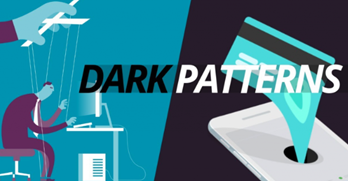
- Dark patterns are manipulative and deceptive digital design strategies used in websites and applications to trick users into doing things they did not originally intend or want to do (e.g., buying unwanted insurance, signing up for hidden subscriptions, or sharing personal data). These practices distort consumer choice and subvert consumer autonomy.
2. Common Types of Dark Patterns
- Drip Pricing: A pricing practice where only part of a product’s cost is disclosed initially, while additional mandatory charges are revealed later during the purchase process.
- False Urgency: Misleading the user by creating a false sense of scarcity or limited time (e.g., fake countdown timers or showing fake limited stock like “Only 2 items left!”) to force an immediate purchase.
- Basket Sneaking: Automatically adding additional items (such as a charity donation, delivery insurance, or an accessory) to the user’s shopping cart at the checkout stage without their explicit consent.
- Forced Action: Compelling a user to take an extra action, such as sharing personal contacts or location details, to access a service that was advertised as free or unrelated.
- Confirm Shaming: It is a dark pattern that uses guilt-inducing or manipulative language to pressure users into making a particular choice, usually accepting an offer or service.
- For example: When a website asks you to subscribe to a newsletter, the decline button may say: “No thanks, I don’t want to save money.” “No, I prefer paying full price.”
- Such wording pressures users into accepting the offer rather than making a neutral choice.
- Subscription Traps: Intentionally making the process of cancelling a subscription or deleting an account excessively complex, long, or hidden.
- Bait and Switch: Advertising a specific product or service at a highly attractive price, but when the user attempts to purchase, replacing it with a different, more expensive alternative.
Regulatory Framework in India
I. Central Consumer Protection Authority (CCPA)
- Statutory Status: The CCPA is a statutory body established under the Consumer Protection Act (CPA), 2019.
- Administrative Ministry: It operates under the Ministry of Consumer Affairs, Food and Public Distribution.
- Mandate: It is empowered to regulate matters relating to the violation of consumer rights, unfair trade practices, and false or misleading advertisements.
II. Guidelines for Prevention and Regulation of Dark Patterns, 2023
- Issued by the CCPA under Section 18 of the Consumer Protection Act, 2019.
- Applicability: These guidelines apply to all digital platforms systematically offering goods or services in India, including advertisers and sellers.
- Legal Classification: Engaging in dark patterns is legally classified as an “Unfair Trade Practice” and a violation of consumer rights under the CPA, 2019.
- Interlinkage with Data Protection: Dark patterns that force users to give up data also violate the Digital Personal Data Protection (DPDP) Act, 2023, which mandates that user consent must be unconditional, explicit, and unambiguous.
MCQ
With reference to Dark Patterns, consider the following statements:
1. They are digital design strategies that manipulate users into making unintended choices.
2. They strengthen consumer autonomy by simplifying decision-making.
3. They may involve hidden subscriptions or unwanted purchases.
Which of the statements given above are correct?
(a) 1 and 2 only
(b) 2 and 3 only
(c) 1 and 3 only
(d) 1, 2 and 3
Answer: (c) 1 and 3 only
Explanation:
• Statement 1 is Correct: Dark patterns are manipulative digital design strategies that trick users into making choices they did not intend.
• Statement 2 is Incorrect: Dark patterns undermine, rather than strengthen, consumer autonomy and informed decision-making.
• Statement 3 is Correct:  Examples include hidden subscriptions, unwanted purchases, basket sneaking, and subscription traps.