
Context
- Recently, U.S. President Donald Trump announced a pause on planned military bombings against Iran, signaling a potential diplomatic deal after hours of intense escalation where he threatened to strike the country “very hard” and explicitly seize Kharg Island and its vital energy infrastructure.
- This critical geopolitical standoff directly highlights Kharg Island’s status as a primary strategic target and a global economic flashpoint.
Overview of Kharg Island
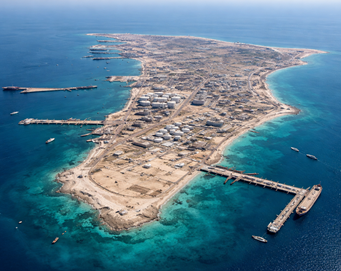
- The Body of Water: Kharg Island is a low-lying, continental island situated in the northern zone of the Persian Gulf.
- Proximity to Mainland: It is located approximately 25 kilometers (16 miles) off the southwestern coast of the Iranian mainland and falls under the administrative jurisdiction of the coastal Bushehr Province.
- Distance from Chokepoints: The island is located about 660 kilometers northwest of the Strait of Hormuz, which serves as the most critical maritime oil transit chokepoint globally.
- Physical Characteristics: Unlike many low sandy islands in the region, Kharg Island is primarily a coral and limestone outcrop that features unique deep-water approaches along its coast, rendering it naturally suitable for large marine vessels. It is also one of the few islands in the Persian Gulf possessing its own natural freshwater supply.
Economic and Infrastructure Significance
- The Backbone of Iranian Exports: Kharg Island operates as the principal maritime terminal for Iran, historically handling up to 90% of the country’s crude oil exports.
- Storage and Logistics: The island hosts a massive concentration of interconnected infrastructure, including specialized marine terminals, extensive pipeline networks linked directly to major inland oilfields (such as Aghajari), and storage facilities capable of holding up to 30 million barrels of crude oil.
- Deep-Water Terminals: The deep coastal waters allow the island to accommodate Very Large Crude Carriers (VLCCs), which are essential for long-distance international energy trade, particularly shipments heading toward major Asian markets like China.
Historical and Archaeological Background
- Ancient Maritime Trade: Because of its position along historic maritime corridors connecting India, Persia, and Mesopotamia, the island served as a critical trading post long before the discovery of fossil fuels.
- Colonial Control: The island was historically occupied and fortified by European colonial powers, including the Portuguese Empire during the 16th and 17th centuries, and subsequently the Dutch East India Company in the 18th century.
- Cultural Heritage: The island preserves several protected archaeological sites, including a 7th-century Christian monastery complex, ancient tombs, and a historic Achaemenid cuneiform inscription dating between 550 BCE and 330 BCE.
Implications for Global Security and India
1. Geopolitical Vulnerability
- Single Point of Failure: Because Iran’s oil export capacities are heavily centralized on this single island, it presents a critical economic vulnerability during periods of military conflict.
- Regional Escalation: Any direct kinetic intervention or prolonged blockade of Kharg Island increases the risk of broader retaliatory measures across the Strait of Hormuz, threatening international merchant shipping and subsea data cables.
2. Impact on Indian Interests
- Energy Security and Price Volatility: Although India has diversified its crude imports, any severe disruptions in the Persian Gulf inevitably trigger global crude price shocks, driving up India’s import bills, fiscal deficit, and domestic inflation.
- Safety of Indian Seafarers: A substantial portion of the commercial vessels operating within the Persian Gulf and the Gulf of Oman employ Indian nationals, making regional military strikes a direct threat to the safety and security of Indian citizens working abroad.
Q. Consider the following statements regarding Kharg Island, which was recently in the news:
STATEMENT I: Kharg Island is a highly strategic continental island located in the northern portion of the Persian Gulf and serves as Iran's primary oil export hub.
STATEMENT II: The island is situated directly within the narrowest corridor of the Strait of Hormuz, making it a natural chokepoint controlled entirely by the Bushehr Province.
Which one of the following is correct in respect of the above statements?
(a) Both Statement I and Statement II are correct and Statement II is the correct explanation for Statement I
(b) Both Statement I and Statement II are correct and Statement II is not the correct explanation for Statement I
(c) Statement I is correct but Statement II is incorrect
(d) Statement I is incorrect but Statement II is correct
Answer and Solution
Correct Answer: (c) Statement I is correct but Statement II is incorrect
• STATEMENT I IS CORRECT: Kharg Island is a critical coral and limestone outcrop situated in the northern end of the Persian Gulf, approximately 25 kilometers off the southwestern mainland of Iran. It handles up to 90% of Iran's crude shipments, confirming its status as the nation's primary oil export hub.
• STATEMENT II IS INCORRECT: While the island is administratively governed by Iran's Bushehr Province, it is not situated directly inside the Strait of Hormuz. Instead, it lies approximately 660 kilometers northwest of the Strait of Hormuz. Therefore, it does not form the physical, narrow chokepoint corridor itself, though its economic output relies on the freedom of navigation through the strait.