
Context
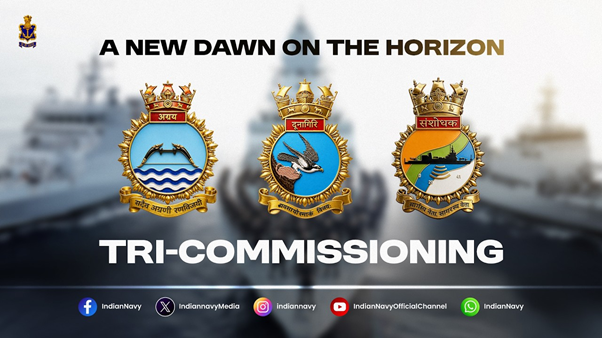
The Prime Minister recently commissioned three technologically distinct, indigenously built naval warships—INS Dunagiri, INS Sanshodhak, and INS Agray—in Kolkata. This historic “tri-commissioning” highlights a major push toward self-reliance, with more than 75% of the components manufactured domestically through Indian shipyards and over 200 MSMEs.
The Three Vessels at a Glance
1. INS Dunagiri — The Blue-Water Stealth Frigate
- Project Classification: Built as an advanced stealth guided-missile frigate under Project 17A.
- Stealth Capability: Engineered with structural modifications to ensure reduced radar cross-section (RCS) and lower sensor visibility.
- Armament & Systems: Equipped with BrahMos surface-to-surface missiles, Medium-Range Surface-to-Air Missile (MRSAM) systems, MFSTAR radar, and advanced electronic warfare suites.
- Strategic Role: Designed for deep-sea blue-water operations against high-intensity conventional and non-conventional threats.
- Sister Ships: Belongs to the same class as INS Nilgiri, Himgiri, Taragiri, Udaygiri, and Vindhyagiri.
2. INS Sanshodhak — The Hydrographic Survey Vessel
- Project Classification: The final ship of the Sandhayak-class Survey Vessels – Large (SVL).
- Technological Payload: Integrated with Autonomous Underwater Vehicles (AUVs), Remotely Operated Vehicles (ROVs), and multi-beam echo sounders.
- Strategic Role: Tasked with underwater hydrographic mapping, measuring ocean depths, plotting navigational routes, and gathering critical oceanographic data.
- Core Significance: Sub-surface mapping is vital for safe submarine route planning, anti-submarine warfare environment assessment, and marine resource tracking.
3. INS Agray — The Littoral Anti-Submarine Hunter
- Project Classification: An Anti-Submarine Warfare Shallow Water Craft (ASW SWC) belonging to the Arnala-class.
- Armament Payload: Fitted with lightweight torpedoes, indigenous anti-submarine rocket launchers, and specialized hull-mounted sonars.
- Strategic Role: Specifically optimized to detect, track, and neutralize enemy submarines in noisy, acoustically cluttered coastal zones and littoral waters near ports and naval bases.
Stragic Significance
· Layered Naval Defense: The simultaneous induction builds a multi-layered security umbrella spanning deep-sea combat (Dunagiri), hydrographic intelligence (Sanshodhak), and coastal defense (Agray).
· Strategic De-hyphenation: Projecting advanced naval platforms helps India frame itself as a Vishwabandhu (global benefactor) offering non-threatening public goods to secure the Indo-Pacific region.
· Industrial Boost: Complements multi-ministerial infrastructure goals like the Sagarmala Project and the newly announced ₹70,000 crore incentive package designed to expand domestic shipbuilding capacity and reduce maritime logistics costs.
With respect to the recently commissioned naval warships, consider the following statements:
I. INS Dunagiri is an advanced stealth guided-missile frigate developed under Project 17A for deep-sea operations.
II. INS Sanshodhak is an Arnala-class vessel optimized for hunting enemy submarines in shallow coastal waters.
III. The Sandhayak-class platforms are primarily designated as large hydrographic survey vessels to map sub-surface marine terrain.
Which of the statements given above is/are correct?
(a) I and II only
(b) II and III only
(c) I and III only
(d) I, II, and III
Answer: C
Explanation:
Statement I is correct: INS Dunagiri is a stealth guided-missile frigate developed under Project 17A, specifically designed with signature-reduction technologies to undertake deep-sea blue-water combat operations.
Statement II is incorrect: INS Sanshodhak is the final ship of the Sandhayak-class Survey Vessels – Large (SVL) intended for hydrographic mapping, not an anti-submarine shallow watercraft.
Statement III is correct: The Sandhayak-class platforms (including INS Sanshodhak) are explicitly designated to perform hydrographic surveys, mapping water depths, navigational routes, and seabed topography.