
Context
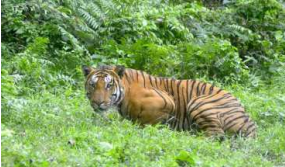
- According to the State Forest Department’s recent data validated by the Wildlife Institute of India (WII), the tiger population at the Nameri Tiger Reserve in Assam has quadrupled over a three-year period, rising from just 3 tigers in 2022 to 12 by the end of 2025.
Key Highlights & Data Points
- Population Growth: The four-fold increase builds directly upon the baseline of three striped cats recorded during the All India Tiger Estimation (AITE) of 2022.
- Reclamation of Satellite Core: Tigers have successfully returned to the contiguous Sonai Rupai Wildlife Sanctuary (which serves as Nameri’s satellite core) after being declared locally extinct there in the early 2000s.
- Kaziranga status: Known primarily for its one-horned rhinoceros, Kaziranga also has one of India’s highest tiger densities (13.44 tigers per 100 sq. km).
Geographic & Ecological Profile of Nameri
- Location: Covers an area of 344 square km in the Sonitpur district of north-central Assam.
- Inter-State Contiguity: It shares a continuous northern boundary with the Pakke Tiger Reserve, located in Arunachal Pradesh.
- The Jia Bhoroli River flows through the reserve.
Broader Tiger Landscape in Assam
- Nameri Tiger Reserve
- Orang Tiger Reserve
- Kaziranga Tiger Reserve (Also a designated UNESCO World Heritage Site)
- Manas Tiger Reserve (Also a designated UNESCO World Heritage Site).
About the All India Tiger Estimation (AITE)
- Conducted every four years.
- Coordinated by the National Tiger Conservation Authority (NTCA) and the Wildlife Institute of India (WII).
About WII
- Established: 1982
- Location: Dehradun, Uttarakhand
- Ministry: Ministry of Environment, Forest and Climate Change (MoEFCC)
- Type: Autonomous institution
With reference to Nameri Tiger Reserve, consider the following statements:
1. It is located in Assam and shares a boundary with Pakke Tiger Reserve in Arunachal Pradesh.
2. The Jia Bhoroli River flows through the reserve.
3. It is a UNESCO World Heritage Site.
Which of the statements given above is/are correct?
(a) 1 and 2 only
(b) 2 and 3 only
(c) 1 and 3 only
(d) 1, 2 and 3
The correct answer is (a) 1 and 2 only.
Explanation of Statements:
• Statement 1 is correct: Nameri Tiger Reserve is located in the Sonitpur district of Assam and shares a continuous northern boundary with the Pakke Tiger Reserve in Arunachal Pradesh.
• Statement 2 is correct: The Jia Bhoroli River (along with its tributaries) flows through the reserve and is considered the lifeline of the national park, providing crucial riverine ecosystems and serving as a major spot for ecotourism activities like river rafting.
• Statement 3 is incorrect: Nameri is not a UNESCO World Heritage Site. Out of the four tiger reserves in Assam (Kaziranga, Manas, Nameri, and Orang), only Kaziranga and Manas hold the designation of UNESCO World Heritage Sites.