
Context
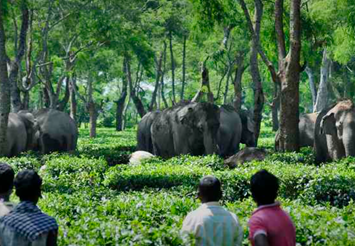
- Recently, The Centre for Wildlife Studies (CWS) study found that rainfall is the key driver of elephant movement in the southern Western Ghats, with vegetation and human land use also influencing elephant occurrence and human-elephant conflict.
Key Findings
- Rainfall as a Primary Driver: Variations in rainfall directly affect forage and water availability, shaping elephant migration and space-use patterns.
- Complex Land-Use Dynamics: In Karnataka, a positive association was found between human settlements and elephant presence. Elephants demonstrate a high threshold of tolerance toward human pressure before retreating.
- Habitat Fragmentation (2012–2022): Land-cover mapping indicated a 31% increase in human settlements in Karnataka and a 16% increase in Kerala, accompanied by a corresponding decline in dense forest vegetation.
- Predictability Shift by 2030: Predictive models indicate that by 2030, due to escalating climate and land-use changes, elephant movement patterns will become highly fragmented and increasingly unpredictable.
- Study Geographies: The research was anchored around major ecologically sensitive zones:
- Karnataka: Bandipur National Park and Nagarahole National Park.
- Kerala: Palakkad and Mannarkkad forest divisions.
Core Concepts
A. Asian Elephant (Elephas maximus) Conservation Status
- IUCN Red List: Endangered.
- Wildlife Protection Act (WPA), 1972: Schedule I (afforded the highest level of legal protection).
- CITES: Appendix I.
- Key Characteristics:
- They have highly complex social structures led by the oldest female (Matriarch).
- They have the longest gestation period of any mammal (18 to 22 months).
B. Project Elephant & Key Initiatives
- Project Elephant: Launched in 1992 as a Centrally Sponsored Scheme to protect elephants, their habitats, and migratory corridors.
- Elephant Corridors: Narrow strips of land allowing elephants to move between secure habitats. Fragmentation of these corridors is the leading cause of Human-Elephant Conflict (HEC).
- MIKE Program (Monitoring the Illegal Killing of Elephants): An international collaboration mandated by CITES to monitor trends in elephant poaching.
C. Protected Areas Highlighted in the Study
| Protected Area | State | Key Features |
| Bandipur National Park | Karnataka | Part of the Nilgiri Biosphere Reserve. Separated from Nagarahole by the Kabini Reservoir. |
| Nagarahole National Park | Karnataka | Also known as Rajiv Gandhi National Park. Vital corridor linking the Western Ghats and Eastern Ghats. |
| Silent Valley National Park | Kerala | Located adjacent to the Palakkad/Mannarkkad divisions; famous for the endangered Lion-tailed Macaque. |
| About the Western Ghats One of the eight “Hottest Hotspots” of Biodiversity. Recognised as a UNESCO World Heritage Site. Extends through Gujarat, Maharashtra, Goa, Karnataka, Kerala and Tamil Nadu. Origin of many major peninsular rivers such as Godavari, Krishna, Kaveri and Periyar. Home to India’s largest contiguous elephant landscape. |
With reference to the recent study on elephant movement in the southern Western Ghats, consider the following statements:
1. Rainfall was identified as the strongest environmental factor influencing elephant occurrence.
2. Elephants completely avoid human-dominated landscapes.
3. Dense vegetation enhances elephant movement and habitat use.
Which of the statements given above is/are correct?
A. 1 only
B. 1 and 3 only
C. 2 and 3 only
D. 1, 2 and 3
Answer: B
Explanation:
• Statement 1 is correct: The study identified rainfall as the strongest environmental factor affecting elephant occurrence.
• Statement 2 is incorrect: The study found that elephants continue to use human-modified landscapes, avoiding them only when disturbance becomes excessive.
• Statement 3 is correct: Dense vegetation supports elephant movement and habitat use.