
Context
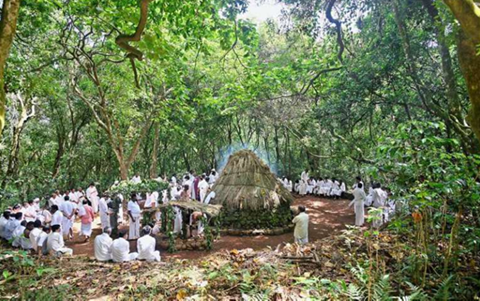
- Members of the Badaga community in the Nilgiris, Tamil Nadu, recently celebrated their traditional harvest festival, Devva Habba, at a sacred forest temple (banagudi) in Udhagamandalam (Ooty).
Who are the Badagas?
- Location: They are the largest indigenous ethno-linguistic group residing in the Nilgiri Hills (Blue Mountains) of Tamil Nadu, living across nearly 400 distinct hill hamlets known as Hattis.
- Linguistic Profile: They speak Badaga (Badugu), a distinct Dravidian language closely related to 16th-century Old Kannada. It has no unique script of its own and is typically written using the Kannada script.
- Socio-Economic Profile: Traditionally known as the agriculturists of the Nilgiris plateau, they revolutionized small-scale highland tea farming, alongside the cultivation of millets, potatoes, and cabbage.
- Inter-tribal Relations: Historically, the Badagas maintained a complex socio-ecological symbiosis with other Nilgiri tribes, including the Toda (pastoralists), Kota (artisans), and Kurumba (forest dwellers/honey-gatherers).
About Devva Habba & Rituals
- Devva Habba is a traditional harvest festival celebrated by the Badaga tribe of the Nilgiri Hills in Tamil Nadu.
- It is observed to express gratitude for a successful harvest and to seek blessings for prosperity and well-being.
- The festival begins with the ritual of Niligolu, in which sacred fire is traditionally produced by friction using wooden sticks or stones (Chikkimukki kallu).
- The sacred fire is then used to boil milk and cook barley (ganje).
- The ritual feast, prepared without salt or sugar, is offered to the ancestors.
- The celebrations are marked by community prayers, folk songs, and traditional dances.
- Members from several Badaga villages participate in the festivities.
Legal & Constitutional Dimension: The ST Status Debate
- Current Status: The Badaga community is classified under the Other Backward Classes (OBC) category in Tamil Nadu.
- Historical Classification: They were designated as an “important primitive tribe” in the 1931 Census during the British Raj and retained the status in the 1951 Census before being de-scheduled.
- Recent Judicial Ruling (March 2025): The Madras High Court dismissed a petition seeking a revised proposal for their ST status, noting that the Registrar General of India (RGI) did not concur with their inclusion in the Scheduled Tribes list due to a lack of traditional tribal vulnerability.
With reference to the Badaga community and Devva Habba festival, consider the following statements:
1. The Badagas are the largest indigenous ethno-linguistic community of the Nilgiri Hills.
2. Badaga is an Indo-Aryan language written in the Tamil script.
3. Devva Habba begins with the ritual of Niligolu, in which sacred fire is produced by friction.
4. The Badaga community is currently classified as a Scheduled Tribe in Tamil Nadu.
Which of the statements given above is/are correct?
(a) 1 and 3 only
(b) 1, 2 and 4 only
(c) 2 and 3 only
(d) 1, 3 and 4 only
Answer: (a) 1 and 3 only
Explanation
• Statement 1 is correct: The Badagas are the largest indigenous ethno-linguistic group in the Nilgiri Hills.
• Statement 2 is incorrect: Badaga is a Dravidian language and is generally written in the Kannada script.
• Statement 3 is correct: The festival begins with Niligolu, a ritual involving the production of sacred fire through friction.
• Statement 4 is incorrect: The Badagas are currently included in the OBC category, not the Scheduled Tribes list.