
Context
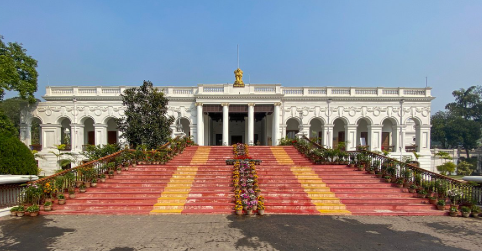
- Recently, the Union Home Minister inaugurated “Shabdalok” (also known as the Museum of Word), which stands as India’s first immersive language museum.
- Developed by the National Library under the aegis of the Union Culture Ministry at the National Library campus in Kolkata, the institution is designed to celebrate India’s rich linguistic heritage and preserve its cultural virasat (heritage).
Key Highlights
- The museum has been established at the National Library campus, Kolkata.
- The museum has been developed under the “Bhasha Shakti” initiative.
- It seeks to preserve and promote India’s rich linguistic and cultural diversity.
- The museum’s first phase comprehensively chronicles the vast diversity of Indian languages, scripts, and literature. It celebrates all 22 official languages recognized under the Eighth Schedule of the Indian Constitution.
Architectural & Operational Framework
- Thematic Layout: The museum structure features nine distinct galleries, each exploring separate facets of language history, developmental milestones, and their profound influence on Indian civilization and culture.
- Technological Interventions: To shift away from traditional display cases and actively engage visitors, Shabdalok integrates:
- Digital Displays for dynamic text and timeline mapping.
- Holograms to recreate historical linguistic contexts.
- Motion-Sensor Technology to provide responsive, interactive cultural experiences.
What is an Immersive Museum?
- An immersive museum uses technologies such as:
- Virtual Reality (VR).
- Augmented Reality (AR).
- Projection mapping.
- Interactive displays.
- Audio-visual experiences.
- It allows visitors to engage with exhibits in an interactive and experiential manner.
About the National Library of India
- The National Library is located in Kolkata, West Bengal.
- It is the largest library in India by volume and public records.
- It functions under the Ministry of Culture.
- The library traces its origins to the Imperial Library, established in 1903.
- It was formally inaugurated as the National Library in 1953.
- It serves as the repository of books published in India under the Delivery of Books and Newspapers (Public Libraries) Act, 1954.
Constitutional Framework of Languages
- Part XVII (Articles 343 to 351): Deals with the official languages of the Union, Regional languages, and Languages of the Supreme Court/High Courts.
- Article 351 (Directive for Development of the Hindi Language): Directs the Union to promote the spread of Hindi so it can serve as a medium of expression for all elements of the composite culture of India, drawing primary vocabulary from Sanskrit and secondarily from other languages.
- Eighth Schedule: Originally contained 14 languages; currently contains 22. Notable amendments include:
- 21st Amendment Act, 1967: Added Sindhi.
- 71st Amendment Act, 1992: Added Konkani, Manipuri, and Nepali.
- 92nd Amendment Act, 2003: Added Bodo, Dogri, Maithili, and Santhali.
With reference to the Bharatiya Bhasha Anubhav Museum, consider the following statements:
1. It is India’s first immersive museum dedicated to languages and linguistic traditions.
2. It has been developed under the Ministry of Home Affairs.
3. The museum aims to preserve India’s linguistic heritage through digital and AI-driven technologies.
Which of the statements given above is/are correct?
(a) 1 and 2 only
(b) 2 and 3 only
(c) 1 and 3 only
(d) 1, 2 and 3
Answer: (c) 1 and 3
Explanation:
• Statement 1 is correct: The Bharatiya Bhasha Anubhav Museum is India’s first immersive language museum.
• Statement 2 is incorrect: The museum has been inaugurated under the aegis of the Ministry of Culture.
• Statement 3 is correct: It employs digital technologies, multimedia and AI-driven exhibits to preserve and showcase India’s linguistic heritage.