
Important for GS Prelims- Governance and Environment
About NMPB
- The National Medicinal Plants Board (NMPB) operates as the apex national body steering policy, planning, and sectoral growth for medicinal plants across India.
- Functioning within the Ministry of Ayush, it serves as the connecting thread between central schemes, state administrations, research bodies, and academic institutions engaged with herbal flora.
- Its mandate covers protecting wild medicinal plant populations, encouraging their cultivation, overseeing domestic trade, and strengthening India’s export standing in this sector.
Key Facts
| Particular | Details |
| Established | Created through a Government Resolution issued on 24 November 2000; became operational from FY 2000-01. |
| Parent Ministry/Body | Ministry of Ayush, formerly housed within the AYUSH Department under the Ministry of Health & Family Welfare. |
| Secretariat/Headquarters | Red Cross Road, New Delhi. |
| Composition/Chairperson | Steered by a Project Approval Committee (PAC) under the Secretary, Ministry of Ayush; the Chief Executive Officer (CEO) acts as Member Secretary, joined by representatives from partner ministries, industry, scientific bodies, and farming communities. |
| Nature | National-level apex body for coordination and advisory functions. |
| Legal/Administrative Framework | Functions under the 2000 resolution and implements the Central Sector Scheme for Conservation, Development and Sustainable Management of Medicinal Plants (CSS). |
Key Responsibilities/Functions
- Aligns implementation of schemes across ministries, states, and forest/agriculture departments.
- Monitors demand-supply trends domestically and globally to build herbal sector market intelligence.
- Advises central and state governments on policy formulation, farming contracts, and conservation approaches.
- Backs research initiatives, clinical trials, and improved agro-practices to raise botanical yields.
- Supports market linkages, processing infrastructure, storage, and logistics for cultivators and forest-based collectors.
- Sets national standards for cultivation and collection practices to improve global quality perception of Indian botanicals.
Related Bodies/Standards Adopted
- State Medicinal Plants Boards (SMPBs) implement national-level directives at the state level.
- Regional Cum Facilitation Centres (RCFCs), based within universities and scientific institutes, guide SMPBs, distribute planting material, and oversee field-level projects.
- Quality Council of India (QCI) collaborates with NMPB on building certification frameworks for quality assurance.
- The Voluntary Certification Scheme for Medicinal Plants Produce (VCSMPP), rolled out on 22 November 2017 jointly with QCI, certifies botanical produce.
- Standards for Good Agricultural Practices for Medicinal Plants (GAP-MP) and Good Field Collection Practices (GFCP) were developed in reference to World Health Organization (WHO) norms to secure safety and traceability.
Conclusion
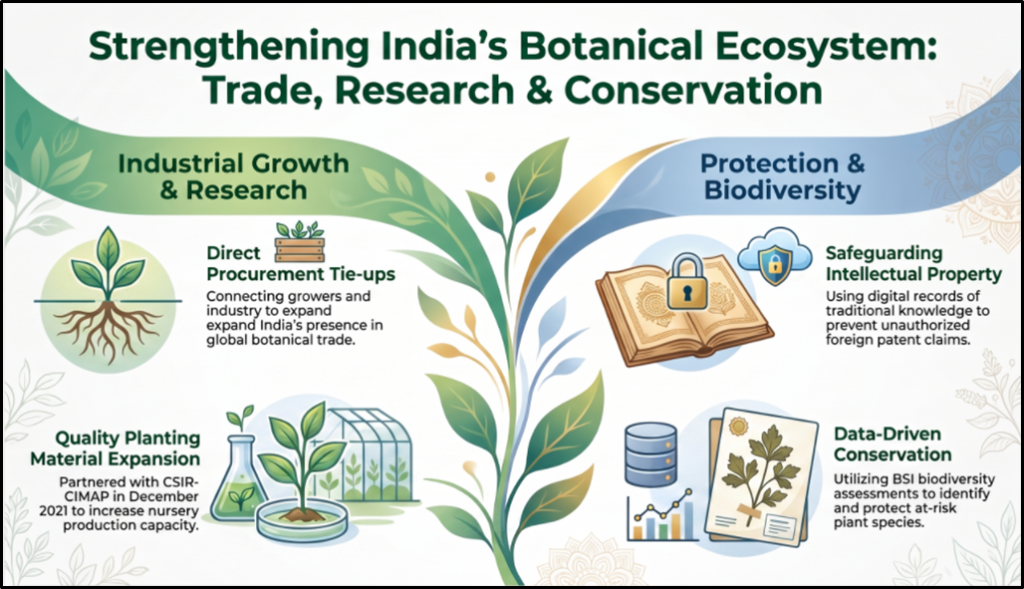
The National Medicinal Plants Board functions as the institutional backbone moving India’s forest-derived medicinal wealth toward an organised, certifiable, and export-ready sector. Through combined efforts in conservation, quality standard-setting, and trade facilitation, it sustains both ecological balance and the economic interests of rural cultivators dependent on this industry.
| This/these Concept has been elaborately discussed in the following article PIB- Promotion of Medicinal Plants under NMPB |