
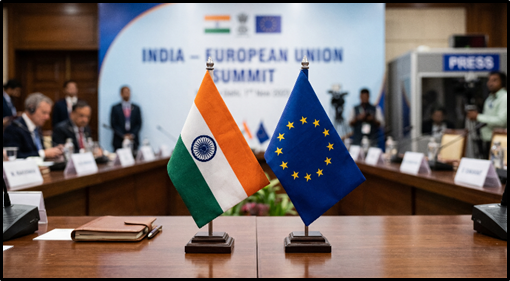
Important for GS Prelims: International Relations
About
- The 16th India–EU Summit was a bilateral summit held between India and the European Union, marking the conclusion of the long-negotiated India–EU Free Trade Agreement (FTA).
- Co-chaired by Indian Prime Minister Narendra Modi, European Council President António Costa, and European Commission President Ursula von der Leyen.
- Core objective was to seal the FTA and adopt a comprehensive strategic roadmap (“Towards 2030”) spanning trade, security, technology, and connectivity.
Key Facts
| Particular | Details |
| Number/Edition | 16th India–EU Summit |
| Date | January 27, 2026 |
| Venue | Hyderabad House, New Delhi |
| Participating Leaders | Narendra Modi, António Costa (European Council President), Ursula von der Leyen (European Commission President) |
| Key Themes | Trade (FTA), security & defence, technology, connectivity, clean energy |
| Major Outcomes | 13 major outcomes, headlined by the FTA and the “Towards 2030” strategic agenda |
| Special Note | Costa and von der Leyen were Chief Guests for India’s 77th Republic Day — first-ever EU leaders as Guests of Honour, with an EU military/naval contingent in the parade |
Key Outcomes
- Conclusion of the India–EU FTA, covering a combined market of 2 billion people and 25% of global GDP.
- India secured zero-duty market access for over 99% of its exports by value, including textiles, apparel, leather, and marine products.
- EU tariffs on Indian goods largely eliminated, while India retained zero market access protections for dairy, cereals, poultry, and sugar.
- European car tariffs cut from up to 110% to 40% (for models over €15,000), with gradual reduction to 10% under a quota system; wine tariffs cut from 150% to 20–30%.
- First-ever overarching bilateral Security and Defence Partnership, signed by EU High Representative Kaja Kallas and EAM S. Jaishankar.
- Adoption of the “Towards 2030” Joint Comprehensive Strategic Agenda built around five pillars.
Major Agreements
- India–EU FTA: Largest trade deal for both; may double EU exports to India by 2032 and save €4 billion/year.
- Security & Defence Dialogue: Expands cooperation in maritime, cyber, space, counterterrorism, defence technology, and a Security of Information Agreement.
- Mobility Framework: Uncapped mobility for ~120,000 Indian students and a European Legal Gateway Office for skilled workers.
- Trade & Technology Council (TTC): Supports Horizon Europe (€93.5 bn), an EV Innovation Hub, and a Deep-Tech Startup Partnership.
- IMEC: Reaffirmed support for the India–Middle East–Europe Economic Corridor.
- EU–Africa–India Digital Corridor: To be developed through the Blue Raman submarine cable.
- Clean Energy: Launch of a Green Hydrogen Task Force and a Wind Business Summit.
- Traditional Medicine: Recognition of Indian medicine practitioners under home titles in EU states lacking regulation.
Related Institutions
- European Council and European Commission — EU institutions represented by Costa and von der Leyen respectively.
- EUNAVFOR ATALANTA and ASPIDES — EU naval operations linked to Indo-Pacific maritime cooperation with the Indian Navy.
- Carbon Border Adjustment Mechanism (CBAM) — EU carbon tax posing compliance burden on Indian steel and cement exports.
- EU Deforestation Regulation (EUDR) — traceability rules affecting $1.3 billion of Indian agricultural exports.
- Proposed “rapid response forum” — to resolve non-tariff barrier disputes, including India’s Quality Control Orders (QCOs).
Strategic Significance
- Reflects India’s pursuit of strategic autonomy and multi-alignment, diversifying partnerships to mitigate US tariff tensions and reduce supply chain dependence on China.
- Marks a departure from traditional protectionism via a “graded” trade approach — protecting sensitive agriculture while opening automobiles and spirits.
- PIB projected INR 6.41 Lakh Crore (USD 75 Billion) of Indian exports poised for growth, supporting the “Viksit Bharat 2047” vision.
Conclusion
The 16th India–EU Summit culminated in the landmark India–EU FTA and a decade-long strategic roadmap spanning trade, security, and technology cooperation. It signals deepening India–EU convergence on connectivity, defence, and digital governance while balancing India’s protection of sensitive domestic sectors. The summit’s outcomes position both partners to jointly address emerging non-tariff and regulatory challenges alongside expanded economic integration.
| This concept has been elaborately discussed in the following article of PIB India’s First Report on Scientific Mine Closure and Repurposing Translate this in Bangla |