
Important for UPSC Prelims: Polity
Context
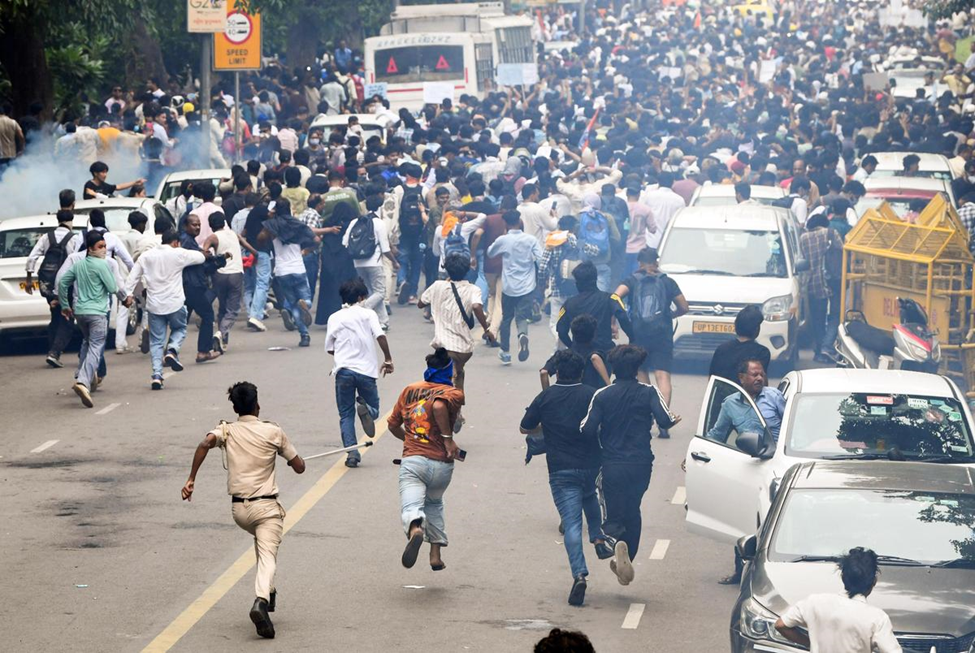
- A recent protest that escalated into clashes between demonstrators and the police has brought renewed attention to the constitutional right to protest, the limits of police powers, and the legal provisions governing public demonstrations in India.
Right to Protest: Constitutional Position
- The Right to Protest is not a Fundamental Right by itself, but is derived from:
- Article 19(1)(a) – Freedom of Speech and Expression.
- Article 19(1)(b) – Right to Assemble Peaceably and Without Arms.
- Article 19(1)(c) – Right to Form Associations or Unions.
- However, these rights are not absolute and are subject to reasonable restrictions under:
- Article 19(2) – Restrictions on free speech.
- Article 19(3) – Restrictions on peaceful assembly.
Grounds for Reasonable Restrictions
- Under Articles 19(2) and 19(3), the State may impose reasonable restrictions on the right to protest in the interests of the sovereignty and integrity of India, security of the State, friendly relations with foreign States, public order, decency or morality, contempt of court, defamation, and incitement to an offence.
When Can a Protest Become Unlawful?
Under the Bharatiya Nyaya Sanhita (BNS), 2023:
- It may become unlawful if it:
- Use criminal force or violence.
- Obstructs the execution of law.
- Compels a person through force or intimidation.
- Disturbs public order or threatens public safety.
Police Powers to Regulate Protests
Police may regulate demonstrations to:
- Maintain public order.
- Prevent violence and damage to property.
- Ensure public safety.
- Manage traffic and essential services.
Prohibitory Orders under BNSS, 2023
- Section 163 empowers the Executive Magistrate to issue orders restricting assemblies, marches or demonstrations in urgent situations to prevent:
- Public nuisance
- Danger to human life
- Rioting or affray
- Such orders are preventive in nature and are generally issued for a limited period.
Prohibitory Orders under BNSS, 2023
- Section 163 of the Bharatiya Nagarik Suraksha Sanhita (BNSS), 2023 empowers an Executive Magistrate to temporarily prohibit assemblies, marches, or demonstrations to prevent public nuisance, danger to human life, rioting, or affray.
- These orders are preventive and are generally issued for a limited period.
Use of Force by Police
- The police may use force only when necessary and in accordance with the principles of legality, necessity, proportionality, and minimum force.
- Force should be used gradually, only as a last resort after peaceful measures fail, and remain subject to judicial scrutiny.
Important Supreme Court Judgements
Mazdoor Kisan Shakti Sangathan (MKSS) v. Union of India (2018)
- The Supreme Court held that the right to protest is a constitutional right, but it must be balanced with the rights of other citizens.
Amit Sahni v. Commissioner of Police (Shaheen Bagh Case), 2020
- Public roads and public spaces cannot be occupied indefinitely in the name of protest.
- The right to protest must be exercised without causing disproportionate inconvenience to the public.
| Important CTC from this Article for UPSC 1. Is the Right to Protest a Fundamental Right? 2. National testing Agency |
Q. With reference to the Right to Protest in India, consider the following statements:
1. The Right to Protest is explicitly mentioned as a separate Fundamental Right under the Constitution.
2. The right to assemble peacefully without arms is guaranteed under Article 19(1)(b).
3. The State may impose reasonable restrictions on public assemblies in the interest of public order.
4. Section 163 of the Bharatiya Nagarik Suraksha Sanhita (BNSS), 2023 empowers authorities to regulate assemblies in certain situations.
Which of the statements given above are correct?
A. 2, 3 and 4 only
B. 1 and 2 only
C. 1, 3 and 4 only
D. 2 and 4 only
Answer: A
Explanation
• Statement 1: Incorrect. The Constitution does not explicitly mention a separate "Right to Protest"; it is derived from Article 19.
• Statement 2: Correct. Article 19(1)(b) guarantees the right to assemble peacefully and without arms.
• Statement 3: Correct. Reasonable restrictions may be imposed under Article 19(3) in the interest of public order and other constitutional grounds.
• Statement 4: Correct. Section 163 of the BNSS, 2023 empowers authorities to regulate assemblies to maintain public order.