
Context
- Kerala has recorded 50 leptospirosis deaths this year, reaffirming its position as India’s worst-affected State for the disease.
- First reported in 1989, leptospirosis has remained endemic in Kerala for three decades and is now the communicable disease with the highest mortality profile in the State.
About the Leptospirosis Disease
- A tropical zoonotic bacterial disease caused by pathogenic Leptospira bacteria; also historically known as Weil’s disease in its severe form.
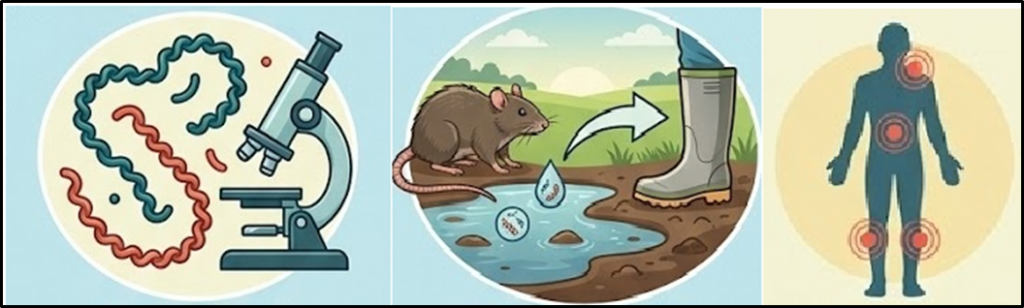
- Transmitted through contact with soil or water contaminated by the urine of infected animals (rodents, cattle), entering the body via mucosal surfaces, abrasions, or broken skin.
- Severity spectrum: subclinical to mild illness in most cases; only 5–10% progress to severe, unpredictable disease.
- Severe presentation includes fever, myalgia, conjunctival suffusion, and gastrointestinal symptoms.
Kerala’s Leptospirosis Burden: Causes, Risk Groups & Rising Fatality
- Monsoon ecology: heavy monsoons, floods, and year-round humidity, combined with rodent/animal reservoirs near homes and farms, sustain Leptospira in soil and water bodies.
- Occupational exposure: paddy cultivation, pineapple plantations, and canal-cleaning remain the primary risk drivers, alongside an emerging urban risk among construction workers and migrant labourers on highway projects.
- Indirect risk: proliferation of wayside eateries has increased rodent-linked soil contamination.
- Surveillance effect: per the Health Department’s reading of National Centre for Disease Control (NCDC) data, Kerala’s stronger surveillance and aggressive case-logging make its reported burden appear disproportionately high.
- Narrow treatment window: progression to pulmonary haemorrhage and multi-organ failure can occur within 4.5 to 5 days, raising fatality risk.
- Diagnostic and health-system gaps: ELISA is unreliable in the acute phase while State-introduced PCR testing remains limited, and secondary hospitals often lack round-the-clock emergency care — compounded by a post-COVID cytokine storm response raising ventilator dependency.
Government’s Institutional Response
National Programme for Prevention and Control of Leptospirosis (NPPCL)
- Launched: 2015, under the Ministry of Health and Family Welfare.
- Coverage: core endemic States/UT — Gujarat, Kerala, Tamil Nadu, Maharashtra, Karnataka, and Andaman & Nicobar Islands.
- Key components: chemoprophylaxis for high-risk groups, surveillance strengthening, and public awareness activities.
| Important CTC from this article for UPSC National Centre for Disease Control (NCDC) What is Leptospirosis. |
Q. With reference to Leptospirosis, consider the following statements:
I. It is a zoonotic disease caused by pathogenic Leptospira bacteria, also known as Weil's disease in its severe form.
II. It spreads primarily through respiratory droplets from infected individuals.
III. The National Programme for Prevention and Control of Leptospirosis (NPPCL) was launched in 2015.
IV. Unlike ELISA, PCR-based testing can give confirmatory results in the acute phase of infection.
Which of the statements given above is/are correct?
(a) I and II only
(b) I, III and IV only
(c) II and III only
(d) I, II, III and IV
Answer: (b) I, III and IV only
● Statement I is Correct: Leptospirosis is a zoonotic disease caused by pathogenic Leptospira, historically termed Weil's disease in severe cases.
● Statement II is Incorrect: It spreads through contact with contaminated soil/water, not respiratory droplets.
● Statement III is Correct: NPPCL was launched in 2015 under the Ministry of Health and Family Welfare.
● Statement IV is Correct: PCR detects bacterial DNA and is reliable in the acute phase, unlike ELISA.