
Context
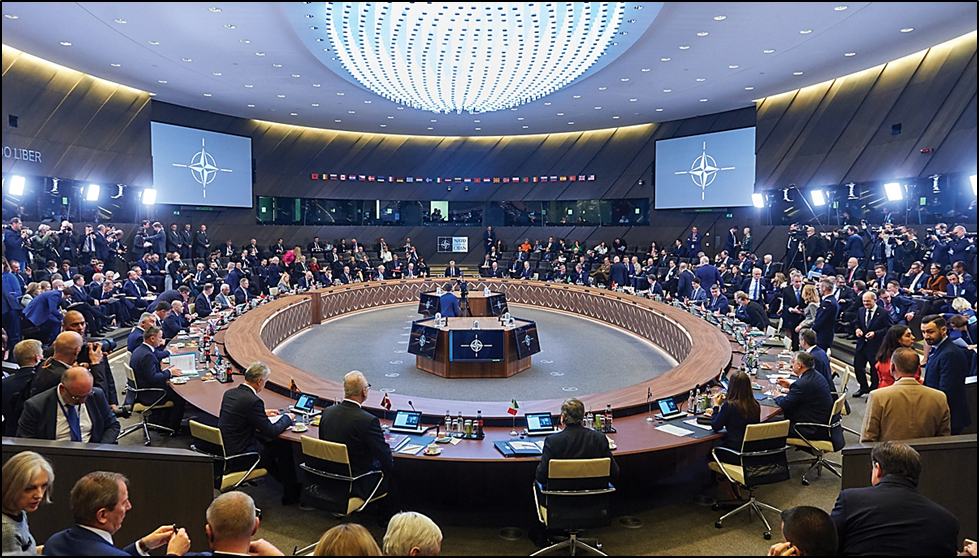
- Amid the changing global security environment following the Russia–Ukraine conflict, NATO is undergoing a major strategic transformation.
- The alliance is shifting towards stronger European defence capabilities, higher defence spending, enhanced military preparedness and greater burden-sharing among member states.
What is NATO?
The North Atlantic Treaty Organization (NATO) is an intergovernmental military alliance established to ensure the collective defence and security of its members.
Formation
- Established: 4 April 1949
- Founding Treaty: North Atlantic Treaty (Washington Treaty)
- Headquarters: Brussels, Belgium
- Current Members: 32 countries (after the accession of Finland in 2023 and Sweden in 2024).
Objectives of NATO
- Ensure collective defence of member states.
- Preserve peace and security in the North Atlantic region.
- Promote political consultation and military cooperation.
- Strengthen interoperability among member armed forces.
- Respond to emerging security threats such as cyber attacks and terrorism.
Key Features
- Article 5: An armed attack against one member is considered an attack against all.
- Decisions are taken by consensus, not by majority voting.
- Has an integrated military command structure.
- Conducts joint military exercises and capability development.
- Partners with several non-member countries through cooperation programmes.
Why is NATO Transforming?
- Russia–Ukraine conflict has revived concerns over European security.
- European members are increasing defence spending and military capabilities.
- Greater emphasis on indigenous defence production and industrial capacity.
- Focus on cyber security, space, artificial intelligence and long-range precision weapons.
- Europe is expected to assume greater responsibility for its conventional defence while the United States focuses increasingly on the Indo-Pacific.
Defence Spending Target
- NATO members have agreed to spend at least 5% of GDP on defence and defence-related expenditure by 2035, including investment in military capability and critical infrastructure.
| NATO and India India is not a member of NATO. India maintains strategic partnerships with several NATO members through bilateral relations. NATO’s evolving role has implications for India’s security environment, defence cooperation and Indo-Pacific geopolitics. |
| Important CTC from This Article for UPSC NATO |
Q. With reference to the North Atlantic Treaty Organization (NATO), consider the following statements:
1. NATO was established in 1949 under the North Atlantic (Washington) Treaty.
2. Article 5 of NATO provides for the principle of collective defence.
3. All decisions in NATO are taken by majority voting.
Which of the statements given above is/are correct?
(a) 1 and 2 only
(b) 2 and 3 only
(c) 1, 2 and 3
(d) 1 only
Answer: (a)
Explanation
• Statement 1 is Correct: NATO was established in 1949 through the North Atlantic (Washington) Treaty.
• Statement 2 is Correct: Article 5 states that an attack on one member is considered an attack on all.
• Statement 3 is Incorrect: NATO takes decisions by consensus, not by majority voting.