
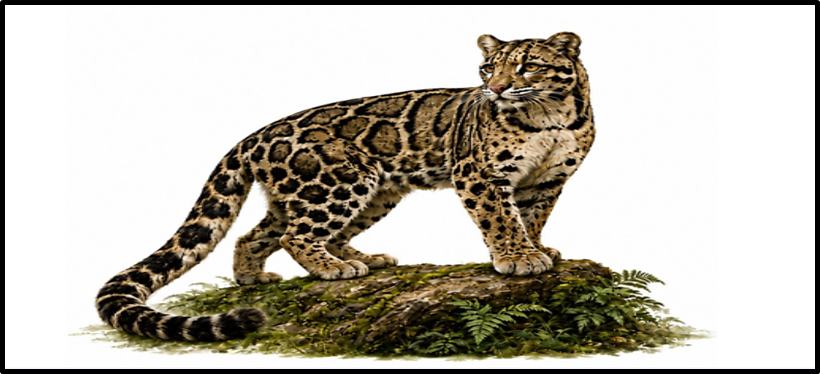
About the Clouded Leopard
Clouded Leopard (Neofelis nebulosa) is a rare wild cat found mainly in the forests of Northeast India and other parts of Southeast Asia. It is an excellent climber and is important for maintaining the ecological balance of forest ecosystems.
What makes the clouded leopard a unique ‘bridge’ Species?
- The Clouded Leopard links big and small cats, showing features of both groups.
- It belongs to Pantherinae but is distinct enough to have its own genus, Neofelis.
Key Biological & Behavioural Traits of the Clouded leopard
- Cannot roar like true big cats and can purr like small cats due to its specialised hyoid structure.
- Has exceptionally long 5-cm canine teeth, similar in length to a tiger’s despite its much smaller body size.
- Usually kills prey by biting the back of the neck, rather than the throat.
- Highly flexible ankles allow it to climb down trees headfirst, while its long tail helps maintain balance.
- Strong binocular vision aids depth perception, while the tapetum lucidum improves vision in low light.
About The Clouded Leopard Conservation Action Plan (CAP)
The Clouded Leopard Conservation Action Plan (CAP) is a Government of India–GEF–UNDP initiative for conserving the Clouded Leopard (Neofelis nebulosa), a Schedule I species under the Wildlife (Protection) Act, 1972, found mainly in the forests of Northeast India.
Released in July 2026, the CAP focuses on protecting habitats, scientific monitoring, improving forest connectivity and involving local communities in conservation.
Key Facts on Clouded Leopard Conservation Action Plan (CAP)
| Particular | Details |
| Species | Clouded Leopard (Neofelis nebulosa), also called Mainland Clouded Leopard |
| Conservation status | IUCN: Vulnerable | WPA 1972: Schedule I | CITES: Appendix I |
| Range in India | Sikkim, North Bengal, Assam, Arunachal Pradesh, Meghalaya, Tripura |
| Nodal Ministry | Ministry of Environment, Forest and Climate Change |
| Prepared under | Government of India–GEF–UNDP initiative |
| Released at | 91st SCNBWL meeting, Coimbatore (July 2026) |
| Priority landscapes identified | 14, across Northeast India |
| Institutional inclusion | Species Recovery Programme of the Integrated Development of Wildlife Habitats (IDWH) scheme |
Key Features of the CAP
- Landscape-scale habitat restoration and corridor conservation to strengthen connectivity between forest habitats.
- Standardised scientific monitoring through camera traps, occupancy surveys, genetics and environmental DNA (eDNA).
- Capacity building of frontline staff, including deployment of the M-STrIPES smart application.
- Strengthened anti-poaching measures, community-based conservation, transboundary cooperation with range countries, and integration of climate resilience into planning.
Conclusion
The CAP provides a comprehensive institutional and scientific framework for long-term conservation of the Vulnerable, Schedule I-listed Clouded Leopard across Northeast India, integrating habitat protection, technology and community participation.
| This concept has been elaborately discussed in the following article – India Launches Clouded Leopard Conservation Action Plan for Northeast India |