
After reading this article you can answer this UPSC mains model question:
Indian handloom represents a unique convergence of cultural heritage, rural livelihoods and women’s economic empowerment. However, structural challenges have constrained its competitiveness and the income of weavers. Discuss the major challenges facing the Indian handloom sector and suggest measures to make it globally competitive while preserving its traditional character. 15 marks (GS3 Economy)
Context
The article comes at a significant juncture for India’s handloom sector. National Handloom Day is observed on 7 August, commemorating the launch of the Swadeshi Movement in 1905, which placed indigenous production and self-reliance at the centre of India’s economic nationalism. The contemporary debate, however, has moved beyond simply preserving handloom towards making it economically viable, globally competitive and attractive to younger consumers.
Introduction
- India’s handloom sector is not merely a traditional craft; it is a labour-intensive, decentralised and culturally embedded economic activity.
- According to the Handloom Census 2019–20, India has about 35.22 lakh handloom workers, of whom more than 72% are women, making the sector particularly important for rural employment and women’s economic empowerment.
Handloom Craft in India: Key Features & Significance
A. Key Features of Indian Handloom
1. Traditional and Skill-Intensive Craft
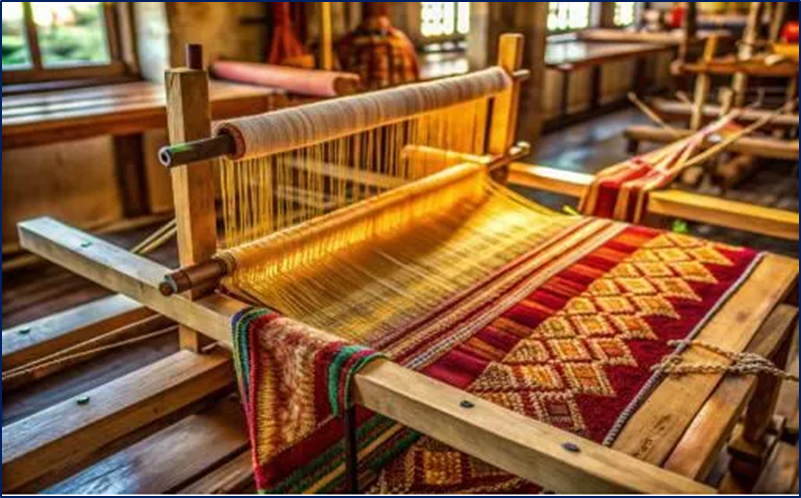
- Relies primarily on manual weaving techniques rather than mechanised production.
- Requires specialised craftsmanship and inherited skills.
2. Decentralised and Household-Based
- Production is largely organised in households, small workshops and cooperatives.
- Concentrated in rural and semi-rural regions enables employment without requiring large industrial infrastructure.
3. Culturally Diverse
- Every region has distinctive Weaving techniques, Designs and motifs, Colours, Fibres, Cultural symbolism.
- Examples: Banarasi, Kanchipuram, Pochampally Ikat, Chanderi, Sambalpuri, Kota Doria and Jamdani.
4. High Product Differentiation
- Variations arising from manual production can enhance their artistic and aesthetic value.
- Competes primarily through quality, authenticity and uniqueness, rather than mass production.
5. Geographically Embedded
- Strongly connected with local ecology, raw materials and community traditions.
- Many products derive their identity from their place of origin creates scope for Geographical Indication (GI) protection.
6. Labour-Intensive
- Generates significant employment relative to the capital invested.
- Particularly important for rural non-farm employment.
- Provides opportunities for workers with limited access to formal industrial employment.
B. Importance of Handloom Craft
1. Economic Significance
- Employment Generation – provides livelihoods to millions of people.
- Rural Economic Development – creates opportunities in the rural non-farm economy and supports local economic activity in weaving clusters.
- Labour-Intensive Manufacturing – relevant for India’s challenge of creating large-scale non-farm employment.
- Export Potential – Indian handloom products have demand in international markets due to Craftsmanship, Authenticity, Cultural uniqueness, Sustainable-fashion appeal.
2. Social Significance
- Women’s Empowerment – Women constitute about 72% of India’s handloom workforce opportunities for home-based income generation.
- Inclusive Livelihoods – Supports economically vulnerable rural households.
- Intergenerational Skill Transfer – Traditional weaving knowledge is transferred from one generation to another.
3. Cultural Significance
- Preservation of Cultural Heritage – Handloom embodies India’s civilisational and regional diversity. Designs and motifs often reflect Local traditions , Religious beliefs
- Regional Identity – Handloom acts as a cultural marker of regions and communities. Examples Banarasi — Varanasi , Kanchipuram silk — Tamil Nadu
- GI Heritage – GI can help establish authenticity, reputation and geographical identity.
C. Strategic Significance for India
1. Atmanirbhar Bharat
- Promotes indigenous production and local value chains.
- Symbolically connected with the Swadeshi movement.
2. Vocal for Local to Global
- Provides an opportunity to convert traditional Indian products into globally recognised brands.
- Can strengthen India’s soft power.
3. Creative Economy
- Handloom lies at the intersection of Culture , Design , Fashion , Technology and Commerce.
- Can therefore become part of India’s expanding creative economy.
4. Sustainable Development
- Supports:
- SDG 1: No Poverty
- SDG 5: Gender Equality
- SDG 8: Decent Work and Economic Growth
- SDG 12: Responsible Consumption and Production
- SDG 11: Sustainable Communities
Major Challenges of the Indian Handloom Sector
1. Competition from Powerlooms and Mechanisation.
- Handloom products, being labour-intensive and decentralised, find it difficult to compete with machine-made textiles purely on price and volume.
- This can eventually lead to the erosion of traditional skills and intergenerational transmission of indigenous weaving knowledge.
2. Low Productivity and Technological Constraints
- Handloom production requires considerable human effort at different stages, including yarn preparation, weaving, dyeing and finishing, which increases production time and labour costs.
- Low productivity can therefore reduce the competitiveness and profitability of individual weavers.
3. Raw Material Constraints
- Fluctuations in the prices of cotton, silk, wool and other yarns directly increase the cost of production for handloom weavers.
- Since many weavers operate on narrow profit margins, even moderate increases in raw-material prices can significantly affect their income.
4. Lack of Access to Institutional Finance
- A large part of handloom production is organised through households and small units, which can make it difficult for weavers to satisfy formal lending requirements.
- Limited documentation, collateral and formal financial records can restrict their access to institutional credit.
5. Weak Design Innovation and Changing Consumer Preferences
- Contemporary consumers increasingly demand new designs, colour combinations, functional clothing, home décor products and fusion wear.
- Traditional products that do not adapt to changing preferences may gradually lose relevance among younger and urban consumers.
Government Initiatives for the Development of the Handloom Sector
1. National Handloom Development Programme (NHDP)
- The National Handloom Development Programme is a comprehensive intervention aimed at strengthening the handloom sector through infrastructure development, cluster-based development, marketing support, credit and welfare measures.
2. Raw Material Supply Scheme (RMSS)
- The Raw Material Supply Scheme addresses one of the major structural problems faced by handloom weavers—the availability and affordability of quality yarn.
Way Forward for the Indian Handloom Sector
A. Shift from Subsidy-Centric to Value-Chain-Centric Policy
- Government policy should gradually move beyond providing only subsidies, loans and equipment and focus on improving the entire economic ecosystem surrounding the weaver.
- The objective should be to ensure that government assistance ultimately translates into higher productivity, better market access and increased income for weavers.
B. Build a Globally Recognisable “Brand India Handloom”
- India should develop a strong global identity for its handloom products based on authenticity, craftsmanship, sustainability and Indian cultural heritage.
- A common identity can help individual regional products gain visibility in international markets while retaining their unique geographical identities.
C. Strengthen Cooperatives and Producer Organisations
- Individual weavers often have weak bargaining power because they purchase inputs and sell products in small quantities.
- Strong cooperatives and producer organisations can aggregate production and enable weavers to negotiate better prices for both inputs and finished products.
D. Adopt a Digital-First Marketing Strategy
- Dedicated digital platforms can connect weavers directly with consumers and reduce the geographical barriers traditionally faced by rural producers.
- Direct sales can improve market access, price transparency and producer margins.
E. Integrate Design with Technology
- Traditional weaving knowledge should be combined with modern design capabilities to develop products that appeal to contemporary consumers without destroying their cultural identity.
- This can create a bridge between traditional craftsmanship and modern fashion markets.
F. Improve Export Competitiveness
- Handloom producers should receive greater support to meet international quality, safety and product standards.
- Consistent quality is essential for building long-term relationships with global buyers.
Conclusion
- The future of Indian handloom lies not in protecting it from modernisation but in modernising it without destroying its traditional identity.
- A weaver-centric, value-chain-oriented strategy combining technology, design, collective institutions, digital markets, GI protection and global branding can transform handloom from a vulnerable traditional livelihood into a competitive creative industry, while preserving India’s cultural heritage and advancing inclusive growth.