
Context
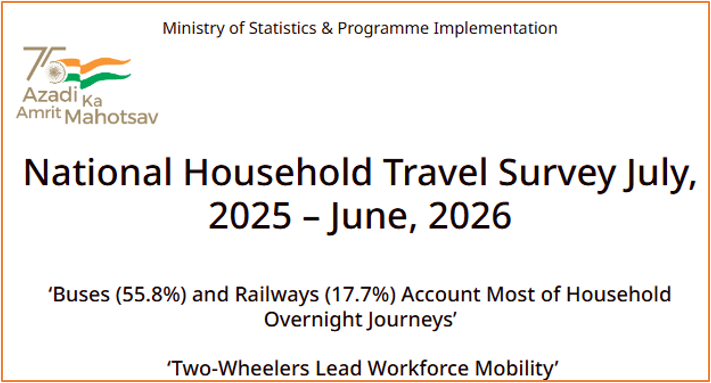
- The National Statistics Office (NSO), under the Ministry of Statistics and Programme Implementation (MoSPI), released findings from the first-ever nationwide National Household Travel Survey (NHTS).
About the National Household Travel Survey (NHTS)
- Conducted by: NSO, MoSPI, during July 2025 – June 2026.
- Coverage: 14,274 villages and 10,377 urban blocks.
- Objective: To generate data-driven insights into domestic travel patterns to support regional transport planning, infrastructure development and evidence-based policy.
- Aspects captured: Purpose of travel, mode of transport, and travel duration and distance.
- Additional purpose: Meets the specific data requirements of the Ministry of Railways.
- Use of findings: Identifying gaps in transport systems, assessing accessibility, optimising routes, and improving service frequency and scheduling.
Key Concepts Introduced
- Travel: Only trips covering 1 km or more; trips below 1 km were not recorded.
- Primary mode of travel: The mode used to cover the longest distance during a trip.
- Travel-day: From 3:00 AM of one day to 2:59 AM of the next.
- Within travel-day trip: A trip that does not keep a member away from home for more than 24 hours.
- Overnight trip: A trip keeping a member away for more than 24 hours (including travel and stay), and covering at least 50 km.
Key Findings on Primary Modes of Transport for Workers
| Mode | Rural | Urban | Rural + Urban |
| Two-wheeler | 37.1% | 52.3% | 42.6% |
| Walk | 36.6% | 13.5% | 28.3% |
| Bicycle | 13.4% | 5.8% | 10.7% |
| Bus | 5.3% | 9.2% | 6.7% |
| Auto-rickshaw | 5.0% | 8.8% | 6.4% |
| Car | 1.5% | 5.7% | 3.0% |
| Train/Monorail/Tram | 0.4% | 5.0% | 2.1% |
Other Key Major Findings
- Gender Gap in Workforce Travel: 61.9% of male workers undertake daily work trips (>1 km) compared to 41.9% of female workers nationwide.
- 73.5% of Overnight Trips Rely on Bus & Rail: Buses (55.8%) and inter-city railways (17.7%) are the primary modes for household overnight travel, followed by cars (15.1%) and two-wheelers (8.8%).
- Urban mass transit (monorail, metro, suburban rail, trams): It accounts for 5.0% of urban worker commutes nationally, but is much higher in Maharashtra (20.7%), West Bengal (16.5%) and Delhi (14.4%).
- States such as Rajasthan, Gujarat and Madhya Pradesh show average travel times of around 20–23 minutes, with higher travel times in parts of southern India.
Conclusion
The NHTS establishes a critical baseline for India’s spatial mobility and public transit usage, offering empirical evidence to bridge last-mile transit gaps, schedule public transportation efficiently, and address regional commuting disparities.
| Important Current to Concept (CTC) from this article for UPSC: What is the Ministry of Statistics and Programme Implementation (MoSPI)? |