
Context
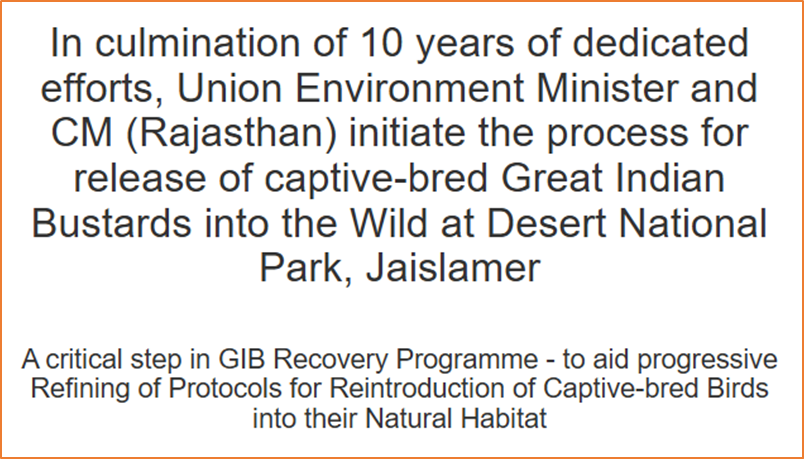
- Recently, the Ministry of Environment, Forest and Climate Change initiated the process for releasing captive-bred Great Indian Bustards (GIBs) into the wild at Desert National Park, Jaisalmer, Rajasthan.
About Great Indian Bustard (GIB) Recovery Programme
- Launched: 2016 by the Ministry of Environment, Forest and Climate Change (MoEFCC) under the species recovery programme of the Integrated Development of Wildlife Habitats (IDWH) scheme.
- Objective: To recover the critically endangered Great Indian Bustard (Ardeotis nigriceps) and stabilise its wild population.
- Nodal agency: Wildlife Institute of India (WII), Dehradun, in collaboration with state forest departments and other institutions.
Key Interventions & Scientific Breakthroughs
- Conservation Breeding Facilities: Operationalized ex-situ breeding centers at Sam and Ramdevra in Jaisalmer, Rajasthan, and a facility at Naliya, Kutch in Gujarat.
- ‘Jumpstart’ Approach: A technique where captive-laid eggs are placed into wild nests to be incubated and reared by wild females, accelerating wild population recovery.
About Great Indian Bustard (GIB)
- The Great Indian Bustard (Ardeotis nigriceps) is one of India’s most threatened grassland birds.
- It is the State Bird of Rajasthan and has strong ecological and cultural associations with the Thar Desert.
- The species is an important umbrella species for the grassland ecosystem.
- Distribution: Primarily found in Rajasthan and Gujarat, with small populations in Maharashtra, Karnataka and Andhra Pradesh.
- Habitat: Grasslands, scrublands and semi-arid regions.
- Features: One of the heaviest flying birds; males have a distinctive black crown and white neck.
- Conservation Status in India: Listed under Schedule I of the Wild Life (Protection) Act, 1972, receiving the highest legal protection.
- IUCN Status: Critically Endangered.
Four Bustard Species in India
| Species | IUCN Status | Primary Habitat / Range in India | Key Feature |
| Great Indian Bustard | Critically Endangered (CR) | Thar Desert (Rajasthan, Gujarat) | Flagship/Umbrella species of arid grasslands; State bird of Rajasthan. |
| Lesser Florican | Critically Endangered (CR) | Gujarat, Rajasthan, Madhya Pradesh, Maharashtra | Smallest bustard; famous for vertical breeding display jumps. |
| Bengal Florican | Critically Endangered (CR) | Terai grasslands (Uttar Pradesh, Assam, Arunachal Pradesh) | Restricted to tall wet grasslands of the Himalayan foothills. |
| MacQueen’s Bustard | Vulnerable (VU) | Winter migratory visitor to northwestern India (Rajasthan, Gujarat) | Palearctic species; migrates from Central Asia. |
About Desert National Park
- Location: Jaisalmer and Barmer districts, Rajasthan, in the Thar Desert.
- Established: 1980.
- Landscape: Sand dunes, rocky terrain, saline depressions and sparse grasslands.
- Key Species: Important habitat for the Great Indian Bustard (GIB); also supports Blackbuck, Chinkara, Desert Fox and Desert Cat.
- Birdlife: Home to several resident and migratory desert birds.
- Geological Significance: Contains fossilized logs and remains dating back 180 million years to the Jurassic Period (e.g., Akal Wood Fossil Park).
Conclusion
The reintroduction of captive-bred Great Indian Bustards represents a crucial transition from conservation breeding to rewilding. The integration of scientific breeding, habitat restoration and community participation can strengthen the long-term recovery of the GIB and the wider Thar grassland ecosystem.