
After Reading This Article You Can Solve This UPSC Mains Model Question:
The Nurses Registration and Tracking System (NRTS) seeks to resolve the healthcare workforce data deficit but is hindered by federal friction. Discuss its significance and the associated challenges in its implementation. 15 Marks (GS-2, Governance)
Context
The Nurses Registration and Tracking System (NRTS) has enrolled only 14.24 lakh out of 46.02 lakh registered nurses in India. This 31-lakh data deficit highlights severe implementation bottlenecks driven by jurisdictional friction between the Centre and State Nursing Councils, leaving a critical void in national healthcare planning.
Introduction
In a country with a suboptimal patient-to-professional ratio, precise healthcare workforce mapping is a critical policy imperative. The Indian Nursing Council (INC) launched the NRTS to build a unified ‘live’ register of nurses. However, its sluggish adoption underscores systemic challenges in cooperative digital federalism, requiring a strategic shift to ensure optimal resource deployment and national health security.
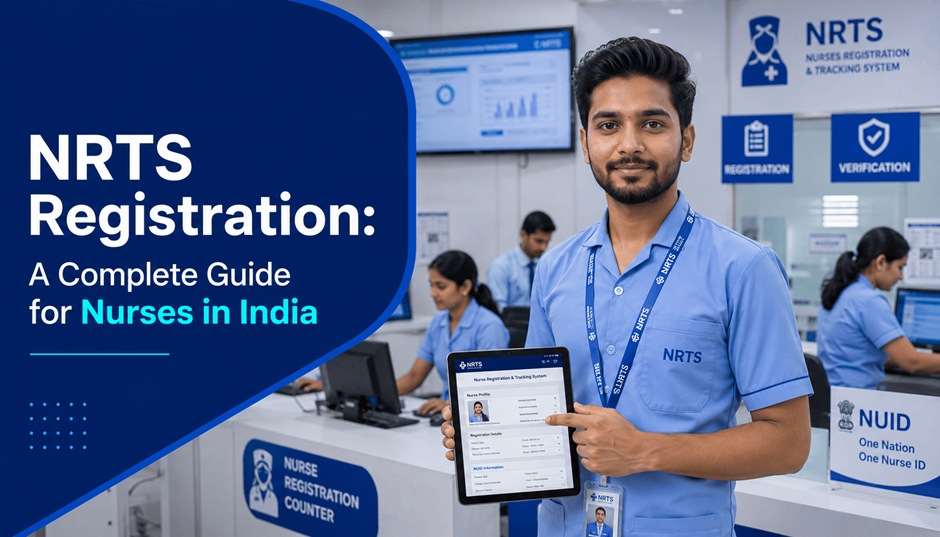
What is Nurses Registration and Tracking System (NRTS)?
- It is a centralized, computerized system designed to bring individual State Nursing Registration Councils onto a single integrated platform.
- It aims to build a “live” register, issuing a National Unique Identity card and passbook to verified nurses.
- It shifts the focus from a historical “stock” of ever-registered personnel to tracking the active workforce, accounting for retirements, deaths, and career exits.
Federal and Administrative Basis
- Healthcare is primarily a State subject, while nursing education standards require Union and INC coordination.
- Primary registration and licensing remain the legal mandate of individual State Nursing Registration Councils.
- The massive data gap is not indicative of illegal practice; rather, it reflects a failure to digitally migrate legacy State records to the national database.
Significance of a Unified National Registry
1. Evidence-Based Policymaking
- A live registry eliminates artificial surpluses or deficits on paper.
- It enables accurate mapping and the equitable nationwide deployment of human resources.
2. Crisis Mobilization and Disaster Management
- During public health emergencies, it allows state and central agencies to mobilize resources rapidly.
- Specialized nursing personnel can be efficiently deployed to high-alert zones.
3. Ensuring Patient Safety
- A unified, deduplicated database prevents unverified individuals or impersonators from operating in the healthcare ecosystem.
- It stops personnel with revoked licenses from practicing using fraudulent credentials.
4. Empowering the Workforce
- A centralized digital system expedites inter-State transfer requests.
- It streamlines rigorous credential verification for nurses seeking overseas employment.
5. Strengthening Cooperative Federalism
- Successful integration of the NRTS serves as a scalable template for national e-governance.
- It demonstrates how to seamlessly merge diverse State-level data into a cohesive national framework.
Challenges Associated with NRTS
1. Jurisdictional Resistance and Autonomy
- State Nursing Councils are hesitant to cede data control to the Centre.
- They view the central portal as an infringement on their statutory licensing authority and prefer operating parallel systems.
2. Stark Regional Disparities
- States with robust healthcare infrastructure (e.g., Tamil Nadu, Karnataka, Andhra Pradesh) are surprisingly lagging in enrollment.
- Conversely, states like Bihar, Jharkhand, and Odisha show high enrollment rates, heavily skewing national data representation.
3. Limitations of Aadhaar Linkage
- While Aadhaar verification prevents identity duplication, it has functional limits.
- It fails to validate a nurse’s active license status, updated qualifications, or current workplace availability.
4. Data Fragmentation and Obsolescence
- The absence of a synchronized census means state registries carry outdated reference dates.
- This severely weakens the reliability of any national estimates derived from fragmented state data.
5. Technological Inertia
- Legacy digital systems at the state level often lack the technical capability or API infrastructure.
- State councils face a shortage of administrative bandwidth to integrate smoothly with the central NRTS framework.
Way Forward
1. Promoting Consensus-Driven Federalism
- The Union Ministry of Health must institutionalize active dialogue with State Nursing Councils.
- Clear data-sharing protocols must be established to alleviate jurisdictional insecurities.
2. Transitioning to Dynamic Auditing
- The registry must shift from a static database to a dynamic tracking model.
- Mandating periodic digital license renewals will actively account for workforce attrition.
3. Incentivizing State Integration
- The Central government should provide targeted financial grants to lagging State councils.
- Technical handholding is required to help them modernize their IT infrastructure.
4. Mandatory Linkage for Professional Benefits
- Policymakers should make NRTS registration a mandatory prerequisite for availing government schemes.
- It should be linked to public sector promotions and international No Objection Certificates (NOCs).
5. Establishing Interoperable APIs
- The government must develop seamless digital bridges between State and Central portals.
- Primary registration at the state level must automatically synchronize with the national register without duplicate efforts.
6. Integrating Continuous Professional Development (CPD)
- Upgrade the NRTS portal to track real-time skill upgrades and CPD credits.
- This moves the system beyond basic identity checks to measure the actual competency of the workforce.
Conclusion
A robust, real-time national nursing registry is a fundamental pillar of India’s health security. Bridging the current 31-lakh enrollment deficit requires moving past federal friction and embracing cooperative digital integration. Accurate, dynamic workforce data is essential to safeguard patient well-being and build a resilient healthcare system for future contingencies.