
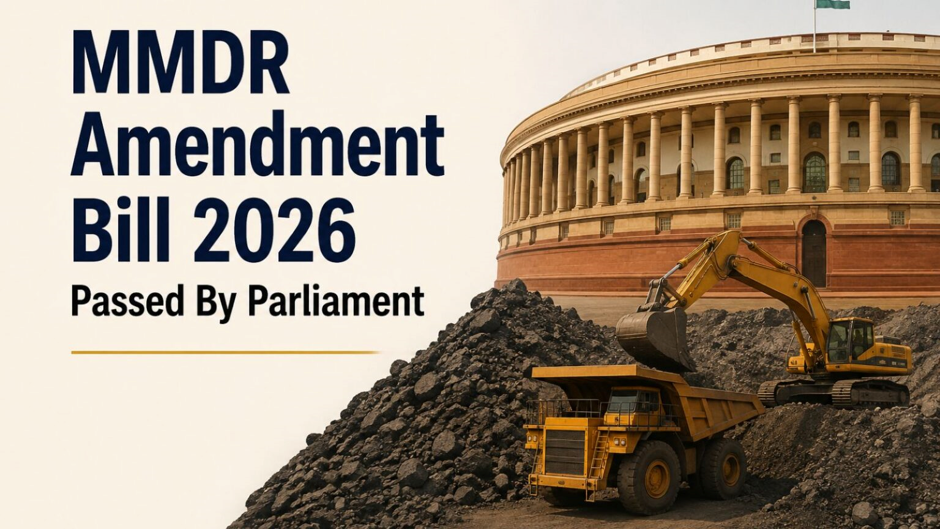
About Mines and Minerals (Development and Regulation) Amendment Act, 2026
The Mines and Minerals (Development and Regulation) Amendment Bill, 2026, amends the principal Act of 1957 to rationalize the taxation powers of State Governments and establish fiscal uniformity across the mineral sector. Under the existing statutory framework, the Central Government regulates major minerals (such as coal, iron ore, and bauxite), while State Governments exercise regulatory control over minor minerals (such as building stones, gravel, and ordinary clay).
Key Provisions of the Bill
- Regulation of Mineral-Bearing Lands: The Central Government is empowered to regulate lands containing mineral resources based on specific parameters it prescribes.
- Introduction of Section 9D: State Governments are prohibited from imposing independent taxes, cesses, or levies on mineral rights or mineral-bearing lands. Any such taxation—whether calculated on mineral quantity, value, or royalty—must strictly adhere to the conditions prescribed by the Central Government.
- Invalidation of Past Levies: Any unrecovered or unpaid State levies imposed prior to this amendment are rendered invalid. However, the legislation explicitly prohibits the refund of amounts that mining entities have already deposited.
- Centralized Rule-Making Power (Section 13): The Central Government acquires the authority to define the specific conditions and restrictions under which States may impose mineral-related taxes or cesses.
Need for the Amendment
- High and Uneven Tax Burden: Cascading and inconsistent State levies significantly increased extraction costs, rendering several operations financially unviable and negatively impacting small and medium-scale miners.
- Investor Uncertainty: Unpredictable and retrospective taxation policies disrupted ongoing operations, deterred capital investment, and eroded overall investor confidence in the sector.
- Inflationary Impact: Elevated extraction costs cascaded into higher production expenses for downstream industries, ultimately driving up prices for end consumers.
- Lack of Fiscal Uniformity: Wide variations in tax rates across different States created a fragmented and uneven national mining landscape.
Conclusion
The MMDR Amendment Bill, 2026, aims to create a unified and predictable fiscal regime to boost domestic mineral production and investor confidence. However, achieving long-term success will require balancing this national economic standardization with the legitimate revenue needs of mineral-rich States.
| This concept has been discussed elaborately in the following article: Decoding the MMDR Amendment Act, 2026: Balancing Mineral Security and Fiscal Federalism |