
After Reading This Article You Can Solve This UPSC Mains PYQ (2021)
What are the salient features of the National Food Security Act, 2013? How has the Food Security Bill helped in eliminating hunger and malnutrition in India? 15 Marks (GS 3, Economy)
Context
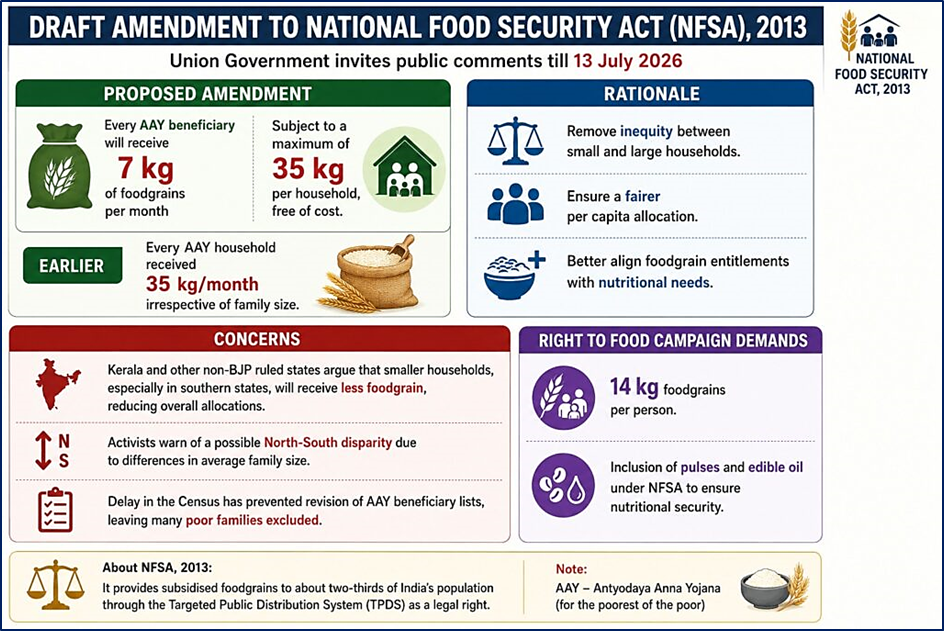
The draft National Food Security (Amendment) Bill, 2026 proposes shifting the Antyodaya Anna Yojana (AAY) from a flat 35 kg per household quota to an individual allocation of 7 kg per person, subject to a maximum ceiling of 35 kg per household.
Introduction
India is shifting its welfare focus from basic caloric access to comprehensive nutrition security. The draft NFSA (Amendment) Bill, 2026 aligns AAY entitlements with family size to rationalize distribution. However, balancing per-capita equity without penalizing smaller, highly vulnerable households remains a critical policy challenge.
What is the Proposed Reform?
- The draft Bill restructures AAY entitlements from a flat 35 kg per household to 7 kg per person monthly, capped at 35 kg.
- It aims to eliminate per-capita disparity between AAY families and Priority Households (PHH), who currently receive 5 kg per person monthly.
- It seeks to align distribution with demographic needs while integrating last-mile health services through Fair Price Shops.
Legislative and Demographic Basis
- Enacted under the National Food Security Act (NFSA), 2013, which guarantees subsidized foodgrains to 75% of rural and 50% of urban populations.
- Statutory coverage remains capped at 81.35 crore beneficiaries based on Census 2011, covering only 55.6% of India’s estimated 146.4 crore population in 2025.
- The reform responds to ICMR-NIN 2024 guidelines and NFHS-6 data, addressing the dual challenge of persistent child undernutrition and rising type-2 diabetes.
Significance of NFSA Entitlement Reforms
1. Rationalizing Per-Capita Equity
- Links foodgrain distribution directly to household size, eliminating disparities where large AAY families received less per-person support than PHH beneficiaries.
- Ensures larger vulnerable households receive equitable per-capita caloric support.
2. Addressing the Double Burden of Malnutrition
- Realigns public food distribution with ICMR-NIN guidelines that recommend limiting cereal energy contribution to 45%.
- Helps curb high carbohydrate intake (62.3% of daily energy), directly addressing rising lifestyle diseases and prediabetes.
3. Leveraging Technology for Transparent Delivery
- Capitalizes on near-universal ePoS coverage across 5.50 lakh Fair Price Shops and the One Nation One Ration Card (ONORC) platform.
- Ensures nationwide ration portability and seamless real-time tracking of foodgrain off-take.
4. Incentivizing Agricultural Diversification
- Incorporating pulses, millets, and edible oils into welfare baskets creates stable demand signals via Minimum Support Price (MSP) procurement.
- Promotes sustainable crop rotation and supports pulse and oilseed farmers.
5. Integrating Health and Welfare Systems
- Transforms Fair Price Shops into informational hubs linking beneficiaries to Ayushman Arogya Mandirs for voluntary NCD screenings.
- Strengthens convergence between the Public Distribution System (PDS), Anganwadi services, and PM POSHAN.
Challenges Associated with the Proposed Bill
1. Reduced Support for Small Vulnerable Households
- The 7 kg per person cap slashes grain allocations for 1- to 4-member AAY families by 20% to 80%.
- Disproportionately affects single elderly individuals, widows, and persons with disabilities.
2. Asymmetric Regional and Federal Impact
- States with smaller average household sizes face steep allocation cuts, such as Tamil Nadu, where 84.5% of AAY families have fewer than five members.
- Leads to a projected 35.6% drop in state grain quota, creating Centre-State federal friction.
3. Exclusion due to Outdated Census Data
- Beneficiary coverage remains locked to Census 2011 figures, excluding millions of deserving poor added over the last decade.
- Leaves a large demographic segment without access to subsidized food security safety nets.
4. Fiscal Costs of Dietary Diversification
- Providing non-cereal items like pulses, milk, and eggs requires massive additional budgeting beyond the ₹2,27,629 crore food subsidy.
- Perishable items create complex cold-chain logistics and supply chain bottlenecks.
5. Risk of Digital and Biometric Exclusion
- Over-reliance on ePoS devices and biometric authentication risks excluding vulnerable populations during technical glitches.
- Lack of robust offline fallback mechanisms can lead to the denial of constitutional entitlements.
Way Forward
1. Institute an Explicit No-Loss Safeguard
- Protect small vulnerable families by guaranteeing a 35 kg monthly floor for all existing AAY households.
- Ensure no household experiences a reduction in baseline foodgrain allocations.
2. Expand Coverage Ceilings Post-Census
- Recalculate NFSA population coverage benchmarks immediately upon release of Census 2027 figures.
- Adjust state-level quotas to reflect current demographic realities and deprivation criteria.
3. Separate Budgetary Allocation for Nutrition
- Fund dietary diversification (pulses, millets, edible oils) through dedicated, independent budget lines.
- Avoid financing non-cereal foods by cutting existing cereal entitlements.
4. Execute Phased State Pilots
- Conduct state-level pilot projects to assess consumption patterns, glycemic impacts, and supply feasibility.
- Use empirical pilot evidence to guide fiscally sustainable nationwide expansion.
5. Guarantee Offline Fallback Protocols
- Institutionalize mandatory offline authentication pathways and assisted access for persons with limited mobility.
- Ensure that biometric or technical failure never results in the denial of entitled rations.
6. Strengthen Last-Mile Health Referrals
- Train Fair Price Shop operators to disseminate voluntary, multilingual nutrition awareness materials.
- Facilitate confidential referrals to Ayushman Arogya Mandirs without tying health checks to ration eligibility.
Conclusion
The draft NFSA (Amendment) Bill, 2026 marks a critical shift toward nutrition security. By implementing a no-loss safeguard, updating Census coverage, and funding dietary diversification, India can successfully combat malnutrition and ensure equitable food security with dignity.