
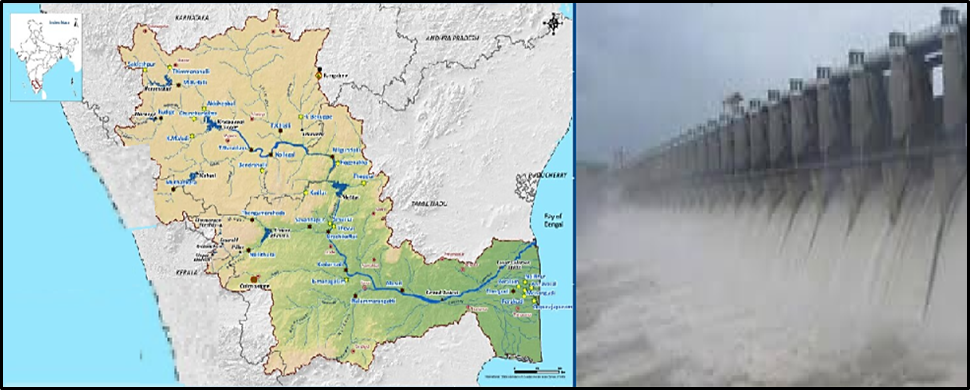
Context
Tamil Nadu has complained that Karnataka is not releasing its proportionate share of Cauvery water, leading to a shortage in Tamil Nadu. Karnataka has said that its own water availability is affected by rainfall and reservoir levels.
The Supreme Court has asked Tamil Nadu to take the issue to the Cauvery Water Management Authority (CWMA), which manages water sharing between the two States.
History of the Dispute
- The Cauvery dispute dates back to 1892 and 1924, when agreements were made between the then princely State of Mysore and Madras Presidency over sharing and use of Cauvery water.
- After Independence, the dispute intensified between Karnataka and Tamil Nadu, leading to the Cauvery Water Disputes Tribunal (1990) and ultimately the Supreme Court’s 2018 verdict and formation of the CWMA.
About the Cauvery River Dispute
- The Cauvery River Dispute is a long-running conflict over sharing Cauvery water, mainly between Karnataka and Tamil Nadu, with Kerala and Puducherry also involved. The dispute arises because Karnataka, the upper-riparian state, needs water for its farmers and cities, while downstream Tamil Nadu depends heavily on Cauvery water for agriculture and drinking needs.
- The Supreme Court in 2018 led the formation of the Cauvery Water Management Authority (CWMA) to implement its Cauvery water-sharing arrangement and monitor, regulate and manage the sharing and release of water among Karnataka, Tamil Nadu, Kerala and Puducherry.
- It is recurring problem due to Poor rainfall and drought often lead to disagreements over how much water Karnataka should release.
Why the Dispute Reached CWMA
- Tamil Nadu’s Claim: Tamil Nadu said Karnataka was not releasing the required share of Cauvery water.
- Karnataka’s Defence: Karnataka said low rainfall and drought-like conditions had reduced water availability, although the Kabini reservoir had enough water after good inflows.
- Tamil Nadu’s Reply: Tamil Nadu argued that Karnataka’s water releases were mainly due to natural inflows, not because Karnataka was following the agreed water-sharing rules.
- Supreme Court’s Direction: The Court asked Tamil Nadu to first raise the issue before the CWMA, called for an updated report, and fixed August 31 for the next hearing.
Cauvery Water Management Authority (CWMA)
- It was Set up under the Cauvery Water Management Scheme, 2018, following the Supreme Court’s final verdict on the Cauvery dispute.
- It implements the Tribunal’s award and regulates storage, sharing and release of Cauvery water among Karnataka, Tamil Nadu, Kerala and Puducherry.
- Headed by a full-time Chairman, with members from the Ministry of Jal Shakti, CWC and representatives of the four States.
- Cauvery Water Regulation Committee (CWRC) is the subordinate technical body assisting the CWMA with real-time monitoring of reservoir storage and water releases.
Legal Framework for Inter-State River Disputes
- Constitutional Basis: Article 262 empowers Parliament to provide for adjudication of inter-State river water disputes and to bar the jurisdiction of the Supreme Court and other courts in such matters.
- The Inter-State River Water Disputes Act, 1956 provides for constitution of tribunals; the River Boards Act, 1956 provides for boards to regulate and develop inter-State rivers.
- The Cauvery Tribunal: The Cauvery Water Disputes Tribunal was constituted in 1990; its final award, given in 2007, was modified by the Supreme Court in its 2018 judgment.
About The River Cauvery
Origin & Course: The Cauvery River originates at Talakaveri in Karnataka, flows through Karnataka and Tamil Nadu, and finally drains into the Bay of Bengal.
Major Dams: Important dams include Krishna Raja Sagara (KRS) and Kabini in Karnataka, and Mettur Dam in Tamil Nadu.
Importance: It is a major source of irrigation, drinking water and hydropower, especially for Karnataka and Tamil Nadu.
| Important CTC from this article for UPSC Cauvery Water Management Authority (CWMA) Cauvery River Dispute |
Q. With reference to the above, consider the following statements:
I. The Cauvery Water Management Authority was constituted under the Cauvery Water Management Scheme, 2018, pursuant to the Supreme Court's final verdict in the Cauvery water dispute.
II. The Cauvery Water Regulation Committee (CWRC) functions independently of the CWMA and holds final authority over inter-State water allocation.
III. Under Article 262 of the Constitution, Parliament may by law bar the jurisdiction of the Supreme Court and other courts in respect of inter-State river water disputes.
Which of the statements given above is/are correct?
(a) I and II only
(b) II and III only
(c) I and III only
(d) I, II and III
Answer: (c). I and III only
Explanation
Statement I is Correct: The CWMA was constituted in June 2018 under the Cauvery Water Management Scheme, notified by the Central Government following the Supreme Court's February 2018 judgment finally adjudicating the Cauvery water dispute.
Statement II is Incorrect: The CWRC operates under the superintendence of the CWMA and provides technical support in real-time monitoring of releases; it does not function independently, and final allocation authority vests in the CWMA.
Statement III is Correct: Article 262(2) empowers Parliament to enact a law excluding the jurisdiction of the Supreme Court and other courts over inter-State river water disputes, which it did through the Inter-State River Water Disputes Act, 1956.