
Context
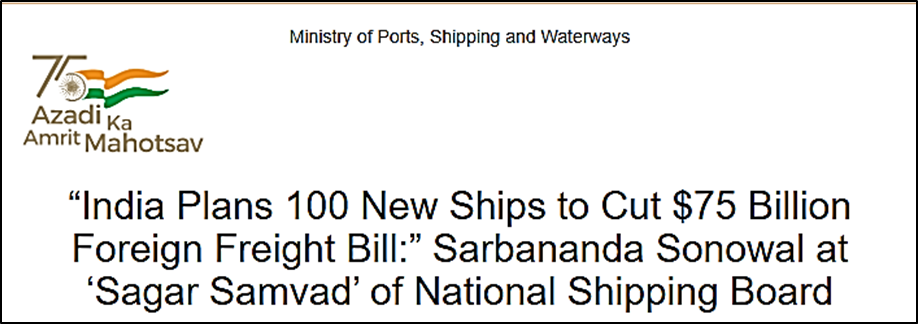
- The National Shipping Board (NSB) organised its first ‘Sagar Samvad’ in August 2026 to deliberate on the roadmap for Maritime India Vision 2030 and Maritime Amrit Kaal Vision 2047.
Key Highlights of ‘Sagar Samvad’
- Fleet Expansion Plan: Target to add 100 merchant vessels to India’s foreign-dependent fleet over the next 5 years.
- Economic Objective: Reduce the estimated $75 billion annual freight bill paid to foreign shipping lines for moving critical commodities (crude oil, LNG, coal, and urea).
- Workforce Initiatives: Focus on seafarer welfare, wage taxation, pension gaps, and expanding specialized training in emerging segments (e.g., cruise shipping, green shipbuilding).
- Industrial Support: Acknowledged early results of the ₹10,000 crore Container Manufacturing Assistance Scheme aimed at boosting domestic container production.
Challenges Facing the Indian Merchant Fleet
- Cost Competitiveness Deficit: Flying the Indian flag is 16% to 20% costlier than operating under foreign flags.
- Taxation & Fiscal Burden: Import duties on ships, high taxes on maintenance/ship-repair services, freight taxes, and Tax Deducted at Source (TDS) on seafarers’ wages inflate operational costs.
- Higher Capital Costs: Domestic shipowners face significantly higher borrowing costs compared to global competitors.
- Right of First Refusal (RoFR) Disadvantage: While Indian flag vessels enjoy RoFR in government cargo tenders, they are required to match the lowest bid (L1) offered by foreign operators who function under lower tax regimes.
- Right of First Refusal (ROFR) is a mechanism under which Indian-flagged vessels can get preference in securing certain cargo opportunities, subject to applicable conditions.
Institutional Framework & Strategic Maritime Vision
I. About National Shipping Board (NSB)
- National Shipping Board (NSB): NSB is older than the ministry it advises, a statutory body constituted in 1958 with one job: make sure India’s shipping policy is written only after listening to the people who sail it, own it and pay for it.
- Motto: “Wisdom in the Ocean, Progress in the Nation.”
- Statutory Basis: The NSB was originally constituted in 1958 and its present mandate is under the Merchant Shipping Act, 2025.
- Ministry: Works under the Ministry of Ports, Shipping & Waterways (MoPSW).
- Head Quarter: New Delhi.
- Core Role: Provides policy advice by bringing together government, shipowners, maritime professionals, financiers, seafarers and other stakeholders.
- The Board was reconstituted in May 2025.
II. Strategic Policy Visions
- Maritime India Vision 2030 (MIV 2030): A 10-year blueprint outlining 150+ initiatives across ports, shipping, and waterways to boost infrastructure and efficiency.
- Maritime Amrit Kaal Vision 2047 (MAKV 2047): A long-term strategic plan aiming to quadruple port capacity to 10,000 MTPA, foster green shipping, and elevate India into the Top 5 global ship-owning countries.
Conclusion
The National Shipping Board’s Sagar Samvad highlights the strategic importance of expanding India’s merchant fleet, reducing dependence on foreign shipping lines and developing a globally competitive maritime workforce. Strengthening Indian tonnage, financing, regulation and maritime skills will be crucial for achieving the objectives of Maritime India Vision 2030 and Maritime Amrit Kaal Vision 2047.
| Important CTC From this Article: National Shipping Board (NSB); Merchant Shipping Act, 2025. |